
c. 6 BC – c. AD 30·Feast June 24
St. John the Baptist
Forerunner of Christ and preacher of repentance
Overview
John the Baptist was an itinerant Jewish preacher, active in the region of the Jordan River in the early first century, whose Hebrew name Yochanan means YHWH is gracious. The Gospels present him as the precursor or forerunner of Jesus, the messenger foretold by Isaiah and Malachi, and Jesus himself identified him as Elijah who was to come. Born about six months before Jesus, according to Luke, to the aged priest Zechariah and his wife Elizabeth, both of priestly descent, he came out of the desert in camel-hair clothing, feeding on locusts and wild honey, and calling all to a baptism of repentance that brought the forgiveness of sins. The majority of biblical scholars accept that he baptized Jesus at the Jordan; several New Testament texts indicate that more than one of Jesus' first followers began as disciples of John. He rebuked Herod Antipas for unlawfully taking Herodias, his brother's wife, and was imprisoned and beheaded at the fortress of Machaerus around AD 30. Josephus records his execution and the popular belief that Herod's later military disaster was divine punishment for it. In Catholic martyrology John alone has both his birth and his death commemorated, and his relics are honored from Damascus to Amiens.
The Complete Life
A Child of Promise
John's origin, as the Gospel of Luke tells it, was marked by miracle from the first. His father Zechariah was an old priest of the course of Abijah, serving in the temple of Jerusalem, and his mother Elizabeth was a daughter of Aaron who had passed menopause without bearing children. While Zechariah performed his priestly functions, the angel Gabriel appeared to him and announced that Elizabeth would bear a son who was to be named John, one who would go ahead of the Lord in the spirit and power of Elijah, reconciling fathers with their children and preparing a people fit for his arrival. Because Zechariah hesitated, he was struck mute until the day of the naming. Mary, the mother of Jesus, was kin to Elizabeth, and when she paid her a visit the child leaped in his mother's womb at the sound of her greeting; Catholic tradition, on Frederick Holweck's authority, teaches that in that instant John was purified from the sin of Adam and made rich with the grace of God. Descended from priests on both sides of his family, John was cousin to Jesus according to Luke, though other Gospels are silent on the family tie and several scholars regard it as uncertain.
§ In Luke and Acts
The Voice in the Wilderness
John's vocation took shape in the desert of Judea, far from the temple his family had served. The Gospels introduce him as the fulfillment of Isaiah's prophecy of a voice crying in the wilderness,Prepare the way for the Lord, a composite text drawing on Isaiah, Malachi, and Exodus that Mark places at the very opening of the gospel story. His appearance proclaimed his calling as plainly as his words: he wore garments of camel's hair with a leather belt about his waist, after the pattern of the ancient prophet Elijah, while locusts and wild honey served him for food. Some scholars suspect he belonged to the Essenes, the semi-ascetic Jewish sect at Qumran that expected a messiah and practiced ritual washing, and the Dead Sea community's discipline of prayer and purification in the wilderness forms a plausible background to his formation. What set John apart was the central symbol of his movement: baptism. He preached a baptism of repentance for the forgiveness of sins to crowds who streamed out from Jerusalem, Judea, and the whole region, and he announced that another was coming after him who would baptize not with water but with the Holy Spirit and with fire, whose sandals he was not worthy to carry.
§ In Mark
Baptizing the Lamb of God
The summit of John's mission came when Jesus himself came to the Jordan to be baptized. The Synoptic Gospels describe the scene: as Jesus rose from the water the heavens opened, the Spirit of God descended on him like a dove, and a voice from heaven declared him the beloved Son. The majority of biblical scholars accept that John baptized Jesus, a fact so fixed in the tradition that Mark, Matthew, and Luke all narrate it and the fourth gospel assumes it. In Matthew's telling John at first objected, protesting his own unworthiness, while in the Gospel of John the Baptist himself testifies that he saw the Spirit descend and remain, and announces that Jesus is the Son of God and the Lamb of God. Luke uniquely records that John taught his hearers concrete charity, baptized tax-collectors, and advised soldiers, and that he taught his disciples to pray; unlike the other evangelists' portrait of crowds coming out to him, Luke shows John traveling through the Jordan region to reach the people. When a dispute arose and his disciples reported that Jesus was now baptizing more people than he, John answered with the humility that defined him: the bridegroom's friend rejoices at the bridegroom's voice, and he must grow greater while John grows less.
§ Baptism of Jesus
The Last of the Prophets
Eastern Christianity honors John as the last of the Old Testament prophets, the bridge between the old revelation and the New Covenant, and teaches that when he died he went down into Hades and announced there, once again, that the Messiah was at hand — herald of Christ in the world below just as he had been in the world above. Even his asceticism preached: the man who owned nothing, ate what the desert provided, and dressed in the prophet's ancient garb embodied the return to God he demanded of others. The Quran portrays him with the same colors, pure and devout, gentle and humble, given wisdom while still a child and granted purity and compassion from God, and granted peace upon him on the day of his birth and the day of his death. Christ gave him the highest testimony of all, saying that among those born of women there had not risen one greater than John the Baptist, and calling him a burning and shining lamp. Orthodox piety dedicates every Tuesday of the year to his memory, places his icon in honor beside that of the Mother of God in the Deesis of every church, and sees in his whole life a single continual act of pointing away from himself toward the Lamb of God.
§ Eastern Christianity
Prison and the Sword
John's fearlessness before the powerful cost him his freedom and his life. He censured Herod Antipas, tetrarch of Galilee, for casting off his wife and then taking Herodias, his brother's former spouse, in an unlawful marriage; Herod answered by seizing him and locking him away. According to Josephus, whose account in the Antiquities of the Jews is independent of the Gospels, Herod feared the prophet's immense influence over the people and resolved to put him to death before his popularity kindled a rebellion; John was sent as a prisoner to the hilltop fortress of Machaerus, overlooking the Dead Sea, and there executed. Mark preserves the grimmer gospel narrative: Herod, who liked to listen to John and knew him to be a righteous and holy man, protected him reluctantly until Herodias' daughter danced at the king's birthday feast and, prompted by her mother, demanded the prophet's head on a plate. Herod yielded, the executioner was sent, and the head was delivered to the girl while John's disciples carried away the body and laid it in a tomb, a sequence many scholars read as a deliberate foreshadowing of the passion of Jesus. Scholars debate the year of his death, proposals ranging from about AD 30 to as late as 35 or 36.
§ In Josephus's Antiquities of the Jews
The Only Saint with Two Feasts of His Own Life
John was never canonized by any pope or council; his cult is older than the machinery of canonization, reaching back to the apostolic age when his disciples buried him and Jesus himself bore witness to his greatness. In Catholic martyrology he holds a distinction granted to no other saint: both his birth and his death are kept as feasts, the Nativity of Saint John the Baptist on June 24, six months before Christmas in keeping with Luke's chronology, and the Beheading on August 29. The Byzantine tradition adds a Synaxis on January 7 immediately after Theophany, the feast of his conception on September 23, the findings of his head on February 24 and May 25, and the commemoration of his parents Zechariah and Elizabeth on September 5, while the Serbian Church keeps his day as the great family slava of Jovanjdan and the Coptic Church celebrates his Nativity and Beheading on its own calendar. Even outside Christianity he is venerated: the Mandaeans revere him as their greatest and final prophet, Muslims honor him as the prophet Yahya, the Druze as a central prophet, and the Baháʼí Faith regards Bahá'u'lláh's forerunner, the Báb, as his spiritual return.
§ Catholic Church
A Relic in Every Land, a Feast in Every Summer
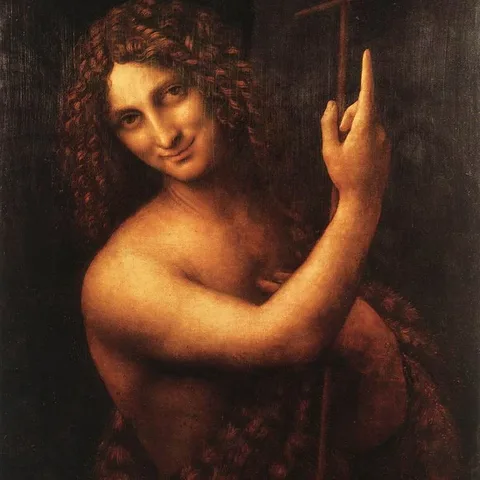
Few saints have left so large a footprint on the world's memory. His relics are claimed across three continents: his head is venerated at the Umayyad Mosque in Damascus, at San Silvestro in Capite in Rome, and at Amiens Cathedral in France, with a fourth claim in Munich; his right hand is honored in Cetinje and Siena, the latter arm donated by Pope Pius II in 1464 as the very arm that baptized the Lord, and other relics rest in India, Egypt, Nagorno-Karabakh, and the Bulgarian cathedral of Sozopol, where bones found in 2010 were later shown by testing to belong to a first-century Middle Eastern man. Art has never exhausted him: from the Baptism scenes of the earliest Christian centuries through the Deesis of every Orthodox church, Donatello's and Giotto's cycles in Florence, Leonardo's haunting pointed-figure portraits, Caravaggio's youths and executions, to the Salomes of the nineteenth century. Guido d'Arezzo built the musical scale on a hymn to his name, and his June 24 feast coincides with midsummer across Europe and Latin America, from the bonfires of Brazil's Festas Juninas to the street festival of Porto, bearing out his own words that he must decrease as the light increases.
§ In art
Timeline
- -6
Born about this time, his birth foretold by the angel Gabriel to his father Zechariah in the temple of Jerusalem.
§ In Luke and Acts
- 30
Baptized Jesus in the River Jordan, where the heavens opened and the Spirit descended like a dove.
§ In Mark
- 30
Beheaded at the fortress of Machaerus on the order of Herod Antipas, at the demand of Herodias' daughter.
§ In Mark
- 452
The head of John, concealed at Emesa, was manifested by revelation, an event kept as the Third Finding in the Orthodox Church.
§ The fate of his head
- 7 Jan 956
The relic of his right hand was transferred from Antioch to Constantinople, still commemorated on the Byzantine Synaxis of January 7.
§ Eastern Christianity
- 1521
The island of Puerto Rico received the formal name San Juan Bautista de Puerto Rico in his honor.
§ Patron saint and local festivals
- 12 Oct 1799
The right hand of the Forerunner was transferred from Malta to Gatchina, a transfer the Russian Orthodox Church still commemorates.
§ Eastern Christianity
- 1969
A crypt and relics identified as John's, mentioned in medieval manuscripts, were discovered during restoration of the Church of St. Macarius in Scetes, Egypt.
§ Relics
- 2010
Bones were found in the ruins of the St. John the Forerunner Monastery on the Black Sea island of Sveti Ivan, Bulgaria.
§ Relics
In Their Own Words
I am not the Christ... I am not... No.
Behold, I will send my messenger, and he shall prepare the way before me.
He must increase, but I must decrease.
The Record
- Patron of
- Florence·Porto, Portugal·Puerto Rico and its capital San Juan·French Canada and Newfoundland·Perth, Scotland, and Penzance, Cornwall·Malta, Xewkija, and Gozo·the Knights Hospitaller (Order of Saint John)·Freemasons (together with John the Evangelist)·the Roman Catholic Diocese of Charleston
- Symbols
- Camel-skin robe·Cross·Lamb·Scroll inscribed Ecce Agnus Dei·Platter bearing his own head·Pouring water from his hands or a scallop shell
- Canonization
- Pre-congregation; venerated as a prophet and saint in every Christian tradition that venerates saints, and honored in Islam, the Baháʼí Faith, the Druze faith, and Mandaeism
Prayer
Bibliography
Show 7 sources
- Metzger, Bruce Manning (1993). The Oxford Companion to the Bible. Oxford University Press. p. 283. ISBN 978-0-19-974391-9.
- Cross, F. L., ed. (2005). "John the Baptist, St". Oxford Dictionary of the Christian Church (3rd ed.). Oxford University Press. p. 893. ISBN 978-0-19-280290-3.
- Flavius Josephus. Antiquities of the Jews. Book 18, 5, 2.
- Croll, Charles (2019). John the Baptist: A Biography. Malcolm Down Publishing. ISBN 978-1-912863-15-0.
- Meier, John (1994). Mentor, Message, and Miracles (A Marginal Jew: Rethinking the Historical Jesus, Vol. 2). Anchor Bible. ISBN 978-0-385-46992-0.
- Buckley, Jorunn Jacobsen (2002). The Mandaeans: Ancient Texts and Modern People. Oxford University Press. ISBN 978-0-19-515385-9.
- Webb, Robert L. (2006) [1991]. John the Baptizer and Prophet: A Socio-historic Study. Eugene, Oregon: Wipf & Stock Publishers. ISBN 978-1-59752-986-0.
Profile text adapted from the Wikipedia article, licensed CC BY-SA 4.0.
Pray with this saint every day
Save St. John the Baptist to your favorites, read the full profile, and get feast-day reminders in the Saints app.
Get the Saints AppFree on the App Store for iPhone and iPad