
c. 339 – c. 405·Feast October 17 (Roman Catholic); Paopi 20 (Coptic Orthodox); November 9 (Eastern Orthodox)
St. John the Dwarf
Desert Father of Scetis
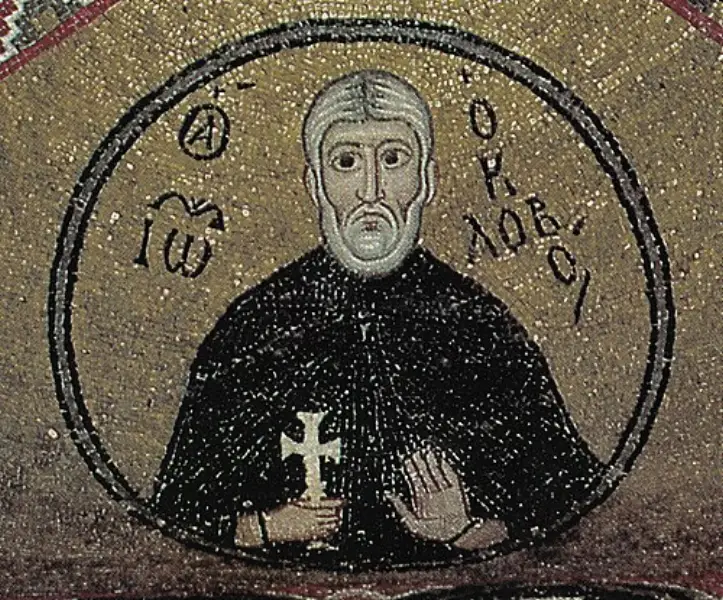
Overview
John, called the Dwarf or Kolobos, stands among the Coptic Desert Fathers of the fourth century. A poor family in Thebes raised him; at eighteen he went with an elder brother into the desert of Scetis and put himself under the direction of Pambo, while forming a close friendship with Pishoy. His own austerity became a school for others, and Arsenius the Great numbered among those he taught. When Pambo had gone to his rest, Pope Theophilus ordained John a priest and he led as abbot the monastery he had founded around the Tree of Obedience. The raid of the Mazices upon Scetis in 395 drove him to the Nitrian Desert and then to Mount Colzim, near modern Suez, where his life ended around 405. His disciples remembered a man who lived on flatbread and vegetables and ate once a day. Above all he was remembered for obedience, illustrated by the famous dry stick that, watered faithfully for three years, burst into leaf and fruit. In 515 his relics were carried to the Nitrian Desert, and a monastery in Scetis bears his name to this day.
The Complete Life
Life
John's story begins at Thebes, where his parents were Christians of little means. At eighteen he left home with an older brother for the desert of Scetis, the cradle of Egyptian monasticism, and there he attached himself to the elder Pambo as his disciple. Among his contemporaries he formed a lasting friendship with Pishoy, and his own practice of austerity drew younger monks to him as a teacher, Arsenius the Great being counted among his pupils. After Pambo's death the church's leadership in Egypt placed its confidence in him: Pope Theophilus ordained him to the priesthood, and he governed as abbot the community that had grown around the Tree of Obedience. That settled life ended when the Mazices invaded Scetis in 395; John pulled back first to the Nitrian Desert, and afterwards to Mount Colzim near the modern city of Suez, dying there around 405. Coptic memory across four centuries preserves his table discipline: flatbread and vegetables, one meal a day.
§ Life
Legend
The virtue that fixed John's reputation was obedience. Its most famous tale tells how Pambo handed him a piece of dry wood with orders to plant and water it. John did as he was told, carrying water from a source some twelve miles away to soak the stick twice daily. After three years the dead wood sprouted, grew, and became a tree bearing fruit. Pambo gathered some of that fruit and carried it among the elder monks, inviting them to eat from the fruit of obedience. The story was still told as living memory a generation later: Postumian, visiting Egypt in 402, reported being shown the tree standing in the monastery courtyard, covered with shoots and green leaves. A long manuscript life of Ababius, monk of Scetis and saint of the Coptic Church, also travels under John's name.
§ Legend
Timeline
- 339
Born at Thebes in Egypt to poor Christian parents
§ Life
- 395
When the Mazices invade Scetis, flees to the Nitrian Desert and then settles on Mount Colzim near present-day Suez
§ Life
- 405
Dies on Mount Colzim around this year
§ Life
- 515
His relics are translated to the Nitrian Desert
§ Life
The Record
- Patron of
- People with dwarfism
- Symbols
- A short monk watering a stick
- Canonization
- Pre-congregation; venerated by the Coptic, Eastern Orthodox, Oriental Orthodox, and Roman Catholic Churches
Prayer
Bibliography
Show 8 sources
- ↑ "القديس يوأنس القصير | الأنبا يحنس القصير | أنبا يوحنا القصير | St-Takla.org" . st-takla.org . Archived from the original on 2022-02-23 . Retrieved 2017-11-10 .
- ↑ Ward, Benedicta (1975). The Sayings of the Desert Fathers: The Alphabetical Collection . Cistercian Publications. ISBN 978-0879079598 .
- ↑ "Saint John the Dwarf, Anchoret of Scete. September 15. Rev. Alban Butler. 1866. Volume IX: September. The Lives of the Saints" . www.bartleby.com . 12 January 2023. Archived from the original on 23 February 2022 . Retrieved 2 July 2020 .
- ↑ " "Venerable Arsenius the Great", OCA" . Archived from the original on 2023-08-11 . Retrieved 2023-06-26 .
- ↑ "},"date":{"wt":""},"website":{"wt":"Catholic.org"},"publisher":{"wt":""},"access-date":{"wt":"June 17, 2025"},"quote":{"wt":""}},"i":0}}]}' id="mwjQ"/> "St. John the Dwarf" . Catholic.org . Retrieved June 17, 2025 .
- 1 2 " "Saint John The Short ", CopticChurch.net" . Archived from the original on 2023-06-25 . Retrieved 2023-11-06 .
- ↑ Stefaniw, Blossom . (2019). Christian Reading: Language, Ethics, and the Order of Things . University of California Press. p. 11. ISBN 978-0520300613
- ↑ "},"date":{"wt":""},"website":{"wt":"St. John the Baptist Coptic Orthodox Church, Florida"},"publisher":{"wt":""},"access-date":{"wt":"June 17, 2025"},"quote":{"wt":""},"archive-date":{"wt":"June 15, 2025"},"archive-url":{"wt":"https://we
Profile text adapted from the Wikipedia article, licensed CC BY-SA 4.0.
Pray with this saint every day
Save St. John the Dwarf to your favorites, read the full profile, and get feast-day reminders in the Saints app.
Get the Saints AppFree on the App Store for iPhone and iPad