
c. 6 – c. 100·Feast December 27
St. John the Evangelist
Beloved disciple and author of the Fourth Gospel
Overview
John the Evangelist, who lived from about AD 6 to about AD 100, is the name that Christian tradition has given to the writer of the Gospel of John. Believers have long identified him with John the Apostle, the son of Zebedee; with John of Patmos, the seer of Revelation; and with John the Presbyter, though scholars debate how many of these figures were in fact the same man. The Gospel itself tells of a nameless disciple dear to Jesus, whose testimony stands behind the book and whose hand set down its message, the writer's identity remaining veiled while pointing to a witness close to the Lord. After the Resurrection the church of Jerusalem rested on its three pillars — John, Peter, and James the Just — and he is thought to be the only one of the Twelve to escape martyrdom. Tradition holds that around AD 95 he was banished to Patmos in the Aegean, and there received the Revelation, and that his final years were spent at Ephesus, from which the Gospel and Epistles plausibly emerged around AD 90 to 110. He died at Ephesus about the year 100, aged about ninety-two, and is honored across the Catholic, Orthodox, Anglican, and Lutheran worlds.
The Complete Life
The Disciple Whom Jesus Loved
The Gospel of John deliberately conceals its author's name, presenting instead a disciple who is never named, one dear to Jesus, on whose testimony and written account the Gospel rests. Reading that Gospel alongside the Synoptics, Christian tradition concluded early that this beloved disciple was John the Apostle, son of Zebedee, since the text explicitly declines to be written by Peter, and James the brother of John had been martyred as early as AD 44. After the death of Jesus, John, Peter, and James the Just emerged as the three pillars of the Jerusalem church, a position of leadership that implies his presence at the movement's center from the beginning. He was one of the original Twelve, and legend preserved in the Acts of John added the detail that he became an apostle at a young age, an idea that shaped centuries of medieval iconography in which he appears as a beardless youth. Whether one accepts the traditional identification or the view of many modern scholars that the Gospel is pseudepigraphic, the figure of John the Evangelist has been worshipped, painted, and read as the Church's supreme witness to the divinity of Christ.
§ Identity
Pillar of the Early Church
Within the apostolic generation, John's vocation unfolded along two complementary paths: witness and writing. As one of the three pillars of the Jerusalem church, he bore public responsibility for a community tested by persecution and internal strain, standing beside Peter at the head of the believers in the holy city. As an author, or at least as the one tradition names behind the writings, he gave the Church a body of literature unlike any other in the New Testament: a Gospel of soaring theological reflection on the Word made flesh, three epistles that distill the commandment of love, and the Revelation, the great apocalyptic vision that closes the Christian Scriptures. In the teaching of Eastern Orthodoxy every Johannine book comes from the pen of John the Apostle; scholarly argument over them has run since at least the second century whether one author or many stand behind them. Some modern critics contend the apostle wrote none of the works, while respected exegetes defend his authorship of at least the Gospel. The debate itself testifies to the force of the tradition: no other apostle's literary claim has been argued with such persistence across twenty centuries.
§ Authorship of the Johannine works
Patmos and Ephesus
Tradition relates that around AD 95 John was exiled to Patmos, a small island in the Aegean, and there received and wrote the Book of Revelation, the record of visions given to a confessor banished for the word of God. Some scholars instead attribute Revelation to a separate figure, John the Presbyter, or to other late first-century writers, and generally date the work to about AD 95, with some portions possibly reaching back to Nero's persecution in the early 60s. The final period of his life is traditionally placed at Ephesus in Asia Minor, where the Gospel and the Epistles plausibly originated between about AD 90 and 110, though a few scholars argue for a Syrian origin instead. In that city the aged apostle is believed to have governed the churches of the province, transmitted his testimony of the Lord's life, and composed the meditation on the Word that bears his name. His mission thus spanned the whole arc of the apostolic age, from Galilee and Jerusalem to the Greek cities of the Roman East, carrying the memory of Christ from the generation of eyewitnesses into the written form that would instruct all later generations.
§ John the Evangelist
The Peaceful End of the Last Apostle
John is thought to be the only one of the original Twelve to escape martyrdom, and the tradition of his peaceful death distinguishes him among the apostolic band. He died about the year AD 100 at a very advanced age, roughly ninety-two years, having outlived his brother James, his fellow pillar Peter, and nearly all who had walked with Jesus. Legend enriched this quiet ending with scenes of trial: one story told how his enemies dared him to swallow poisoned wine so that his faith might be put to the proof, and how, through God's help, the draught could do him no harm; another related that he was at some point boiled in oil and miraculously preserved. Such narratives, drawn from the Acts of John, circulated widely in the medieval Church and fixed his image as the apostle who suffered everything and yet was not permitted to die by violence. The actual place of his burial has been associated with Ephesus, while his principal shrine in the Latin West is honored in the cathedral of 's-Hertogenbosch in the Netherlands, where his memory has been cultivated for centuries.
§ John the Evangelist
Eagle, Chalice, and the Feast of Christmas
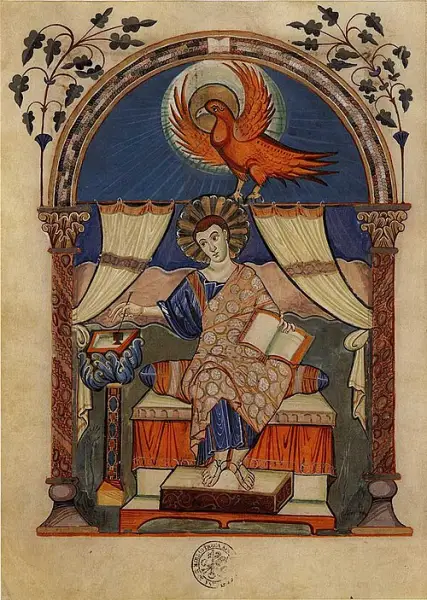
The feast of St. John falls on December 27 in the Catholic Church, the Anglican Communion, and the Lutheran calendar, the third day of Christmastide, so that the evangelist is honored immediately after the martyr Stephen within the octave of the Nativity. In the Tridentine calendar he was commemorated on each following day up to January 3, an octave abolished by Pope Pius XII in 1955; the traditional liturgical color for his feast is white. Freemasons have kept the same feast since the eighteenth century, when it was used for the installation of Grand Masters. In art John appears either as a venerable old man with a white or gray beard, a type favored in Byzantium and possibly influenced by antique portraits of Socrates, or as a beardless youth, a form known in Rome from the fourth century and preferred in the medieval West, where he was often rendered with androgynous or feminized features that invited the affective piety of late-medieval believers. His symbols are the eagle, drawn from the visions of Ezekiel and Revelation, the chalice, frequently with a serpent, recalling the poisoned cup legend and the words of Christ to the sons of Zebedee, and the book or scroll that signifies his writings.
§ In art
Timeline
- 6
Born around this time, traditionally between about AD 6 and 9.
§ John the Evangelist
- 90
The Gospel of John and the Johannine Epistles are traditionally and plausibly dated to the years around this time at Ephesus, though some scholars argue for a Syrian origin.
§ Authorship of the Johannine works
- 95
Tradition holds that he was sent into banishment about this year on Patmos, an island of the Aegean, and that there the Book of Revelation took shape.
§ Identity
- 100
Died at an age of about ninety-two, remembered as the only one of the Twelve to escape martyrdom.
§ John the Evangelist
- 1955
Pope Pius XII abolished the former Octave of his December 27 feast, which had been kept in the Tridentine calendar through January 3.
§ Feast day
In Their Own Words
My chalice indeed you shall drink.
The Record
- Major works
- Gospel of John (traditional attribution)·First, Second, and Third Epistles of John (traditional attribution)·Book of Revelation (traditional attribution)
- Symbols
- Eagle·Chalice, often with a serpent emerging from it·Book or scroll
- Canonization
- Pre-congregation; venerated as an apostle and evangelist since the earliest centuries of the Church
Prayer
Bibliography
Show 5 sources
- Saint Sophronius of Jerusalem (2007 [c. 600]). "The Life of the Evangelist John". The Explanation of the Holy Gospel According to John. House Springs, Missouri: Chrysostom Press. pp. 2–3. ISBN 978-1-889814-09-4.
- Harris, Stephen L. (1985). Understanding the Bible. Palo Alto: Mayfield. pp. 302–310, 355.
- Ehrman, Bart D. (2004). The New Testament: A Historical Introduction to the Early Christian Writings. New York: Oxford. p. 468. ISBN 0-19-515462-2.
- Cross, F. L. (1997). The Oxford Dictionary of the Christian Church. New York: Oxford University Press. p. 45.
- Fonck, L. (1910). "St. John the Evangelist". In The Catholic Encyclopedia. New York: Robert Appleton Company.
Profile text adapted from the Wikipedia article, licensed CC BY-SA 4.0.
Pray with this saint every day
Save St. John the Evangelist to your favorites, read the full profile, and get feast-day reminders in the Saints app.
Get the Saints AppFree on the App Store for iPhone and iPad