
c. 641 – 669·Feast January 2
St. John the Good
Archbishop who led Milan home from exile
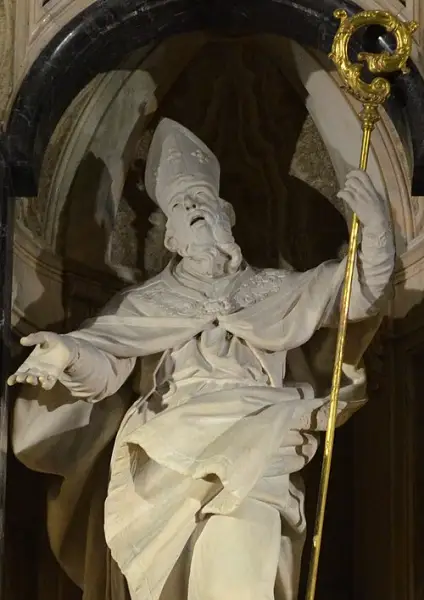
Overview
John the Good, known in Latin as Ioannes Bonus and in Italian as Giovanni Bono or Buono, also called John Camillus, served as Archbishop of Milan from about 641 until his death, which the sources place in 669. He was born at Recco in the diocese of Genoa, though the neighboring town of Camogli also claims him as a native. His episcopate is remembered above all for ending one of the longest exiles in the history of the Italian Church: after the Lombard conquest of Milan in 569, the bishops of the city had resided in Genoa for more than seventy years. John's election, probably connected with Rothari's capture of Genoa in 641, allowed the bishop to take up residence in Milan once more. He subscribed to the documents of the Lateran Council of 649, arriving in Rome after the assembly had closed. A medieval poem in his honor praises his generosity and charity, from which he earned the surname the Good, and records miracles, the transfer of relics of Saint Syrus of Genoa to Desio, and his death in 669, leaving his estates to the Church of Milan. His relics rest in the cathedral of Milan.
The Complete Life
A Son of the Genoese Coast
John came from the Ligurian coast that looks out on the Tyrrhenian Sea, born in the village of Recco within the diocese of Genoa. The claim of his birth there is not unchallenged: the nearby town of Camogli has long asserted that it is his true birthplace, a dispute that testifies to the honor both communities attached to producing a saint. He grew up in a region that had become, through force of history, the refuge of the church of Milan. When the Lombards seized Milan in 569, Bishop Honoratus had escaped to Genoa, and every one of his successors had remained in that city, which was then a suffragan diocese of Milan under the control of the Byzantine Empire. John was therefore raised amid the displaced hierarchy of one of the great sees of northern Italy, in a coastal society shaped by Byzantine administration and by the pressure of the Lombard kingdom pressing down from the north. Nothing else is recorded of his childhood or his formation for ministry; the two principal sources for his life, the tenth-century Catalogue of the Bishops of Milan and a poem composed between the eleventh and thirteenth centuries, begin their account in earnest only with his elevation to the episcopate.
§ Life
The Return to Milan
It is not known exactly when John became Archbishop of Milan, but his election is believed to have followed the conquest of Genoa in 641 by Rothari, King of the Lombards. That event transformed the situation of the exiled church: the city that had sheltered the Milanese bishops for more than seventy years now belonged to the same Lombard kingdom as the see they had been forced to abandon. John, once raised to the archbishopric, did what none of his predecessors since Honoratus had been able to do; he returned to reside in Milan itself. The act restored the physical presence of the bishop to a city that had lived without one for the better part of a century, reuniting the flock with its shepherd. The medieval catalogue of the Milanese prelates records his reign as lasting about ten years, while the poem in his honor extends it until his death in 669; the discrepancy remains one of the unresolved questions of his biography. However the chronology is settled, his tenure marks the renewal of the ancient church of Ambrose in its own city, and the close of the so-called Genoa period in the succession of Milan's bishops.
§ Life
Council, Charity, and the Care of Churches
In 649 John was summoned to participate in the Lateran Council, the Roman assembly convened to condemn the Monothelite position then troubling the Eastern Empire. Traveling from Lombard Italy, he arrived in Rome only after the council had already concluded, yet he formally subscribed to all the documents the council had issued, aligning the church of Milan with the doctrinal settlement of Pope Martin I's assembly. The poem in his honor, the richest source for his character, describes a bishop marked out by generosity and charity toward the poor and toward the church alike, a reputation so strong that it supplied the name by which history knows him, John the Good. The same poem credits him with miracles and with bringing part of the relics of Saint Syrus of Genoa to Desio, a place he raised up as a pievan church, an ecclesiastical and administrative territory that organized the pastoral care of the surrounding countryside. By his death he had arranged the disposition of everything he possessed, including family estates in the area of Genoa, for the benefit of the Church of Milan, so that his generosity outlived him in the patrimony of his see.
§ Life
Death and the Question of Dates
John died leaving everything to the church he had served, but the very date of his death is a matter of ancient disagreement. The medieval poem asserts that he died in 669, and the official lists of the archbishops of Milan give the same terminal year for his tenure. The tenth-century Catalogue of the Bishops of Milan, however, assigns him a reign of only about ten years, which would place his death no later than 659, since his election is usually set around 641. Modern scholars note this incoherence without being able to resolve it; the historian of the Milanese church must hold both possibilities open. The catalogue records that he died on January 2, while the poem gives January 10. The latter date became his original feast day and remains his feast in the Eastern Orthodox Church to the present, while the Roman Catholic Church keeps his memory on January 2, and the cathedral of Milan celebrates it on January 15, joining him also to the common solemnity of all the canonized bishops of Milan on September 25. Whatever the exact year, he was buried in the little church of Saint Michael in Domo in Milan.
§ Life
The Saint in the Cathedral
John's body rested for centuries in the church of Saint Michael in Domo, and the first documented survey of his relics was undertaken by Archbishop Aribert, who governed the see from 1018 to 1045. When that church was shortly to be demolished, Cardinal Carlo Borromeo, the great reforming archbishop of the sixteenth century, had the body moved on May 24, 1582, into the south transept of the great church of Milan, where devotion to the saint continues in our own day. The cathedral choir of Milan thus holds one of its ancient predecessors in a place of honor beside the altar, a physical link across ten centuries between the restored church of John's day and the Counter-Reformation see of Borromeo. Devotion to him endures on three separate dates: January 2 in the Roman Catholic Church, January 10 in the Eastern Orthodox Church, and January 15 in the Ambrosian rite of his own city, together with the great commemoration of the Milanese bishops on September 25. His patronage of Milan is inscribed in the oldest strata of the city's Christian memory, and the sobriquet the Good remains, after thirteen centuries, the simplest summary of his life.
§ Life
Timeline
- 569
The Lombards invaded northern Italy and conquered Milan, and Bishop Honoratus fled to Genoa, beginning the exile of the Milanese bishops.
§ Life
- 641
Believed to have been elected Archbishop of Milan following the Lombard king Rothari's conquest of Genoa, and returned to reside in the city.
§ Life
- 649
Invited to the Lateran Council, he reached Rome after it had ended but subscribed to all of the council's documents.
§ Life
- 669
Died, according to the medieval poem in his honor, leaving all his property, including estates near Genoa, to the Church of Milan.
§ Life
- 1018
Archbishop Aribert, whose episcopate began in this year, conducted the first survey of John's relics in Milan.
§ Life
- 24 May 1582
Cardinal Carlo Borromeo moved John's remains into the south transept of Milan's cathedral just ahead of the demolition of the church of Saint Michael.
§ Life
The Record
- Major works
- Pievan Church of Desio, erected as an ecclesiastical and administrative territory
- Patron of
- Milan, Italy
- Canonization
- Pre-congregation; venerated in the Roman Catholic Church and the Eastern Orthodox Church
Prayer
Bibliography
Show 5 sources
- "Latin Saints of the Orthodox Patriarchate of Rome". www.orthodoxengland.org.uk. Retrieved 2024-08-11.
- Cazzani, Eugenio (1996). Vescovi e arcivescovi di Milano. Milano: Massimo. pp. 52–55. ISBN 88-7030-891-X. (in Italian)
- Pasini, Cesare (1989). "Giovanni Buono, santo (sec. VII)". Dizionario della Chiesa Ambrosiana. Vol. 3. Milano: NED. pp. 1450–1452. ISBN 88-7023-102-X. (in Italian)
- The book of saints: a dictionary of servants of God canonised by the Catholic Church: extracted from the Roman & other martyrologies. Whitefish, MT: Kessinger Publishing. 2001 [1921]. p. 147. ISBN 978-0-7661-7269-2.
- Biblioteca Ambrosiana, codex S 89 sup.
Profile text adapted from the Wikipedia article, licensed CC BY-SA 4.0.
Pray with this saint every day
Save St. John the Good to your favorites, read the full profile, and get feast-day reminders in the Saints app.
Get the Saints AppFree on the App Store for iPhone and iPad