
died c. 1002·Feast July 12
St. John the Iberian
Georgian monk and founder of Iviron Monastery
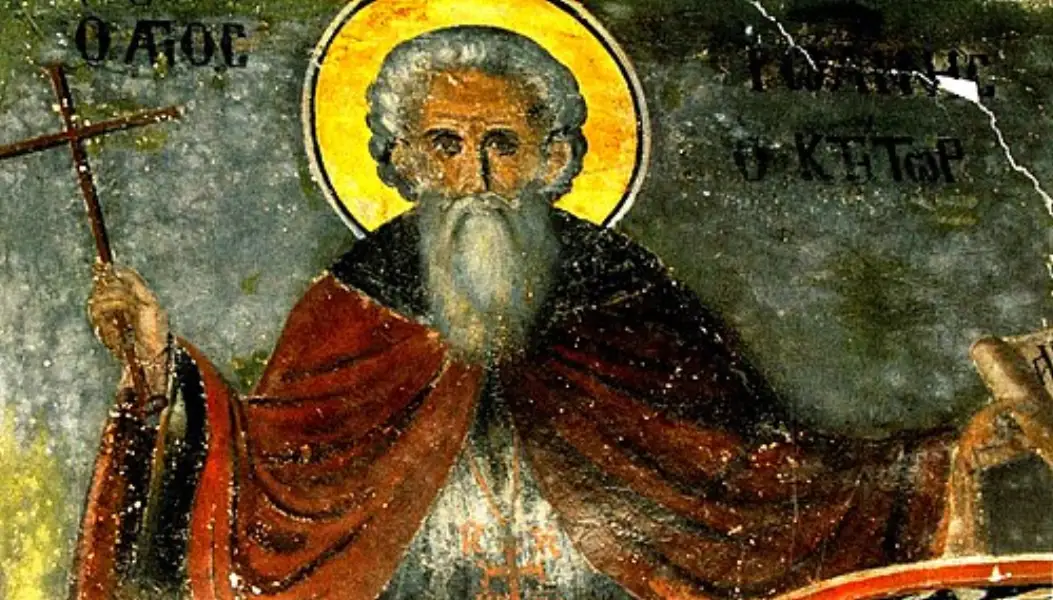
Overview
John the Iberian, also called John the Georgian and John the Hagiorite, was a Georgian monk venerated by both the Eastern Orthodox and Roman Catholic churches. Born into a noble family of Tao-Klarjeti in southern Georgia, he first pursued a worldly path, wedding and leading troops as a commander. In the first years of the 960s, once a deep personal and spiritual change of heart had taken hold, he received the monastic habit at the lavra of the Four Churches in his native region. Seeking deeper guidance, he went to Mount Olympus in Bithynia, a celebrated school of Byzantine monasticism, and then to Constantinople, where he obtained the release of his son Euthymius, held hostage by the Byzantine emperor. Father and son became the heart of a growing circle of disciples and withdrew to the monastery of Saint Athanasius on Mount Athos. There, together with John's brother-in-law, the retired general Thornikos, they brought the Iviron monastery into being, and it grew into the great center of Georgian monastic culture on the Holy Mountain. John served as its first abbot, guiding its spiritual, administrative, and intellectual life until his death around 1002. His sanctity was recognized by his contemporaries, and hymns composed in his honor survive from the twelfth century.
The Complete Life
A Nobleman of Tao-Klarjeti
John came from a noble Georgian family of Tao-Klarjeti, a borderland region of southern Georgia renowned for its monasteries and its fierce defense of Christian life. Little is recorded of his childhood, but his early adulthood followed the path of a Georgian aristocrat: he married, raised a family, and rose to command troops as a military commander. The sources give no details of his campaigns, presenting him instead as a man of rank and responsibility whose life took a decisive turn in mid-course. In the early 960s, moved by what the sources describe as personal and spiritual transformations, he abandoned his military career and received the monastic tonsure at the lavra of the Four Churches in Tao-Klarjeti. This decision separated him from his former station, though not from his family: his young son Euthymius remained behind, soon to be taken as a hostage to Constantinople by the Byzantine emperor. The pattern of his early life — noble birth, marriage, soldiery, and conversion — was familiar in the Christian East, yet in John it produced a particular fruit: a monk who never forgot his Georgian homeland, and who would spend the rest of his life transplanting its spiritual heritage to new ground. His later reverence among both Georgians and Greeks suggests a man who carried his national identity lightly, as a gift to be offered rather than a possession to be defended.
§ Life
From the Lavra to the Holy Mountain
Having taken the habit at the lavra of the Four Churches, John did not remain long in his native region. His hunger for spiritual direction drew him along the well-worn road of Georgian ascetics toward Byzantium. He traveled first to Mount Olympus in Bithynia — the modern Uludağ — which stood among the most renowned centers of Byzantine monasticism, where generations of monks from the Caucasus had been formed. There he was shaped by the disciplines of a mature monastic culture before political necessity called him onward. His son Euthymius had been held hostage at Constantinople by the Byzantine emperor, and John went to the imperial city to secure the boy's release. The journey proved providential: father and son were reunited, and the child who had been a diplomatic pawn grew up to become Euthymius the Illuminator, one of the great translators and fathers of Georgian letters. The two did not return to Tao-Klarjeti. Their evident holiness attracted followers, and rather than gathering a crowd they chose the strictest school available: the monastery of Saint Athanasius on Mount Athos, already recognized as a major center of Orthodox monastic life. There John placed himself under Athanasius's direction, the same obedience he would later commend in word and example to the monks who gathered around him.
§ Life
Founding Iviron
On Mount Athos, John and his son Euthymius quickly drew others by their piety and leadership, and the Georgian presence on the Holy Mountain began to consolidate around them. With John's brother-in-law John Thornikos, a retired general of considerable standing and means, they founded the monastery of Iviron — 'the monastery of the Iberians' — as a permanent home for Georgian monastic culture on Athos. John became its first abbot and guided its growth on every level: spiritual direction of the brethren, administration of its estates and affairs, and cultivation of its intellectual life. Under him Iviron flourished as a workshop of Georgian art, of copying manuscripts, and of liturgical learning, a house where Greek and Georgian churchmen grew close through prayer and learning. Euthymius and his successors carried out the great work of translation that made the Scriptures and the fathers speak Georgian, while John's governance gave the enterprise stability. He went on guiding the brotherhood at Iviron to the very end, dying around 1002 — an old man who had turned a company of exiles into one of the enduring institutions of Athonite monasticism. The house he founded remains to this day among the principal monasteries of Mount Athos, the living memorial of his stewardship.
§ Life
A Saint in His Own Lifetime
John's sanctity was not a posthumous reputation. The tradition records that he was considered a saint even while he lived, revered alike by Georgians and by Greeks on the Holy Mountain. The most striking witness comes from Athanasius of Athos himself, the founder of Athonite coenobitism, who wrote of John that after joining him on the mountain he shone forth in many and diverse spiritual graces, ministering to God, to Athanasius, and to the whole brotherhood in a manner none other had ever done. Such praise, from the founder of the Great Lavra to a monk of another rite and tongue, speaks of a holiness that crossed every boundary of the Athonite world. After his death around 1002, his veneration continued unbroken in both Georgian and Athonite tradition. Compositions in his honor appeared, and a pair of them from the twelfth century's first half still survive — liturgical evidence that his cult was flourishing within a century of his falling asleep. He is commemorated on July 12 in both the Eastern Orthodox and Roman Catholic churches, and invoked as a patron of Georgia and of Mount Athos. His feast joins him with his son Euthymius and his kinsman Thornikos as a founder of the Athonite commonwealth.
§ Legacy
Timeline
- 960
Received the monastic habit at the Four Churches lavra in Tao-Klarjeti in the first years of the 960s, having left military life behind.
§ Life
- 1002
Died on Mount Athos, having led the Iviron monastery as its first abbot until the end of his life.
§ Life
In Their Own Words
The God-fearing monk John, after he had come unto our mount and had joined himself unto me, a lowly and sinful man, yielding himself unto my unworthiness (according to the commandment of God, and also for the preservation of his own virtue and honourable soul), did shine forth in many and diverse spiritual graces, fulfilling innumerable and exceeding great works in the aforesaid obedience. Wherefore he did minister and profit not only unto God, but also unto me, the lowly, and unto all our Christly brotherhood, in such wise as none other hath ever done.
The Record
- Major works
- Iviron monastery on Mount Athos, founded as a center of Georgian monastic culture
- Patron of
- Georgia·Mount Athos
- Canonization
- Pre-congregation; revered as a saint by Georgians and Greeks even during his lifetime
Prayer
Bibliography
Show 3 sources
- Speake, Graham (2018). A history of the Athonite Commonwealth: the spiritual and cultural diaspora of Mount Athos. New York. ISBN 978-1-108-34922-2.
- Butler, Alban (1995). Butler's Lives of the Saints. Vol. 7. Liturgical Press.
- Kaukhchishvili, Simon (1970). Georgica. Vol. VIII. Metsniereba. p. 172.
Profile text adapted from the Wikipedia article, licensed CC BY-SA 4.0.
Pray with this saint every day
Save St. John the Iberian to your favorites, read the full profile, and get feast-day reminders in the Saints app.
Get the Saints AppFree on the App Store for iPhone and iPad