
c. 560 – c. 620·Feast November 12 (Eastern Orthodox); January 23 (Roman Catholic)
St. John the Merciful
Almsgiving Patriarch of Alexandria
Overview
John the Merciful, called also John the Almsgiver and John the Compassionate, served as Chalcedonian Patriarch of Alexandria in the opening decades of the seventh century. Born at Amathus on Cyprus to Epiphanius, the island's governor, he belonged to a noble family, married, and fathered children; only after the deaths of his wife and children did he give himself wholly to the Church. Chosen by the people of Alexandria and appointed by the emperor, he governed the patriarchate from 606 to 616 and poured its revenues into the relief of the poor, compiling a register of several thousand needy persons whom he supported personally and addressing them as his 'lords and masters.' A reformer as well as an almoner, he attacked simony and corruption among officials, reorganized the city's weights and measures for the benefit of the poor, and promoted religious education, while the number of Alexandria's churches grew from seven to seventy. When Persian armies sacked Jerusalem in 614 he sent abundant relief in food, wine, and coin to the Christian fugitives; and once the Persians occupied Alexandria itself he fled in old age to his native Cyprus, where he died between 616 and 620. His life was written by Leontius of Neapolis, who knew him, and his fame spread throughout the Christian world: he entered the Golden Legend, became the original patron of the Knights Hospitaller, and remains one of the few Byzantine-era saints widely honored in the West.
The Complete Life
A Son of Cyprus
John was born at Amathus, an ancient city on the southern coast of Cyprus, into a noble family of consequence: his father Epiphanius served as governor of the island. The sources preserve almost nothing of his boyhood, but one episode from his youth proved decisive. He saw in vision a beautiful maiden wearing a garland of olives, who announced that she was Compassion, firstborn of the Great King. The vision stayed fixed in his mind and became, in effect, the program of his life. As a young man he followed the ordinary course of a Christian nobleman: he married and had children, and there is no sign that he sought ecclesiastical office. Providence intervened through grief, for his wife and children died, and freed of every domestic tie he turned to the religious life with the whole strength of his mature years. He was therefore unusual among bishops of his age in more ways than one — a married man with children who became a bishop, elected while still a layman, and destined to become a saint without shedding a martyr's blood. The man who had lost his own family would soon become father to thousands of the destitute, and the vision of his youth would find its fulfillment in an almsgiving that made his name a byword for mercy across the Christian East.
§ Early life
Called to Alexandria
When Patriarch Theodore of Alexandria died, the Christian people of that great and turbulent city asked Emperor Phocas to name John of Amathus as Theodore's successor, and the emperor consented. John thus arrived at one of the most demanding thrones in Christendom not by ambition but by acclamation, elevated from the laity straight to the patriarchate. He understood the office as a stewardship of the poor. Among his first acts was the compilation of a list of several thousand needy inhabitants of Alexandria, whom he took under his personal care, supporting them from the revenues of his see — revenues he is said to have devoted entirely to the relief of those in want. He spoke of the poor consistently as his 'lords and masters,' acknowledging that in them he served Christ, and he made himself accessible to sufferers of every condition who came seeking help. Three times each week he visited the hospitals of the city in person, and he liberated great numbers of slaves with his own funds. The vision of Compassion that had marked his youth now took institutional shape: mercy was no longer a private virtue but the policy of an entire patriarchate, administered with the same rigor he brought to its governance.
§ Patriarch of Alexandria
Reforming a Church and a City
John's patriarchate was a program of reform as well as charity. He waged a determined campaign against simony, refusing to let sacred things be bought and sold, and combated heresy by promoting religious education among the clergy and people. Turning to the civic order, he overhauled how weights and measures were reckoned, so the poor would no longer be cheated in the marketplace, and moved against corruption among officials whose extortion burdened the helpless. The visible fruit of his governance was a remarkable flourishing of the Church in Alexandria: across his years of office the city's count of churches climbed from seven to seventy. His prudence was tested by difficult cases. When Vitalis of Gaza, a monk notorious for visiting the city's most disreputable quarters, was accused of scandalous behavior, John declined to punish him — and time vindicated the patriarch, for Vitalis's ministry to the prostitutes of Alexandria became renowned as a work of heroic mercy. John's liberality extended beyond his own diocese and even beyond prudence as the world reckons it: he helped a shipwrecked merchant three times over, finally fitting him out with a ship and cargo of wheat that carried him, by favorable winds, as far as Britain, where famine prices repaid the investment abundantly. Mercy, in his practice, was an economy of its own.
§ Patriarch of Alexandria
The Grammar of Mercy
The anecdotes preserved by Leontius of Neapolis reveal the interior logic of John's charity. Told of an alms-seeker exposed by his officers as an impostor, he answered simply that the man might be his Lord in disguise, and ordered him given alms anyway. Presented by a rich admirer with a magnificent bed covering, he kept it a single night, sold it, and distributed the price to the poor; when the donor bought it back and presented it again, and the game repeated itself several times, John observed drily that they would see who tired first — and the lesson was not lost. The most piercing of his ascetic inventions was a tomb: he had his own grave dug, but only partly, and stationed a servant to whisper before him on every state occasion that his tomb was unfinished and that he knew not the hour when death would seize him. Amid the pomp of a patriarchal court he kept the memory of death daily before his eyes, and out of that memory flowed his indifference to wealth. When the Sassanids stormed Jerusalem in 614, his compassion crossed every boundary: he sent rich stores of provisions and money to the Christian fugitives without inquiring into their communion, a mercy the Coptic Church would one day repay by enrolling this Chalcedonian patriarch among her own saints.
§ Anecdotes from the Life by Leontius
Exile and Death
The last years of John's patriarchate were darkened by the great war between Byzantium and Persia. After the fall of Jerusalem in 614 the flood of refugees reached Alexandria, and John emptied his stores and treasury on their behalf. But the war soon overtook his own city: Persian forces occupied Alexandria, and the aged patriarch, whose whole administration had been one long act of resistance to cruelty, was obliged to flee. He returned to the island of his birth, taking refuge in native Cyprus after a lifetime spent in Egypt, and there he died between 616 and 620 — the dates vary in the sources, as does the exact length of his episcopate, which some tables give as 610 to 619. He died as he had lived: dispossessed, dependent on others, and at peace. The man who had governed the second city of the empire finished his days as a refugee on the shore where he had first seen the vision of Compassion, the eldest daughter of the Great King. His subjects had lost their almsgiver, but the Church had gained a saint whose reputation would grow rather than fade with the passing of the turbulent age that had produced him.
§ Anecdotes from the Life by Leontius
Venerated East and West
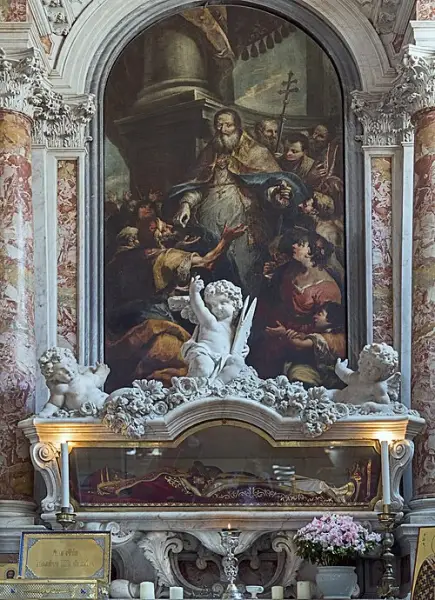
John was canonized by acclamation, without any formal process, and his cult spread with unusual breadth. He is honored as a saint in the Eastern Orthodox Church, the Catholic Church, and — remarkably, given his Chalcedonian allegiance amid the Monophysite controversies — the Coptic Orthodox Church, which preserves his feast in its own calendar. Ibn Kabar records his Coptic feast as 14 Paopi, while the Ethiopian Synaxarium, agreeing with the Greek Menaia, gives 15 Hathor, corresponding to 11 November; the Eastern Orthodox churches commemorate him on 12 November and the Roman Catholic Church on 23 January. The authority behind his fame was his contemporary Leontius, bishop of Neapolis in Cyprus, who appears to have known John personally and composed the hagiographical Life on which nearly every later account depends; a general notice in the Greek Orthodox Patriarchate's own records gives his episcopal years as 610 to 621. His relics became centers of pilgrimage: preserved at San Giovanni in Bragora in Venice, honored at a church dedicated to him in Cospicua on Malta, and divided by Sultan Bayezid II in 1489, when a relic was sent to the king of Hungary. Few Byzantine-era saints have won so durable a following in the Latin West.
§ Death and veneration
The Patron of Merciful Order
John's afterlife in Christian institutions has been extraordinary. In the medieval West he entered the Golden Legend, the great collection of saints' lives that shaped European devotion, and his example of organized charity made him the original patron of the Knights Hospitaller, the order that grew from hospices for pilgrims in Jerusalem into one of the great institutions of Christendom. His name endures in the modern world through the St John's Ambulance Corps of the British Commonwealth, which took its patron from him and carries his ideal of merciful service into emergency care. His cult is inscribed in the map of Europe: the Venetian church of San Giovanni Elemosinario was dedicated to him after his relics arrived in 1249, the Royal Chapel of Buda Castle was dedicated to him when a relic reached Hungary in 1489, and his veneration traveled as far as the St John the Merciful Chapel in St Martin's Cathedral in Bratislava. He is patron saint of Casarano in Italy and of Limassol in Cyprus, and a bastion of the Santa Margherita Lines at Cospicua, Malta, bears his name. Painters of the Cretan-Venetian school portrayed the patriarch in his vestments, and the poor of every century have found in him the model of a powerful man who counted beggars as his masters.
§ Death and veneration
Timeline
- 560
Born at Amathus on Cyprus to Epiphanius, the governor of the island, into a noble family.
§ Early life
- 606
Appointed by Emperor Phocas at the people's request and enthroned as Chalcedonian Patriarch of Alexandria.
§ Patriarch of Alexandria
- 614
Sent abundant provisions — food, wine, and coin — to Christians in flight after the Sassanid sack of Jerusalem.
§ Anecdotes from the Life by Leontius
- 616
His patriarchate drew to a close as Persian forces occupied Alexandria, ending his charitable administration.
§ Anecdotes from the Life by Leontius
- 620
Died in his native Cyprus between 616 and 620, having fled there in old age from the Persian occupation.
§ Death and veneration
- 1249
His remains were translated from Constantinople to Venice, where San Giovanni Elemosinario was dedicated to him.
§ Death and veneration
- 1489
Sultan Bayezid II sent a relic of John to King Matthias Corvinus of Hungary for the Royal Chapel of Buda Castle.
§ Death and veneration
In Their Own Words
Give unto him; he may be Our Lord in disguise.
We will see who tires first.
My Lord, your tomb is unfinished; pray give orders for its completion, for you know not the hour when death may seize you.
The Record
- Major works
- Register of several thousand needy Alexandrians supported under his personal care·Reform of Alexandria's weights and measures to protect the poor·Expansion of the city's churches from seven to seventy
- Patron of
- Egypt·Casarano, Italy·Limassol, Cyprus·Knights Hospitaller (original patron)
- Symbols
- Bishop vestment·Miter·Crosier
- Canonization
- Pre-congregation; venerated in the Eastern Orthodox, Catholic, and Coptic Orthodox churches
Prayer
Bibliography
Show 8 sources
- Baynes, Norman H. Introduction to the Life of St John the Almsgiver.
- Churchill, Leigh (2001). The Birth of Europe. Paternoster Press. pp. 176-180.
- Frend, William (1972). The Rise of the Monophysite Movement. p. 340. ISBN 978-0227172414.
- Meyendorff, John (1989). Imperial Unity and Christian Divisions: The Church, AD 450-680. St. Vladimir's Seminary Press. p. 278. ISBN 978-0881410556.
- Maspero, Jean (1923). Histoire des Patriarches d'Alexandrie. p. 328.
- Leontios of Neapolis (1865). Vita Sancti Joannis Eleemosynarii. Patrologia Graeca, Vol. 93. Paris: Imprimerie Catholique.
- Acta Sanctorum. Vol. II (January). Societas Jesu. 1865. p. 501b.
- Herbermann, Charles, ed. (1913). "St. John the Almsgiver". Catholic Encyclopedia. New York: Robert Appleton Company.
Profile text adapted from the Wikipedia article, licensed CC BY-SA 4.0.
Pray with this saint every day
Save St. John the Merciful to your favorites, read the full profile, and get feast-day reminders in the Saints app.
Get the Saints AppFree on the App Store for iPhone and iPad