
c. 1690 – 1730·Feast June 9
St. John the Russian
Slave and confessor of Cappadocia
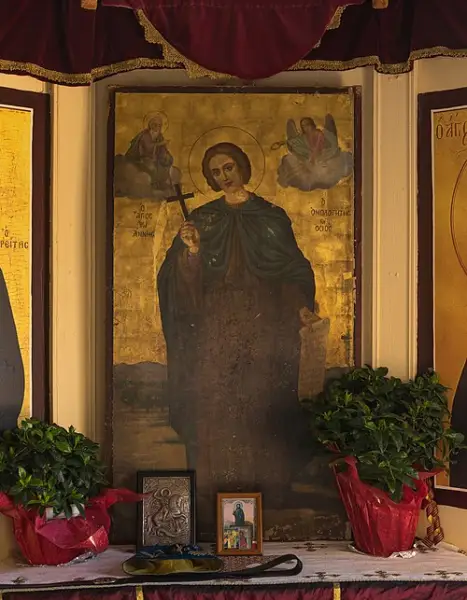
Overview
John the Russian was a soldier of Peter the Great who became a slave in Ottoman Cappadocia and won sanctity without ever regaining his freedom. Born around 1690 in the Cossack Hetmanate, he was recruited into the imperial army as a young man and fought in the Russo-Turkish War of 1710–1711, where he was captured and sold to the head of the Ottoman cavalry at Ürgüp. Because he refused to convert to Islam he was mocked as an unbeliever and put to work as a groom in the stables, yet his steadiness of faith, humility, and diligence gradually silenced the ridicule and earned the respect of his master's whole household. Offered freedom and a house of his own by the Ağa, he declined, saying that God had predestined him to serve as a slave in a foreign land for his salvation. He kept strict fasts, prayed without ceasing, and by night secretly attended the cave-church of St George, receiving Communion every Saturday. A miracle reported at his master's table — a dish of pilau conveyed to Mecca and back — led even Muslims to call him a wali, a friend of God. He died on 9 June 1730, his relics were honored as incorrupt, and in 1924 the Greeks expelled from Turkey carried them to Euboea, where they remain.
The Complete Life
A Soldier of Peter the Great
John was born around 1690 in the Cossack Hetmanate, the autonomous Cossack territory of the Russian Tsardom, in an era when the young empire was pressing its claims against the Ottoman world. Of his family and childhood the sources say nothing; he enters history when, having come of age, he was recruited into the army of Peter the Great. His regiment was sent to the war of 1710–1711, the brief and disastrous campaign that ended with the Tsar's army surrounded on the Pruth. During that war John fell into Turkish hands. For a captured Orthodox soldier the fate was a familiar and terrible one: he was sold as a slave, passing into the household of the head of the Ottoman cavalry, an Ağa who lived at Ürgüp in Cappadocia, deep in the interior of Anatolia. Thus, in his early twenties, the Russian soldier was carried a thousand miles from everything he knew — language, church, homeland — into a Muslim land where his faith would be tested not by battle but by decades of servitude. Everything the Church would later venerate in him grew out of that catastrophe accepted without despair.
§ Early life and military service
Confessor in the Stables
In the Ağa's household at Ürgüp, John's first trial was his refusal to become a Muslim. For this he was humiliated and tormented, and the Turks around him called him gavur — an unbeliever. But the abuse could not make him deny his baptism, and with time even his tormentors fell silent before his steadiness of faith, humility, and diligence. He was set to work as a groom and lived among the horses in the stables, the lowest place in a great house. When other slaves mocked him for serving so zealously, he took no offense and instead sought to aid and console them in their distress. His gentleness won the love and confidence of the Ağa himself, who went so far as to offer him freedom and a separate house to live in — the dream of every slave. John refused. God, he said, was his patron, and no one stood above Him; if God had marked him out for bondage in an alien land, then so it must be, for his salvation. The refusal is the key to his vocation: he had stopped measuring his life by circumstance and had accepted the stable as his monastery, the groom's work as his obedience, and the foreign land as the field of his salvation.
§ Life in slavery
Hidden Prayer and the Pilau of Mecca
John's outward life was labor; his hidden life was prayer. By day he worked in the stables and kept a strict fast, and when night fell he slipped away in secret to the cave-church of St George, where he stood through the prayers of the All-Night Vigil, returning to receive Holy Communion every Saturday. Neither his master nor the Muslim city knew what sustained him. The household, meanwhile, prospered: the Ağa became one of the most influential men of Ürgüp and credited the holy man under his roof. Then came the story that changed everything. Setting out on the Hajj, the Ağa left home; while he was away his wife gave a dinner for relatives and friends, and as the master's favorite dish, pilau, came to the table, she sighed to John — then waiting on the guests — that his master would relish sharing it. John begged her to hand the dish over to him, vowing to convey it to Mecca. The company chuckled, supposing he wanted the rice for himself or meant to give it away. When the Ağa returned he told of a marvel: in Mecca, in his locked room, he had found a steaming plate of pilau bearing his name, engraved as on every plate in his house. Even Muslims started hailing him as a wali — one of God's own friends.
§ Life in slavery
A Death in a Muslim House
The miracle did not change John's manner of life. He went on working hard and praying in the same obscure corner of the Ağa's household, as though nothing had been revealed about him. When his final illness came and he could no longer stand, he asked for a priest to bring him Holy Communion. The times were dangerous: the priest feared to be seen entering a Muslim house, and so he concealed the Eucharist inside an apple and carried it in that disguise to the dying slave. Having received the Body of Christ, John died on 9 June 1730 — 27 May by the old calendar — in the house of the master he had served for more than twenty years. He was buried at the church of St George in Prokopio, the village near Ürgüp, and from that day the local Church revered him as a saint. His relics were found incorrupt and began to work wonders. Even in death the Russian groom did not leave Cappadocia; he became the holy man of the place, claimed by Orthodox and remembered by Muslims alike, until history itself uprooted his people.
§ Beginning of veneration
Incorrupt and Wonderworking
John was never the subject of a formal canonization process; the Church at Prokopio simply reckoned him among the saints from the day of his burial, as the ancient custom allowed. The grounds were the classic ones: incorrupt relics, a life of confessed holiness, and a stream of wonders attributed to his intercession. Tradition, preserved in the communities that honored him, holds that his remains remained incorrupt and wonderworking, and that he shows particular care for the two classes of sufferers dearest to his own story of humble endurance: sick children and those afflicted with cancer. His veneration crossed confessional boundaries in a way few saints' have — the Muslims of Ürgüp had called him a wali while he lived, and the Orthodox of Cappadocia kept his feast on 9 June after his death. He is venerated in the Eastern Orthodox Church and the Eastern Catholic Churches, and his cult remains alive in both the Greek and the Russian worlds that claim him. In him the Church honors a confessor of a rare kind: a man who never preached, wrote, or founded anything, whose whole testimony was the refusal, repeated daily for a lifetime, to let slavery make him unfaithful.
§ Beginning of veneration
From Cappadocia to Euboea
The twentieth century completed John's story with a second exile. When the Greeks of Asia Minor were expelled from Turkey in 1924 under the population exchange, the Christian people of Cappadocia refused to leave their saint behind: they carried his relics with them over the Aegean to Euboea, the island that became their refuge. There the remains were interred in the Church of St John the Russian at Prokopi in Euboea, Greece, which has become one of the great pilgrimage shrines of the country, drawing the sick — especially children — to his incorrupt hand. A portion of him rests abroad as well: his right hand is preserved in the Russian Monastery of St Panteleimon on Mount Athos. His homeland has likewise recovered him. With the blessing of Patriarch Alexy II of Moscow, a small wooden church of Righteous John the Russian was raised in the Kuntsevo district of Moscow in 2003–2004, a larger stone church was consecrated nearby in 2016, and in Novosibirsk a side chapel within the church honoring the Sign of the Mother of God commemorates him. Even Finland keeps a small eukterion in his honor at Viljakkala in the Ylöjärvi municipality — a Cappadocian saint of Russian birth, venerated from the Aegean to the Baltic.
§ Legacy
Timeline
- 1690
Born in the Cossack Hetmanate of the Russian Tsardom around 1690.
§ Early life and military service
- 1710
Recruited as a young man into the army of Peter the Great and sent to the Russo-Turkish War of 1710-1711.
§ Early life and military service
- 1711
Captured in the fighting and sold into bondage to the commander of the Ottoman horse at Ürgüp in Cappadocia.
§ Early life and military service
- 9 Jun 1730
Died at Ürgüp on 9 June (Old Style 27 May) 1730, soon after secretly receiving Holy Communion.
§ Beginning of veneration
- 1924
The Greeks expelled from Turkey carried his relics from Cappadocia to a new refuge on the island of Euboea.
§ Beginning of veneration
- 2003
With the blessing of Patriarch Alexy II of Moscow, a small wooden church dedicated to him was erected in Moscow in 2003-2004.
§ Legacy
- 2016
A larger stone church built near the wooden one in Moscow's Kuntsevo district was consecrated in his honor.
§ Legacy
In Their Own Words
My patron is Lord, and no one is above Him. He predestined me to live as a slave in a foreign land; seems, it must be so for my salvation.
The Record
- Major works
- Quiet conversion of a Muslim household in Ürgüp through service and prayer
- Patron of
- Sick children·Cancer patients
- Canonization
- Pre-congregation; revered as a saint by the local Church from the time of his burial in 1730
Prayer
Bibliography
Show 2 sources
- "St. John the Russian: The Saint of Kayakapi | Kayakapi Premium Caves - Cappadocia". Archived from the original on 15 August 2020. Retrieved 5 April 2021.
- "Neo Prokopion". 38°44′13.44″N 23°29′23.79″E.
Profile text adapted from the Wikipedia article, licensed CC BY-SA 4.0.
Pray with this saint every day
Save St. John the Russian to your favorites, read the full profile, and get feast-day reminders in the Saints app.
Get the Saints AppFree on the App Store for iPhone and iPad