
454 – 558·Feast May 13
St. John the Silent
Hesychast bishop hidden in the desert
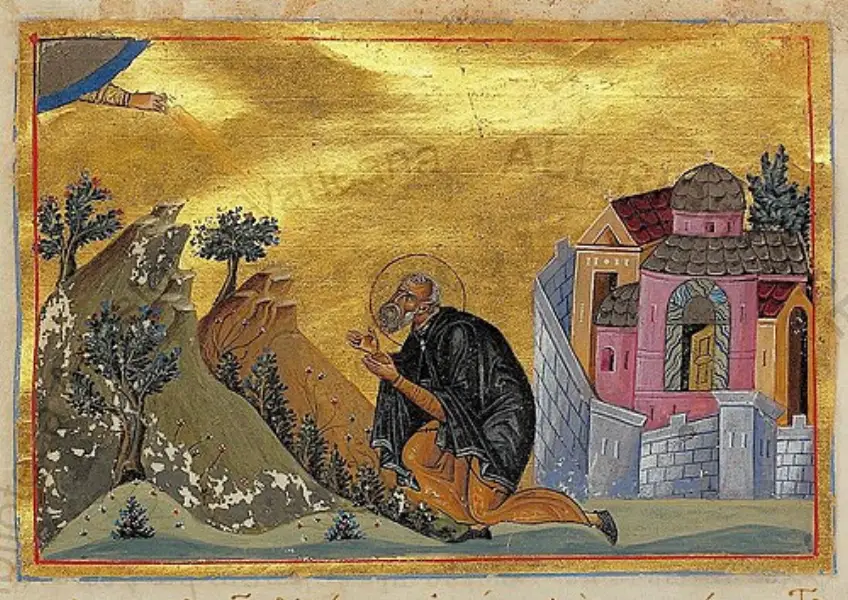
Overview
John the Silent, also called John the Hesychast, was a sixth-century bishop of Armenia who abandoned his see for the desert of Palestine and spent seventy-six years in solitude. Born in Nicopolis, Armenia Prima, into a family of generals and governors, he was orphaned at eighteen, built a monastery, and lived there with ten young monks until his reputation for sanctity carried him, unwillingly, to the episcopate: consecrated bishop of Colonia at about twenty-eight, he governed the see for nine years before withdrawing from public life. Sent to Constantinople in 490 to obtain the emperor's help against a local persecution, he accomplished his mission and then slipped away to Jerusalem. A vision of a luminous cross directed him to the great laura of Sabbas the Sanctified, where he concealed the fact that he had ever been a bishop, served as the monastery's steward, and lived as a hermit in near-total silence. Even the discovery of his episcopal ordination — revealed to Patriarch Elias of Jerusalem at Calvary on the day he was to be made a priest — did not end his hiddenness. Driven briefly into the wilderness by turmoil at the laura, he returned to his cell and remained there forty years, refusing no one who sought instruction. He died at Jerusalem in 558, aged one hundred and four, leaving behind the life written by his visitor Cyril of Scythopolis.
The Complete Life
An Orphan of the Armenian Nobility
John was born on January 8, 454, at Nicopolis in Armenia Prima — the modern Koyulhisar in Turkey — into a family whose men were mainly generals and governors, a household of imperial service and worldly standing. He was eighteen when both his parents died, and the inheritance of rank fell to a young man who had already begun to look beyond it. Instead of pursuing the career his blood prescribed, he built a monastery and gathered ten young monks around him, directing them in a life of hard work and devotion. The gesture defined him: where his family had built fortresses and administered provinces, he built a house of prayer and administered a small brotherhood. For years the monastery was his world, and its discipline formed the interior strength that would later sustain far stranger vocations. A reputation for leadership and sanctity grew around the young abbot, spreading beyond Nicopolis until it reached the archbishop of Sebaste — with consequences John did not want. The noble orphan had found freedom in the cloister; the Church was about to take him out of it again.
§ Biography
A Bishop Against His Will
The archbishop of Sebaste consecrated John bishop of Colonia in Armenia when he was only twenty-eight, and the sources are explicit that he had no desire for the role. He accepted it as obedience and held the post for nine years, governing a rough Armenian see in the turbulent decades after the Council of Chalcedon. When a local persecution broke out, John undertook the long journey to Constantinople in 490 to secure the emperor's intervention, and he succeeded. But having accomplished the mission, he made a decision that ended his public life forever: instead of returning to Colonia, he made for Jerusalem, longing for the hidden life once more. A bishop had become a fugitive from his own dignity. One night at prayer a shining cross took shape in the air above him, and a voice bade him: if he wished to be saved, let him follow the light; the light moved and pointed to the monastery of Sabbas the Sanctified in the desert. At thirty-eight he presented himself to the great laura, which then held one hundred and fifty monks — and he told no one that their new applicant had once governed a diocese.
§ Biography
The Hidden Bishop of St. Sabas
In the laura of St. Sabas, John began again at the bottom. Around 494, after the community had come to know his character, Sabas allowed him a separate hermitage for uninterrupted contemplation; five days a week he fasted alone in his cell, leaving only on Saturdays and Sundays for the public Mass. After three years of this regimen he was made steward of the monastery, an office of labor and responsibility he performed without revealing anything of his past. The crisis came four years later, when Sabas, judging John worthy of priesthood, presented him to Patriarch Elias of Jerusalem for ordination at Calvary. There John asked for a private audience and, under a promise of secrecy, disclosed that he was already a bishop — one who had fled to this desert, weighed down by his many sins, to await the Lord's visitation. Astonished, the patriarch declined to ordain him. Sabas, fearing some hidden crime, prayed until God revealed the truth, then complained that John had kept the secret from him — and John, distressed, wanted to leave the monastery altogether. Sabas prevailed on him to remain, vowing to bury what he had learned in silence, and John went back to his cell, where for four more years he spoke to no one but the brother who brought him necessities.
§ Biography
Six Years Speaking Only to God
In 503 turmoil struck the laura itself: certain turbulent disciples forced Sabas to abandon his own monastery. For John the upheaval became the occasion of his deepest solitude. He moved to a nearby wilderness and spent six years there in silence, conversing only with God, eating nothing but wild roots and herbs. This was his maturity as a hesychast — the epithet 'the Silent' records a man whose ordinary speech had been surrendered for decades. When Sabas was restored to his community he sought John out and convinced him to return, but the desert had done its work: John had so accustomed himself to converse with God alone that everything else now tasted to him of bitterness and emptiness. He prized obscurity and humility, wanting to live unknown to men, and the sources note with gentle irony that he was unable to do so — sanctity kept leaking into view. Back in the laura he settled into his cell for what would be the final forty years of his life, and here his silence opened rather than closed: he refused no one who desired his instruction. The silence, it turned out, was not for himself. It was a well dug deep enough that others could drink from it for generations.
§ Biography
The Last Forty Years and a Healed Biographer
Among those who came to John's cell for direction was Cyril of Scythopolis, the monk who would become the great historian of Palestinian monasticism and John's biographer. Cyril asked the old father what he should do with his life, and John told him to join the Laura of St. Euthymius. Cyril disobeyed, choosing a little monastery by the Jordan's banks instead, and there illness struck him and regretted his stubbornness. Then John appeared to him in a dream: after scolding him for not obeying, the elder promised that if Cyril returned to St. Euthymius's monastery he would recover and find his salvation. Cyril went the next day and was well again — a healing that inaugurated the book which preserves John's memory. Thus counsels given in silence bore fruit in history. John died at Jerusalem in 558, on May 13, at the age of one hundred and four. He had lived in solitude for seventy-six years, interrupted only by the nine years of his episcopate — a lifetime divided, as his biographer reckoned it, between the burden of governing and the freedom of hiding in God.
§ Biography
The Silent Father of Two Calendars
John was never canonized by process; the Church of East and West received him as a saint on the strength of the life Cyril of Scythopolis wrote and the continuous devotion of monasteries that treasured his memory. He is venerated in the Catholic Church and the Eastern Orthodox Church, and his cult is old enough to carry two separate feast days: May 13 on the Roman Catholic calendar, and December 3 among Orthodox and Eastern Catholic Christians, the date on which the Christian East keeps his memory. The iconographic tradition places him among the ascetic fathers of Palestine — the Menologion of Basil II includes his portrait among the saints of the Byzantine year. His very surname became a title of honor: 'the Hesychast' attached to his name in the Greek tradition, and his story entered the great collections of the West, from Butler's Lives to the Catholic Encyclopedia. Hermits and contemplatives claim him as a patron, and his Feast is kept by communities that know his story only in outline — a bishop who fled his own throne and found, seventy-six years later, that the silence he chose had made him known to the whole Church.
§ Biography
Timeline
- 8 Jan 454
Born at Nicopolis in Armenia Prima into a family of generals and governors.
§ Biography
- 472
Orphaned at the age of eighteen, he built a monastery where he stayed with ten young monks.
§ Biography
- 482
Consecrated bishop of Colonia in Armenia at about twenty-eight, despite having no desire for the office.
§ Biography
- 490
Traveled to Constantinople to obtain the emperor's intervention against a local persecution, then went instead of returning home to Jerusalem.
§ Biography
- 494
Around 494, Sabas granted him a separate hermitage for uninterrupted contemplation at the laura.
§ Biography
- 503
When turbulent disciples forced Sabas from the monastery, John withdrew to a nearby wilderness for six years of silence.
§ Biography
- 13 May 558
Died at Jerusalem on May 13, 558, at the age of one hundred and four.
§ Biography
In Their Own Words
If you desire to be saved, follow this light.
Father, I have been ordained bishop; but on account of the multitude of my sins have fled, and am come into this desert to wait the visit of the Lord.
The Record
- Major works
- Monastery founded in his youth at Nicopolis·Witness preserved in the Life written by Cyril of Scythopolis
- Patron of
- Hermits and contemplatives
- Canonization
- Pre-congregation; venerated from antiquity in the Catholic and Eastern Orthodox churches
Prayer
Bibliography
Show 5 sources
- The Lives of Saints. London: Thomas Meighan. 1729. pp. 303-307.
- Mershman, Francis (1913). "St. John the Silent". In Herbermann, Charles (ed.). Catholic Encyclopedia. Vol. 8. New York: Robert Appleton Company.
- Butler, Alban (1866). "May 13 St. John the Silent, Bishop and Confessor". Butler's Lives of the Saints. Vol. V. Dublin: James Duffy.
- Ghezzi, Bert. Voices of the Saints. Loyola Press.
- Benedictine Monks of St Augustine's Abbey, Ramsgate (1921). The Book of Saints. A & C Black. pp. 148-149.
Profile text adapted from the Wikipedia article, licensed CC BY-SA 4.0.
Pray with this saint every day
Save St. John the Silent to your favorites, read the full profile, and get feast-day reminders in the Saints app.
Get the Saints AppFree on the App Store for iPhone and iPad