
4th century·Feast July 30 (Julian) / August 12 (Gregorian)
St. John the Warrior
Soldier-martyr of Julian's persecution
Overview
John the Warrior, called John the Soldier in the Catholic tradition, was a fourth-century soldier and martyr of the Byzantine world whose quiet defiance outlasted an emperor's rage. During the reign of Julian the Apostate, the last great era of imperial persecution of Christians, John served as a soldier in the Roman army, compelled to take part in the campaign against the Church. He refused its purpose from within: as a Christian he warned fellow believers of impending attacks and imprisonments, visited Christians held in prison, and extended his charity beyond the persecuted to the poor, the needy, the sick, and the suffering. When Julian learned that John was supporting the Christians, he had him imprisoned, and the warrior awaited his sentence of death there. The emperor's death in battle in 363 brought John release, and he lived on to a very great old age. According to legend, he designated the place of his own funeral, aided by a devout woman who appeared for that purpose. His remains were kept at a Constantinople church honoring the Apostle John, where they were credited with wonders. In later centuries, especially in the Russian Orthodox tradition, he became the helper of the poor and the bereaved, the revealer of thefts, the guardian of households, and the intercessor of prisoners.
The Complete Life
A Christian in Julian's Army
John served as a soldier under the emperor Julian the Apostate, whose short reign in the fourth century brought the last great persecution of Christians within the Roman Empire. Every soldier of the age served at the emperor's pleasure, and Julian made his Christian troops instruments of his anti-Christian policy: John was forced to participate in the persecutions the emperor unleashed. What the emperor could not compel was his conscience. John remained a Christian in fact and not merely in name, and he turned his position inside the machine of persecution into an instrument of rescue. He warned believers of coming attacks and possible imprisonments, giving them the hours they needed to flee or prepare; he visited the Christians already in prison, sustaining them with presence and comfort. His charity refused the categories of the persecution: he was good not only to fellow Christians but to the poor and to all in need, visiting the sick and consoling the suffering wherever he found them. The army had made him a warrior; his baptism made him a different kind of one, fighting for the very people his emperor had ordered him to hunt.
§ Biography
Prison and the Emperor's Death
Such open partisanship could not remain hidden from an emperor who watched for it. When Julian saw that John was supporting the Christians, he had him arrested and imprisoned, and in his cell the warrior awaited the death penalty for his defiance. The record does not preserve the details of his confinement — the interrogations, the threats, the length of his waiting — only the fact of it: a soldier of the empire, chained for loving the people he had been ordered to destroy. The crisis resolved itself not by John's doing but by heaven's. In 363 Julian died during the Battle of Samarra, his Persian campaign cut short along with his attempt to reverse the Christianization of the empire, and with the persecutor gone, John was released from prison. The martyrdom he had prepared for was never consummated; his confession of faith ended not in blood but in liberation. He emerges from the sources as one of those confessors whom the Church honors nearly as highly as martyrs — a man who accepted death as certainly as any martyr and received back his life as a gift to be spent in old age and prayer.
§ Biography
Old Age, a Legend, and Relics
The sources fall silent about the rest of John's life, knowing only that the exact date of his death is unknown and that he died of very old age, long after the age of persecution had passed. One legend survives from those closing years: the old soldier ordered the place of his own funeral, and in due course a devout woman appeared to carry out his wishes — a story told to show that even his burial was arranged by providence rather than chance. His remains were kept at a Constantinople church honoring the Apostle John, honored there as wonderworking. The faithful sought from the saint help and consolation for the wounded and the mourning — a fitting patron for a soldier who had spent his life among the suffering and the imprisoned. Thus the man whom an emperor had locked away in a dungeon became, in the memory of the Church of Constantinople, a permanent presence in one of its great sanctuaries, his tomb a place where the afflicted came to find the comfort he had once gone about distributing in person.
§ Biography
Veneration in Rus and Rome
John's cult flourished especially in the Slavic East. In the Russian Orthodox tradition he is regarded as a helper in sorrow and poverty, and his veneration was particularly widespread in Little Russia. The old anthology known as Legends of the Saints prescribes a special prayer to him for the recovery of stolen things and the return of escaped servants, and the prologues about the Warrior say he holds servants back from running away, gives warning of theft, and brings hidden deeds to light — the intercessor, in other words, who sees what is hidden and rights what is wrong. In Saint Sophia Cathedral in Kyiv an icon depicts John the Warrior together with the prayers and kontakia addressed to him, opening with the appeal to the mighty intercessor to have mercy on the servant beset by misfortunes and to protect him from offenders. People imprisoned in dungeons and jails pray to him, remembering the confinement he himself endured. In the Roman Catholic Church he is honored as John the Soldier, with his feast celebrated there on July 29; the Orthodox keep him on July 30 by the Julian calendar, corresponding to August 12 Gregorian.
§ Veneration
The Cross, the Spear, and the Shield
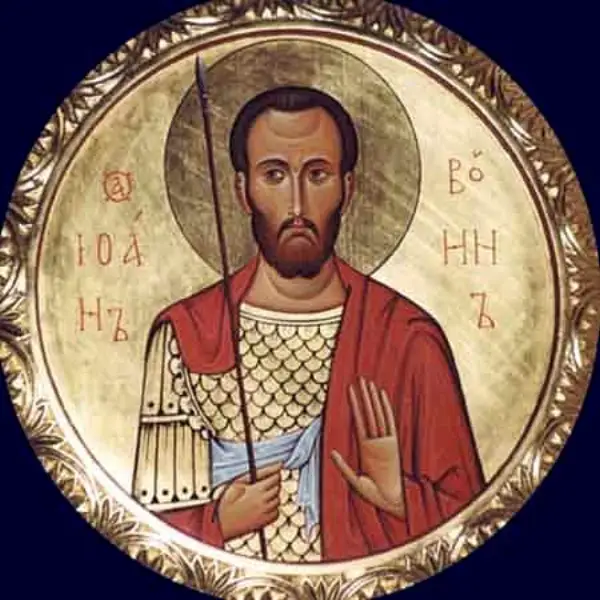
John's memory has been carried above all by icons. He is always depicted with dark hair and a beard, wearing a weskit, trousers, boots, scale armor — suggesting that he was a horseman — and a cape. Three symbols characterize him and sum up the theology of his life: the cross, which signifies the faith he defended by all available means; the spear, signifying the strength given by God for the war against sin and unbelief; and the shield, signifying God's protection from all misfortunes. Russian masters painted him repeatedly — an early nineteenth-century Palekh icon of John the Warrior ('Ioann Voistvennik') by an unknown artist of the school, worked in egg tempera and gold, is preserved in the State Palekh Art Museum, and a late seventeenth- or early eighteenth-century icon pairs him with St. Simeon Stylites in the church of Simeon Stolpnik in Yaroslavl, its restoration completed in 2005 and the panel now in the Yaroslavl Art Museum. The troparion sung to him calls him the miracle-worker, the faithful servant and soldier of the all-good Sovereign, who strengthens soldiers in battle and rescues the suffering from wounds, sudden death, and cruel misfortunes — the soldier's saint whose battles were all fought for others.
§ Iconography
In Their Own Words
O mighty intercessor and saint of Christ, John the Warrior! Have mercy upon thy servant who suffers misfortunes, affliction, and all types of adversity. Save him from all evil and protect him from offenders, for thou hast been granted such grace from God.
O mighty and all-gracious martyr John, glorious and terrifying, warrior of the Heavenly King. Accept the supplication of thy servant and from present misfortunes, from those who plot, from evil plunder and from ordeals yet to be, deliver me who cry faithfully unto to thee Hallelujah.
The Record
- Patron of
- Helper in sorrow and poverty·Recovery of stolen things·Prisoners·Soldiers in battle·The bereaved and afflicted
- Symbols
- Cross·Spear·Shield·Scale armour and cape
- Canonization
- Pre-congregation; honored as a martyr from the early centuries in the Eastern Orthodox and Catholic churches
Prayer
Bibliography
Show 4 sources
- "Святой мученик Иоанн Воин" [Martyr Saint John the Warrior]. Pravoslavie.ru. Retrieved 27 February 2012.
- Oprishko, Nadezhda Alexandrovna (2002). Православные святые. Почитание и прославление [Orthodox saints. Veneration and Doxology] (in Russian). Olma Media Group. p. 149. ISBN 978-5-224-03372-0.
- "ИОАНН ВОИН" [John the Warrior]. Pravoslavnaya Entsiklopediya.
- "CatholicSaints.Info » Blog Archive » Saint John the Soldier". Retrieved 7 November 2021.
Profile text adapted from the Wikipedia article, licensed CC BY-SA 4.0.
Pray with this saint every day
Save St. John the Warrior to your favorites, read the full profile, and get feast-day reminders in the Saints app.
Get the Saints AppFree on the App Store for iPhone and iPad