
1049-1129·Feast February 23
St. John Theristus
Byzantine Monk Known as the Harvester
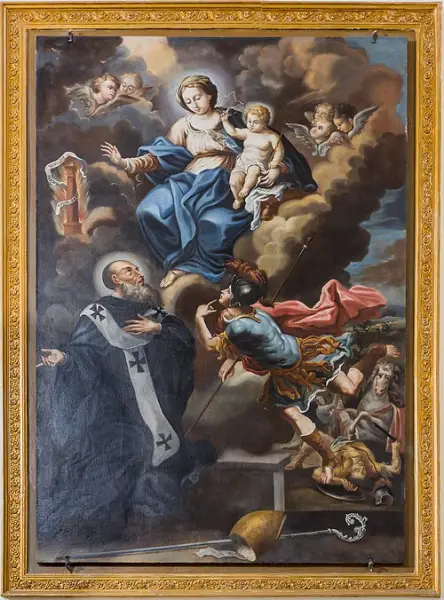
Overview
John Theristus, whose Sicilian name Santu Juanni Teristi and Greek sobriquet mean John the Harvester, was an Italian Byzantine Benedictine monk of the eleventh and twelfth centuries, and one of the rare saints whom East and West alike honor, even though his death fell nearly a hundred years after the Great Schism of 1054. The story of his life comes down through legend and popular belief. Raiding Saracens had killed the father, Arconte di Cursano, a Byzantine farmer with land near Botterio Signore in the Stilo territory; the raiders carried off the farmer's Calabrian wife to Palermo, and the captive gave birth to John in that city, so that the boy grew up Christian in a Muslim land. His mother, when he was fourteen, pressed him to escape to the land of his fathers; he made the Strait of Messina crossing in a boat that carried neither oar nor sail, came ashore at Monasterace, and there, after the bishop had tried him harshly, received baptism at his hands. Drawn to the Basilian ascetics Ambrose and Nicholas in the caves around Stilo, he was admitted to their community despite his youth, distinguished himself in virtue, and was elected abbot, distributing a family treasure he discovered at Cursano to the poor. A miraculous harvest, won by his prayer against a destroying storm at Monasterace, earned him the name Theristus, the reaper, and made him the helper of Calabrian farmers. He died at Stilo in 1129.
The Complete Life
Born of a Raid, in Captivity
The story of John's beginnings, as the tradition hands it down, begins in violence. His father, Arconte di Cursano, was a Byzantine farmer working land near Botterio Signore in the territory of Stilo, on the Calabrian coast. In a Saracen raid on those coasts Arconte was killed. His Calabrian wife was seized and carried off to Palermo, the Saracen capital of Sicily, and there in captivity she gave birth to the boy who would be called John. The child thus grew up in a household of the cross inside a Muslim emirate, raised by his mother in the Christian faith amid an environment of Islam. It was an inheritance of dispossession that nonetheless preserved what mattered: he knew whose son he was, and where he had come from. At the age of fourteen, encouraged by his mother, he determined to escape to his native country. The escape became the first of the legends that surround him: an over-water crossing of the Strait of Messina with neither oar nor sail, a voyage that the tin ship crowning the cloister well of his monastery — with its child at prayer — would long commemorate. He came safe to Monasterace on the Calabrian shore, and his life in Italy began.
§ Life
Baptism and the Cave Monks of Stilo
The fugitive boy, dressed as a Moor, was brought by the astonished inhabitants of Monasterace to their bishop, who interrogated him; John answered that he was seeking baptism. Yet baptism did not come at once: first the boy was made to endure hard trials, and only then did the bishop pronounce his name — a delay the legend treats as the first testing of a vocation rather than an unkindness. Baptized and growing to manhood in his recovered homeland, John felt the pull of the cave-dwellers of the Stilo district grow stronger and stronger, drawn above all by two Basilian ascetics, Ambrose and Nicholas, whose example fascinated him and who became his masters. Despite his youth he pressed his suit with such insistence that the community finally admitted him. There his monastic life unfolded in the Byzantine tradition that flourished in southern Italy, and he distinguished himself by virtue to the point that his brethren later elected him abbot. The legend preserves one episode that joins his two worlds: at Cursano he found a treasure that had belonged to his family, the wealth of the farmer his father had been, and following the rule of Saint Basil, under which the monk owns nothing, he distributed the whole of it to the poor. The captive's son had come home, and gave away what home had cost.
§ Life
The Harvest That Would Not Fail
The miracle that fixed John's place in the affection of the Calabrian countryside happened in June, at harvest time. One June, harvest being near, John set out for Monasterace to call on the knight whose provisions kept the monastery fed; wine in a flask and some bread made up his traveling store. At the two fields named Marone and Maturavolo he came upon the reapers and shared out the bread and wine among them. A furious storm then rose up, threatening to destroy the harvest entire, but through John's prayer the tempest held off until the wheat could be harvested and gathered into sheaves. The crop was saved, and the locals with it, for the miracle was remembered as the rescue of a population from starvation. The episode and other deeds of help given to farmers earned the monk the nickname by which he has been known ever since: Theristus, the reaper. The gentleman whose fields these were, struck by what he had seen, made Marone and Maturavolo over to the monastery, binding the miracle into the monastic economy it had saved. It is a saint's legend shaped precisely to the anxieties of an agricultural people, and the menologies and synaxaria of the east, together with the Roman Martyrology, carry the memory of the reaper monk on their pages to this day.
§ Life
Death and the First Miracles
John died at Stilo in 1129, having spent the greater part of a long life in the cave monasticism of the Stilaro valley. The tradition surrounds his death with the beginning of a new flood of wonders. King Roger, the account relates, bore a wound on his face that no remedy could master, until the touch of John's tunic healed it; the lame, the sightless, the deaf and the tormented found their cures in the same stream of grace. In gratitude, Roger II founded the monastery of St. John in Nemore, of the Woods, named after John Theristus, an enduring royal foundation in the saint's own valley. It is a measure of John's double memory that these stories belong to the heritage of both the Byzantine and the Latin traditions of the south, for the monk who died in 1129 had been born before the Great Schism of 1054 and died almost a century after it, and the churches that it divided agreed in honoring him. Every Greek menology and synaxarion used in the Orthodox and Byzantine-Catholic liturgies carries his commemoration; the Roman Martyrology received him as well, under 23 February, while Stilo and Bivongi keep his feast a day later, on the 24th.
§ Veneration
The Monastery in the Woods
John's cult gathered around his relics, and their history traces the fortunes of his monastery through the centuries. In 1660 Pope Alexander VIII had the body transferred to Stilo, to shield it from the raids of brigands and the earthquakes that afflicted the region. There on 12 March 1662 his body was entombed beside the relics of Ambrose and of Nicholas, his two masters, in a church the Minim Fathers had raised; the Basilians bought the building afterwards and gave it the title of the monastery of San Giovanni Teristi. The Redemptorists took over the house in 1791 and adorned both church and convent with marble; beneath the left aisle's altar the relics of Theristus and his brother monks receive veneration still. The complex keeps the memory of the saint's childhood escape in stone and ornament: the convent's doorway is a portal of worked marble, and at the cloister's midpoint rises a well of ancient pink granite, ringed by four columns and sheltered by a canopy; crowning it, a tin ship carries a child at prayer with a cross in its hands — a monument to the boy's miraculous voyage over the sea. The restored monastery looks out over the Calabrian countryside whose harvests he protected, and the farmers of Stilo and Bivongi keep his feast as their own.
§ Veneration
Timeline
- 1049
Born at Palermo in the Emirate of Sicily, where his Calabrian mother, captured by Saracens, had been carried into captivity
§ Life
- 1129
Dies at Stilo in Calabria, in the County of Sicily
§ Introduction
- 1660
Pope Alexander VIII has his body transferred to Stilo to protect it from brigand raids and earthquakes
§ Veneration
- 12 Mar 1662
The relics of Ambrose and of Nicholas are laid to rest alongside his own in a church the Minim Fathers built, later the Basilians' monastery of San Giovanni Teristi
§ Veneration
- 1791
The monastery passes to the Redemptorists, who embellish the church and convent with marble works
§ Veneration
The Record
- Canonization
- Venerated as a saint in both the Roman Catholic and Eastern Orthodox Churches; his memory is recorded in the Roman Martyrology on 23 February, with no canonization date recorded in the source
Prayer
Bibliography
Show 4 sources
- "St. John Theristus". Catholic Online.
- Facella, A. Notizie degli scavi di Antichita, Kaulonia, ricognizioni archeologiche nel territorio (2001-2005).
- "February 24". St. Patrick Catholic Church Saint of the Day (archived 2020-01-09 at the Wayback Machine).
- "Saint John Theristus". CatholicSaints.Info (archived 2016-09-23 at the Wayback Machine).
Profile text adapted from the Wikipedia article, licensed CC BY-SA 4.0.
Pray with this saint every day
Save St. John Theristus to your favorites, read the full profile, and get feast-day reminders in the Saints app.
Get the Saints AppFree on the App Store for iPhone and iPad