
c. 920 – 985·Feast June 12
St. John Tornike
Georgian general turned monk and founder of Iviron
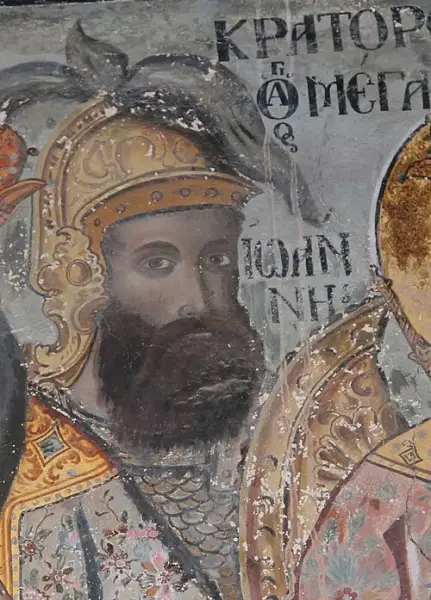
Overview
John Tornike, called Ioane Tornik'e in Georgian and Ioannes Tornikios in Greek, was a noble Georgian commander who abandoned a distinguished military career for the ascetic life on Mount Athos. Born around 920 into the family of Chordvaneli, he rose to the rank of eristavi under the Bagratid rulers and also received the Byzantine dignity of patrikios while serving as a general of David III of Tao. Around 963 he laid down his command and received the monastic habit at the Lavra of Athanasius, taking the name Ioane. Public affairs soon interrupted his retreat: when Bardas Skleros rebelled against Emperor Basil II in 976, the young emperor summoned the monk-general to Constantinople, and Tornike obtained twelve thousand Georgian horsemen from David III. The rebels were crushed at Pankalia in 979. Laden with imperial favors, he returned to the Holy Mountain and devoted the spoils, including twelve kentenaria of gold, to building the Iviron Monastery, which he directed as ktetor alongside Abbot John the Iberian until his death in 985.
The Complete Life
A Noble Birth in the Kingdom of the Iberians
Tornike came into the world around 920 among the great houses of the Kingdom of the Iberians, a Georgian land wedged between the Byzantine Empire and the rising Muslim powers of the frontier age. His family belonged to the immediate circle of the Bagrationi, the dynasty that was gathering the Georgian lands under its rule. His father, Chordvaneli, had traveled in the retinue of the Georgian prince Ashot II Kuropalates when that ruler paid a visit to the Byzantine emperor Constantine Porphyrogennetos at Constantinople around 950, an embassy that shows how closely his house stood to both Georgian and imperial power. The family's prominence endured after Tornike's own time: three of his nephews pursued military careers, and one of them, Varazvache, reached the high Byzantine post of katepano, or military governor, of the eastern outpost of Edessa in 1037 and 1038. A man of such a lineage could expect honors, commands, and wealth, and in his youth Tornike took full advantage of that expectation.
§ Life
From the General's Cloak to the Monk's Habit
Under the Georgian Bagratid dynasty Tornike built an exceptionally successful career in arms and at court. He held the office of eristavi, the Georgian counterpart of the Greek strategos or general, and the Byzantine court added the dignity of patrikios to his name. Yet in about 963, while serving Prince David III of Tao, he resigned his command, received the monastic name Ioane, and withdrew to the Lavra of Athanasius on Mount Athos, the growing center of Byzantine monasticism. In the early 970s his solitude was eased by the arrival of another retired Georgian officer, also named Ioane, who came with his young son Ek'vt'ime. These two would become his closest collaborators, for the son would grow into one of the great literary figures of Georgian monasticism. The choice Tornike had made was radical: a man at the height of his powers, honored by both crown and court, chose the narrow cell, the common prayer, and the daily discipline of the holy mountain over every further advancement.
§ Life
The Monk Who Saved an Empire and Built a Monastery
In 976 rebellion engulfed the Asian provinces of the Byzantine Empire. Bardas Skleros, victor in a string of battles against the loyal general Bardas Phokas, marched through Anatolia toward Constantinople in the greatest upheaval of Basil II's young reign. The emperor summoned John-Tornike to the capital to mediate an alliance with David III of Tao, and the monk consented reluctantly, persuaded by his brethren that obedience would serve the whole Athonite community. David answered vigorously, placing some twelve thousand Georgian cavalry under his former general. On March 24, 979 the decisive engagement was fought at Pankalia near Caesarea, and the rebels went down to crushing defeat. The rewards transformed Georgian Athos: David received lands in northeastern Anatolia for life, Tornike was named synkellos of the Patriarchate of Constantinople, and the monk-general went home carrying precious objects and twelve kentenaria of gold, imperial grants, subsidies, and tax exemption. With these resources the Georgians raised their own house, Iviron, Tornike governing it as ktetor and John the Iberian as hegoumenos.
§ Founding of Iviron monastery
The House of the Iberians Endures
The monastery Tornike founded with his spoils of war grew into a fountainhead of Georgian Christian culture, where the Scriptures were transcribed, prayer rose up in the Georgian tongue, and the bonds between Georgia and Byzantium were woven tighter generation after generation. Although Greeks later came to populate the house, it is known to this day by the Greek appellation Iviron, meaning 'of the Iberians,' a permanent memorial to the Georgian monks who built it. The frescoes of Iviron still portray Tornike among the Athonite Fathers, and the Eastern Orthodox Church venerates him with a feast on June 12. His patronage is invoked for Georgia and for Mount Athos themselves, the two loves of his life. Few figures of the tenth century embody so completely the paradox of holy worldliness renounced: the general whose single campaign saved an emperor used the very rewards of that campaign to found a house of prayer that outlived every empire of his age.
§ Founding of Iviron monastery
Timeline
- 950
His father Chordvaneli accompanied Prince Ashot II Kuropalates on a state visit to Emperor Constantine Porphyrogennetos in Constantinople.
§ Life
- 963
Resigned his post as general of David III of Tao and retired as a monk named Ioane to Athanasius' Lavra on Mount Athos.
§ Life
- 970
Was joined on Athos in the early 970s by the retired Georgian officer Ioane and the latter's son Ek'vt'ime.
§ Life
- 976
The rebellion of Bardas Skleros erupted in the Asian provinces, the gravest crisis of Basil II's early reign.
§ Life
- 24 Mar 979
The Georgian relief force he commanded helped destroy Skleros' rebels at the battle of Pankalia near Caesarea.
§ Life
- 985
Died on Mount Athos, having established the Georgian house of Iviron with his war spoils.
§ Life
The Record
- Major works
- Iviron Monastery on Mount Athos, founded as a center of Georgian Orthodox culture
- Patron of
- Georgia·Mount Athos
- Canonization
- Pre-congregation; venerated in the Eastern Orthodox Church
Prayer
Bibliography
Show 6 sources
- Morris, R. (2002). Monks and Laymen in Byzantium, 843–1118. Cambridge University Press. pp. 85–86. ISBN 0-521-26558-4.
- Bogveradze, A. (1979). Georgian Soviet Encyclopedia, Vol. 4. p. 695.
- Zhordania, T. (1893). Chronicles, Vol. I.
- S. Kaukhchishvili, ed. (1963–1966). Georgica. Byzantine Authors' Reports on Georgia, Vols. IV–V, VI.
- Metreveli, E. (1996). Essays on the Cultural and Educational Centers of Athos.
- Lomouri, N. On the History of Bardas Skleros' Rebellion. Tbilisi State University Works, No. 67.
Profile text adapted from the Wikipedia article, licensed CC BY-SA 4.0.
Pray with this saint every day
Save St. John Tornike to your favorites, read the full profile, and get feast-day reminders in the Saints app.
Get the Saints AppFree on the App Store for iPhone and iPad