
1320 – 1379·Feast October 21
St. John Twenge
Prior of Bridlington and wonderworker of Yorkshire
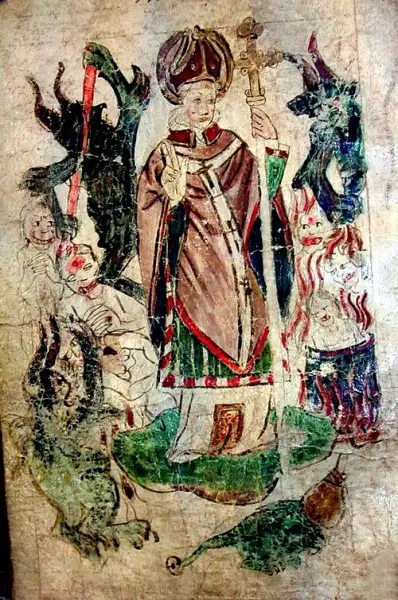
Overview
John Twenge, better known as St. John of Bridlington, was an English Augustinian canon of the fourteenth century whose holiness drew the admiration of his own generation. He came into the world in 1320 at Thwing, high among the Wolds of Yorkshire, and began his schooling in the village before finishing his education at Oxford and entering the community of Canons Regular at Bridlington Priory. There he served successively as novice master, almsgiver, preacher, and sub-prior, became a canon of the priory in 1346, and after long hesitation accepted election as prior, taking up the office in January 1362 and holding it for seventeen years until his death on October 10, 1379. Contemporaries praised the integrity of his life, his learning, and his unostentatious generosity, and credited him with miracles both during his life and after it. His cause moved quickly: evidence was gathered on the order of the Archbishop of York in 1386, and Pope Boniface IX canonized him on September 24, 1401. He was the last English saint to receive canonization before the English Reformation.
The Complete Life
A Yorkshire Boy of Thwing
John Twenge was born in 1320 in the village of Thwing, high on the Yorkshire Wolds and about nine miles west of the sea town of Bridlington. He belonged to the Yorkshire family of Twenge, a house whose faith would long outlive him: during the English Reformation it would give the Church two Roman Catholic priest-martyrs, and its members would also be instrumental in establishing the Institute of the Blessed Virgin Mary at Bar Convent in York. His education began early and locally, for he was sent to the village school at the age of five. From those modest beginnings his studies carried him to Oxford University, then the intellectual center of England, where he completed his formation. Nothing in the record suggests privilege or ease; the boy from the Wolds climbed by diligence and talent through the schools of his day. It was a preparation that fitted him strangely well for the life he would choose, joining as it did the discipline of the classroom with the plain piety of the Yorkshire countryside in the generation before the Black Death.
§ Life
Canon of Bridlington
On completing his studies at Oxford, John entered the community of Augustinian Canons Regular at Bridlington Priory, one of the great religious houses of the East Riding. There he carried out his duties, in the words of those who recorded his life, with humility and diligence, and the community entrusted him in turn with a widening circle of responsibilities: novice master, charged with forming the young canons; almsgiver, dispenser of the priory's charity to the poor; preacher; and finally sub-prior. In 1346 he became a Canon of the Priory. His reputation within the community grew to the point that in 1356 the canons elected him their Prior. True to the humility that had marked his whole religious life, he declined the office. When the community elected him again, probably in 1361, he no longer felt free to refuse, and in January 1362 he took up the duties of prior. He would exercise that office for seventeen years, until his death, ruling one of Yorkshire's most important houses through years of plague, war, and social upheaval.
§ Life
Integrity, Scholarship, and Quiet Generosity
The tradition that preserved John's memory singled out three qualities above all: an uncorrupted manner of living, deep learning, and charity given without display. These were not spectacular virtues, and that is precisely why his contemporaries found them convincing. In an age when religious houses were often accused of worldliness, the prior of Bridlington was commended for a goodness so consistent that it seemed to need no ornament. His reputation for holiness was joined in the popular mind to a reputation for miraculous power. Reputedly he changed water into wine on one occasion, an echo of Cana performed at a Yorkshire priory. On another, five sailors out of Hartlepool, their vessel on the point of going down, implored God through the merits of His servant John — whereupon the prior, seen in his canonical habit, stood before them and steered the ship into port unharmed. The saved men abandoned their vessel at the harbor and made their way on foot to the monastery, thanking John face to face for the deliverance. Such stories, told of a living prior, show how completely his neighbors identified him with the mercy of God.
§ Miracles attributed to him
Seventeen Years as Prior
From January 1362 until his death in 1379 John governed Bridlington Priory as its prior, completing seventeen years of leadership. The office made him responsible for the worship, discipline, estates, and charity of a large community of Canons Regular, and the sources describe his tenure as an exercise of the same virtues that had marked his service in lesser offices. He died on October 10, 1379, from natural causes, in the priory he had served since leaving Oxford. His memory did not rest in the grave. A medieval vision known as the Vision of William Staunton, preserved in manuscripts of the British Library, recounts how a visitor to St. Patrick's Purgatory is conducted through purgatory and the earthly paradise by St. John of Bridlington himself, together with St. Ive — a sign that within a few years of his death the prior of Bridlington had passed into the imaginative world of English Christianity as a guide between this world and the next. The prior who had shrunk from authority became, after death, a patron with authority in heaven.
§ Life
From Local Cult to Papal Canonization
After John's death the fame of the miracles worked through his intercession spread rapidly through the land. On July 26, 1386, Alexander Neville, Archbishop of York, ordered his suffragans and other officials to gather testimony for the cause — public homage, in effect, outrunning the formal machinery. On March 11, 1404, Richard le Scrope, who held the see of York from 1398 to 1405, presided — joined by the bishops of Durham and Carlisle — over the pope-commanded ceremony that moved the saint's remains to a new shrine. Boniface IX, the same pope, had already canonized John on September 24, 1401. The canonization itself was doubted and disputed in later centuries, and the question closed only when T. A. Twemlow, a scholar working in Rome on behalf of the British government, recovered the original bull from the Vatican archives. John thus stands as the last English saint canonized before the English Reformation. His shrine, described as magnificent, was destroyed in 1537 despite an appeal to Henry VIII to spare it; only the restored nave of 1857 now remains of the priory church.
§ Death and canonisation
Patron of Fishermen and of Mothers
Devotion to St. John of Bridlington attached itself to the working life of his region. Women in difficult labour may pray to him as their patron saint, and he is associated with the local fishing industry — an association reflected in his emblems, for a wooden panel at St. Andrew's Church, Hempstead in Norfolk portrays him with a fish in hand, arrayed in a bishop's vestments despite never occupying an episcopal see. Kings invoked him in war: Henry V credited his triumph at Agincourt to the heavenly prayers of this John and of John of Beverley. His memory remains woven into the places he sanctified. At All Saints Church, Thwing, a window of the 1950s shows him alongside St. Cecilia; Bridlington keeps a St. John Street, a venerable lane joining the Old Town that clustered round the priory to the quayside quarter of fisherfolk and traders. The sole surviving witness to the music of his Office stands in the Wollaton Antiphonal; the canons regular mark his feast on October 9, and the general calendar on October 21.
§ Veneration
Timeline
- 1320
Born at Thwing on the Wolds of Yorkshire, roughly nine miles to the west of Bridlington.
§ Life
- 1346
Became a Canon of Bridlington Priory after his studies at Oxford.
§ Life
- 1356
Was elected Prior of Bridlington but declined the office out of humility.
§ Life
- Jan 1362
After re-election, probably in 1361, took up the duties of Prior, which he exercised for seventeen years.
§ Life
- 10 Oct 1379
Died at Bridlington after leading the priory through nearly two decades.
§ Life
- 26 Jul 1386
Archbishop Alexander Neville of York charged his suffragans to collect evidence toward canonization.
§ Death and canonisation
- 24 Sep 1401
Canonized by Pope Boniface IX, the last English canonization before the Reformation.
§ Death and canonisation
- 11 Mar 1404
Archbishop Richard le Scrope presided, with the bishops of Durham and Carlisle attending, over the pope-commanded ceremony moving the saint's remains to a shrine.
§ Death and canonisation
- 1537
His magnificent shrine at Bridlington was destroyed at the English Reformation despite appeal to Henry VIII.
§ Death and canonisation
- 1857
The nave of the priory church was restored, and it remains all that survives of Bridlington Priory.
§ Death and canonisation
The Record
- Major works
- Service as novice master, almsgiver, preacher, sub-prior, and Prior of Bridlington Priory
- Patron of
- women in difficult labour·fishermen
- Symbols
- fish·book·crozier·fur almice·muzzled animal at his feet
- Canonization
- Canonized 24 September 1401 by Pope Boniface IX
Prayer
Bibliography
Show 5 sources
- Wilson, Mike. "St John of Bridlington", Bridlington.net
- Eileen Gardiner, Medieval Visions of Heaven and Hell: A Sourcebook (New York: Garland, 1993), 153–54.
- "CATHOLIC ENCYCLOPEDIA: St. John Twenge". www.newadvent.org. Retrieved 21 July 2020.
- Holman, Tom (2008). A Yorkshire Miscellany. France's Lincoln Ltd. p. 63. ISBN 978-0711228658.
- St Andrew, Hempstead at The Norfolk Churches Site
Profile text adapted from the Wikipedia article, licensed CC BY-SA 4.0.
Pray with this saint every day
Save St. John Twenge to your favorites, read the full profile, and get feast-day reminders in the Saints app.
Get the Saints AppFree on the App Store for iPhone and iPad