
c. 1620 – 1679·Feast July 12
St. John Wall
Franciscan friar and martyr of the Popish Plot
Overview
John Wall, known in religion as Friar Joachim of St. Ann, was an English Franciscan priest put to death in the hysteria of Titus Oates's fabricated Popish Plot. Born around 1620 at Preston in Lancashire to a wealthy and staunchly Catholic family, he was sent while still young to the English College at Douai, where he went under the alias John Marsh to escape the government's informers. He entered the English College in Rome in November 1641, was ordained a priest in December 1645, and departed for the English mission in 1648 under yet other assumed names. In 1651 he joined the Order of Friars Minor at St. Bonaventure's Friary in Douai, served as master of novices, and returned to England in 1656, settling in Worcestershire, where he ministered for twenty-two years and served as a governor of the Royal Grammar School Worcester. Arrested in December 1678, he refused the Oath of Supremacy, was tried at Worcester in April 1679, and, though cleared of all plotting in London, was executed on Red Hill on August 22, 1679 amid the tears of a largely Protestant crowd. He was canonized by Pope Paul VI in 1970 among the Forty Martyrs of England and Wales.
The Complete Life
A Son of Catholic Lancashire
John Wall was born around 1620 at Preston in Lancashire, the son of wealthy parents who belonged to that county's stubborn tradition of recusant Catholicism. His family paid the price of their faith openly: his brother William also became a priest, entering the Benedictine order, and was later arrested and condemned for his priesthood, though he was reprieved and survived. In an England where the old religion was outlawed and the education of Catholic boys abroad was watched by the government's agents, John was sent when very young to the English College at Douai in the Spanish Netherlands, the great seminary for English mission priests. Even as a student he lived under a false name, calling himself John Marsh, because the English government kept spies and informers on the continent to track those preparing for the illegal priesthood at home. The boy thus learned early the disciplines of the mission he would one day walk: disguise, prudence, and the quiet assumption that fidelity to Rome might cost him everything. It was from this world of clandestine seminaries and hunted vocations that one of the most intellectually gifted English priests of his generation emerged.
§ Life
Priest of Rome, Friar of Douai
On November 5, 1641, John Wall entered the English College in Rome, the other great nursery of English Catholic clergy, and there he was ordained a priest on December 3, 1645. Within two years the college sent him toward the English mission: on May 12, 1648 he set out under the aliases Francis Johnson and Dormore, and through the following years he celebrated the forbidden Mass in Catholic homes, sustaining the sacramental pulse of families who would not conform. But Wall's vocation deepened beyond the missionary priesthood. He returned to Douai, and on January 1, 1651 he joined the Order of Friars Minor at St. Bonaventure's Friary, taking the religious name Joachim of St. Ann. His abilities were quickly recognized, and he was soon named master of novices, forming the next generation of Franciscans in the friary that served as the spiritual home of the English Franciscan mission. He held that office until 1656, when obedience called him back to the dangers of England, this time under the name Francis Webb. The route of his life — Lancashire, Douai, Rome, the mission, the friary, and the mission again — traced the whole geography of English Catholic survival.
§ Life
Twenty-Two Years on the Worcestershire Mission
Settling in Worcestershire in 1656 under his final alias, Francis Webb, Wall spent the remaining decades of his life in unbroken service to the Catholics of the region. His ministry combined the classic work of the missionary priest with an unusual public role: he became a Governor, one of the Six Masters, of the Royal Grammar School Worcester, an office that placed a Catholic friar, however disguised, in the government of a public institution. For twenty-two years he said Mass, reconciled penitents, and sustained the faith of households living under penal legislation. Among the clergy of the English mission his standing as a scholar was unmatched — quite possibly the ablest mind of his priestly generation — and that learning shaped both his preaching and the esteem he enjoyed. The end began without drama: in December 1678, at Rushock Court by Bromsgrove, an officer of the sheriff who was hunting a debtor stumbled upon him in the first wave of arrests touched off by Titus Oates's alleged plot. Offered the Oath of Supremacy, he declined, and Worcester Gaol received him. When he stood trial on April 25, 1679, the fatal witness against his priesthood was a man whose vices he had once rebuked.
§ Life
Innocent of Plot, Faithful unto Death
Condemned at Worcester, Wall was sent to London, where the architects of the Popish Plot examined him four times, hoping to entangle the learned friar in their fabrications of conspiracy. Oates, Bedloe, and their allies failed completely: he was declared innocent of all plotting. His judges went further and offered him his life on one condition — that he abjure his religion. He refused. The bargain countless compromised men accepted in those years had no hold on a priest who had worn false names all his life so that the old faith might endure. Worcester received him back, and he died on Red Hill on August 22, 1679, at fifty-eight or fifty-nine years of age. Locals held him in deep esteem, and the tears of the crowd betrayed where their sympathies lay. Many of the onlookers, mostly Protestants, wept openly, and the Sheriff reportedly cried out asking whether this would end Popery, saying it was the way to make them all Papists. The martyrdom meant to terrify English Catholicism instead exposed, before its own people, the injustice of the plot that produced it.
§ Life
From the Gallows to the Altar
The martyr's remains were treated with the reverence his judges denied him. Friends received his quartered body and laid it to rest in the graveyard beside Worcester's church of St. Oswald, while his head crossed the Channel to the Franciscan friary of Douai — the house of his profession, and still his chief shrine. Veneration followed the slow path of English Catholic recovery: he was beatified by Pope Pius XI on December 15, 1929, and canonized by Pope Paul VI on October 25, 1970, together with the Forty Martyrs of England and Wales, the cloud of priests, religious, and laypeople put to death for the faith between the Reformation and the Popish Plot. The Franciscan Order once kept his memory on August 22, the day he died; the observance now falls on July 12, held jointly with his brother friar in martyrdom, John Jones. The Archdiocese of Birmingham honors him on August 23, and he is recalled besides on October 25 with the Forty Martyrs and on October 29 among the Douai Martyrs.
§ Veneration
Memory in Worcester and Birmingham
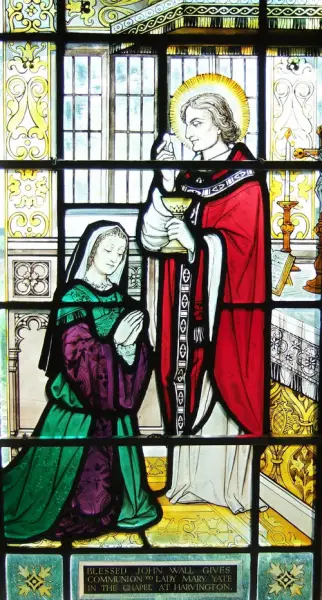
St. John Wall's memory lives on most vividly in the institutions that bear his name and the images that preserve his story. St John Wall Catholic School in Birmingham is named after him, carrying his example to new generations of Catholic students. At Harvington Hall, the recusant house in Worcestershire with its hidden rooms, a stained glass window shows the martyr celebrating Mass in one of the secret chambers of that house — an image that gathers up his whole life of clandestine priesthood in a single scene. In art he is depicted with the martyr's palm, the crucifix, the chalice and the Eucharist, holding a rope or noose, and with a book or bible, sometimes clothed in the Franciscan habit he wore as Friar Joachim of St. Ann. As one of the Forty Martyrs of England and Wales and one of the Douai Martyrs, he belongs to the company that keeps alive the memory of the penal era for English-speaking Catholicism. The intellectually brilliant friar, offered his life if he would abandon his religion and refusing the bargain, remains a witness that neither learning nor prudence was ever his final allegiance.
§ Veneration
Timeline
- 1620
Born at Preston, Lancashire, into a wealthy and staunch Catholic family.
§ Life
- 5 Nov 1641
Entered the English College in Rome, having studied from youth at the English College, Douai.
§ Life
- 3 Dec 1645
Ordained a Catholic priest in Rome.
§ Life
- 12 May 1648
Sent on the English Mission under the aliases Francis Johnson and Dormore, saying Mass for recusant households.
§ Life
- 1 Jan 1651
Joined the Order of Friars Minor at St. Bonaventure's Friary, Douai, taking the name Joachim of St. Ann.
§ Life
- 1656
Having formed the novices, went back to England as Francis Webb and made his home in Worcestershire.
§ Life
- Dec 1678
Apprehended at Rushock Court near Bromsgrove and committed to Worcester Gaol for refusing the Oath of Supremacy.
§ Life
- 25 Apr 1679
Tried and condemned at Worcester after a man whose vices he had reproved testified to his priesthood.
§ Life
- 22 Aug 1679
Executed on Red Hill, Worcester, after four examinations before Oates and Bedloe found him innocent of plotting.
§ Life
- 15 Dec 1929
Beatified by Pope Pius XI.
§ Veneration
- 25 Oct 1970
Canonized by Pope Paul VI among the Forty Martyrs of England and Wales.
§ Veneration
In Their Own Words
Will this end Popery? This is the way to make us all Papists!
The Record
- Major works
- Twenty-two years of missionary service to the Catholics of Worcestershire·Master of novices at St. Bonaventure's Friary, Douai·Governor (Six Master) of the Royal Grammar School Worcester
- Symbols
- martyr's palm·crucifix·chalice·Eucharist·rope or noose·book or bible·Franciscan habit
- Canonization
- Beatified 15 December 1929 by Pope Pius XI; canonized 25 October 1970 by Pope Paul VI
Prayer
Bibliography
Show 6 sources
- Stanton, Richard. A Menology of England and Wales, Burns & Oates, 1887, p. 407
- "Saint John Wall", Franciscan Media
- Whitfield, Joseph Louis. "Venerable John Wall." The Catholic Encyclopedia Vol. 15. New York: Robert Appleton Company, 1912.
- Duffy, Patrick. "The Forty Martyrs of England and Wales", Catholic Ireland, 25 October 2012
- Leicester, Hubert A. (1930). Forgotten Worcester. Worcester: Ebenezer Baylis. p. 30.
- Kenyon, J.P. The Popish Plot. Phoenix Press reissue 2000.
Profile text adapted from the Wikipedia article, licensed CC BY-SA 4.0.
Pray with this saint every day
Save St. John Wall to your favorites, read the full profile, and get feast-day reminders in the Saints app.
Get the Saints AppFree on the App Store for iPhone and iPad