
died 1900·Feast July 9
St. John Zhang Jingguang
Seminarian and Martyr
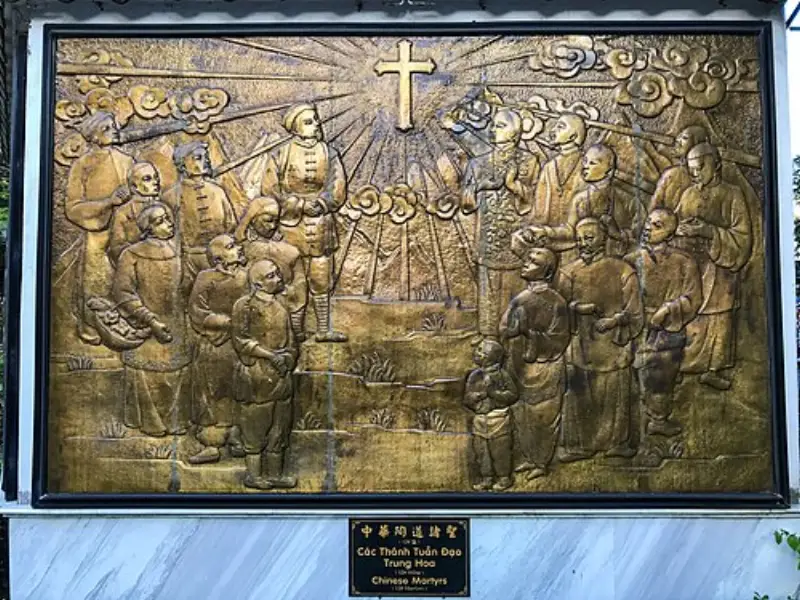
Overview
John Zhang Jingguang was a Chinese seminarian of the Secular Franciscans attached to the Franciscan mission at Taiyuan in Shanxi. He is remembered as one of the eleven Secular Franciscans, all Chinese, who belonged to the wider Franciscan family that perished in that city. When the Boxer uprising overwhelmed Shanxi in the summer of 1900, he was put to death on 9 July 1900 in the massacre at Taiyuan alongside bishops, priests, religious sisters, and laypeople — one flock under one stroke. John Paul II canonized him on 1 October 2000 among the 120 Martyr Saints of China.
The Complete Life
Early Life
John Zhang Jingguang was a Chinese seminarian of the Secular Franciscan Order attached to the Franciscan mission at Taiyuan in Shanxi. The Secular Franciscans of that mission, eleven in all and all Chinese, belonged to the wider Franciscan family of the city: friars of the First Order, Franciscan Missionaries of Mary, seminarians preparing for priesthood, and lay members of the third order. The record that survives of Zhang is that of the group rather than the individual; the biographies of the 120 Martyr Saints of China carry his name, his status, and the manner of his death, and the details of his family and early years have not come down in the general sources. He is one of the majority of the 120 who were Chinese rather than foreign missionaries.
Mission and Ministry
As a seminarian and Secular Franciscan, Zhang's part in the mission was formation rather than command: study for the priesthood under the friars, participation in the prayer and work of the Taiyuan household, and service to the Catholic congregation of the city. The Shanxi mission in 1900 was under strain that its members understood well, since the Boxer movement had been spreading through the province with official encouragement, and the Catholic community was a known target. The seminarians did not scatter when the crisis broke; the sources remember them as having stayed with the community to which they belonged, which is the substance of their witness.
Trial and Final Years
In the summer of 1900 the Boxer uprising overwhelmed Shanxi. Zhang was put to death on 9 July 1900 in the massacre at Taiyuan, alongside the bishops Gregorio Grassi and Francis Fogolla, the priests and brothers of the mission, the seven Franciscan Missionaries of Mary, and the lay faithful of the city, one flock under one stroke. His death with the whole Franciscan family of Taiyuan made him one of the eleven Secular Franciscans, all Chinese, whom the group of martyrs includes, and one of the youngest ranks of the church's dead in that persecution. The uprising that killed him had travelled from Shandong through Shanxi and Hunan, its ranks swollen by the flood of 1898 and the drought of 1898-1900; in the rebellion as a whole some thirty thousand Chinese converts were slaughtered alongside missionaries and other foreigners. Taiyuan's slaughter of bishops, friars, sisters, seminarians and lay people in a single July day became its most remembered single act.
Canonization
Zhang was beatified by Pope Pius XII with the martyrs of Taiyuan on 24 November 1946, and canonized by Pope John Paul II on 1 October 2000 among the 120 Martyr Saints of China. The canonization deliberately joined Chinese laity, catechists, seminarians, and clergy with the foreign missionaries who had died among them, so that the group of 120 counts eighty-seven Chinese and thirty-three Westerners. He shares the common optional memorial kept on 9 July, the anniversary of the Taiyuan massacre. His beatification on 24 November 1946 fell within the largest single group Pius XII raised from the China causes, twenty-nine martyrs of the Franciscan family; further groups followed in 1951, 1955 and 1983 before the canonization of 2000 closed the sequence.
Legacy
Zhang's legacy lies in what his presence in the canonized group asserts: that the church of the Chinese martyrs was Chinese, and that its dead included students and lay members as well as bishops and missionaries. For the Secular Franciscan Order he and his ten companions are a specific memory, the Chinese tertiaries of Taiyuan, and the order keeps their names among its martyrs of the modern era. In the local church of Shanxi the martyrs of 1900 remain the anchor of a continuous Catholic identity that has outlasted the politics that sought to end it. History added a coda the martyrs did not live to see: the failed rebellion opened decades of growth, so that by 1925 eight thousand missionaries worked in China and the first native Chinese bishops were consecrated in 1926. In that longer arc the seminarians of Taiyuan stand for the native clergy that was already forming when the blow fell.
Timeline
- 9 Jul 1900
Killed in the Taiyuan massacre alongside bishops Gregorio Grassi and Francis Fogolla, the friars, and the lay faithful of the city.
§ Martyrs of the Boxer Rebellion
- 24 Nov 1946
Beatified by Pope Pius XII among the twenty-nine martyrs beatified that day.
§ Introduction
- 1 Oct 2000
Canonized by Pope John Paul II among the 120 Martyr Saints of China.
§ Introduction
The Record
- Canonization
- Canonized by Pope John Paul II on 1 October 2000, among the 120 Martyr Saints of China
Prayer
Profile text adapted from the Wikipedia article, licensed CC BY-SA 4.0.
Pray with this saint every day
Save St. John Zhang Jingguang to your favorites, read the full profile, and get feast-day reminders in the Saints app.
Get the Saints AppFree on the App Store for iPhone and iPad