
1888 – 1925·Feast October 20
St. Jonah of Hankou
Bishop of Manchuria and orphan's father
Overview
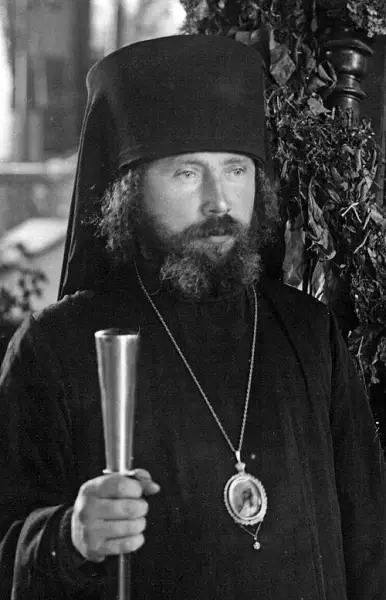
Bishop Jonah of Hankou, born Vladimir Ilyich Pokrovsky, was a bishop of the Russian Orthodox Church Outside Russia who served the refugee Church in northern China in the years after the Bolshevik Revolution. Orphaned in Kaluga at the age of eight, he was taken in by a deacon, educated at the Kazan Theological Academy, and there tonsured a monk of the Optina Brotherhood, taking the name Jonah; he joined the Academy's teaching staff only in obedience to Elder Gabriel of Optina. The Revolution of 1918 drove him from Kazan into suffering: arrested by the communists, he was beaten to the point of unconsciousness and imprisoned, then freed by the White Army and made igumen and senior priest of the southern volunteer troops. He withdrew with General Dutov's army across the Pamirs and the Gobi Desert to Beijing, where he joined the Ecclesiastical Mission and was soon consecrated bishop. Though titular bishop of Hankou, he ministered in the border town of Manzhuria, whose Orthodox community he transformed in a few short years by establishing an orphanage, a school, and a soup kitchen for the destitute. He died on October 20, 1925, of blood poisoning contracted while nursing a priest sick with typhoid, and the healing of a crippled boy on the night of his death began the veneration that led to his glorification.
The Complete Life
An Orphan of Kaluga
Vladimir Pokrovsky was born in Kaluga on April 17, 1888, into a Russia whose Church life still breathed the spiritual inheritance of Optina Hermitage. His childhood was broken early: orphaned at the age of eight, he might have vanished into the anonymity of a provincial century, but a deacon took him in and saw that he was educated. Books became his path. He entered the Kazan Theological Academy, graduated from it, and in time joined its teaching staff — a post he accepted, characteristically, not as a career but out of obedience to the Elder Gabriel of Optina. While still a student at the Academy he was tonsured a monk of the Optina Brotherhood and given the name Jonah. The double formation of his youth deserves notice: an orphan raised by the Church's mercy, and a monk formed in the school of the Optina elders, whose blend of learning, obedience, and tenderness for the suffering would mark everything he later did. The boy who lost his parents would one day build an orphanage in the wastes of Manchuria; the student who taught only in obedience would one day govern a diocese with the same deference to God's will.
§ Life
Revolution, Prison, and the Road East
The Revolution of 1918 turned the young hieromonk's life into an epic of exile. Expelled from Kazan, he fell into communist hands and endured beatings fierce enough to render him unconscious, followed by imprisonment; his liberation came from the White Army, which soon raised him to the rank of igumen and appointed him senior priest of the southern volunteer troops. When those forces collapsed, Father Jonah shared the great retreat of the defeated: he withdrew with the army of Alexander Dutov toward the borders of Western China, enduring terrible hardships in the crossing of the Pamir cliffs, where with wounded hands he was often forced to cling to sparse shrubbery and the jagged, ice-covered ledges of the rocks. Then came the Gobi Desert, and at last Beijing, where he was received into the Russian Ecclesiastical Mission and soon consecrated a bishop. His title was bishop of Hankou in Hubei province, but his actual charge was Manzhuria — the frontier town now called Manzhouli, on the border through which the fleeing Russians poured into China. A monk formed in the quiet of Optina was made, by history, the shepherd of a people in flight.
§ Life
Building Mercy at the Frontier
Bishop Jonah's episcopate lasted only a few years, but in that short time he transformed the Orthodox community of Manzhuria. The town was a railway border settlement filled with refugees, soldiers, orphans, and the destitute — precisely the people his own life had prepared him to love. He answered with institutions, not merely sentiments: he established an orphanage for the abandoned children of the exile, a school so that the fleeing nation's children would not grow up unlettered, and a dining hall that fed the poor of the settlement. It was the mercy he had himself received at the age of eight, multiplied and handed on. His diary and sermons — a sermon on Pascha among his surviving works — show a bishop wholly given to this flock. The work could not last: he was thirty-seven years old, worn by imprisonment, desert crossings, and ceaseless labor, when typhoid came to Manzhuria. Nursing a priest sick with the fever, Jonah contracted the illness himself, and from chronic tonsillitis there followed complications and blood poisoning. The shepherd caught the dying man's disease in the act of carrying him — the pattern of his whole episcopate in a single act.
§ Life
A Holy Death and a Gift of Legs
Jonah knew he was dying and prepared with perfect freedom. He composed a last letter to his people, urging them to hold fast to mutual love; then he made a final confession to Archbishop Methodius of Beijing and received Holy Communion; he blessed those gathered in his room. Then, clothed in the epitrachelion and cuffs that had belonged to the Optina elder Ambrose — the tradition of his tonsure reaching out to hold him at the end — he began chanting the office for the departing soul, aloud and bowing low, until weakness finally overwhelmed him and he lay down on his bed and said, 'God's will be done. Now I shall die,' and died within minutes, on October 7/20, 1925. That same night, in the same town, a ten-year-old boy named Nicholas Dergachev lay crippled by an inflammation of the knee joints, unable to walk or even stand after every medical effort had failed. He dreamed of a hierarch vested in white, who offered the boy his own legs, saying he had no further need of them and asking for the boy's in exchange. The child woke miraculously healed, and from a photograph he identified the hierarch as Bishop Jonah, who had died that very night. The veneration of the new saint began, as it were, before his funeral.
§ Death
Righteous One of the Diaspora
Jonah's memory endured long after his death, kept alive by the refugee Church he had served. St John (Maximovitch), archbishop of Shanghai and San Francisco, held him up as proof that holiness had not died with old Russia, testifying in his Sermons that the diaspora still had righteous ones of its own day, not yet glorified, from whom the faithful were receiving wondrous signs — Bishop Jonah of Manchuria among them. The formal recognition followed decades later. The Russian Orthodox Church Outside Russia officially glorified Bishop Jonah on October 20, 1996 — the anniversary of his repose — publishing the decree for his glorification and a translated life in Orthodox Life that same year. On February 3, 2016, the Bishop's Council of the Russian Orthodox Church of the Moscow Patriarchate canonized him among the saints of the whole Church under the title Enlightener Jonah of Hankou, healing the institutional divisions of the exile by jointly honoring its missionary bishop. He is commemorated on October 20 new style (October 7 old style), and stands as the chief saint of the Russian diaspora in China — a bishop whose orphanage outlasted him in the gratitude of the people he fed.
§ Death
The Search for the Grave
Unlike most saints, Jonah has no known tomb. The town of Manzhouli, where he died and was buried, passed through decades of upheaval, and the site of his grave was lost. In July 1994 an attempt was made to excavate his relics, guided by those who remembered the old Orthodox cemetery, but the grave could not be found. In 1997 fresh details came to light that may at last have pinpointed the spot, and documents on the search for the relic of St Jonah in Manzhouli have been preserved, yet no second attempt has been undertaken. The uncertainty has not diminished his veneration. His icon hangs in the parishes of the Russian diaspora, the service composed in his honor is sung on his feast, and his life is retold in both Russian and English — the deacon's orphan who became a bishop of the exiles. His grave may yet give up its relics; meanwhile the Church holds his memory as the treasure the communists and the frontier could not destroy. In him ROCOR honors its first glorified saint of the Chinese mission, and the Moscow Patriarchate an enlightener of Manchuria — one man, canonized twice over, belonging to the whole Church.
§ Relics
Timeline
- 17 Apr 1888
Born in Kaluga, Russia, with the secular name Vladimir Ilyich Pokrovsky.
§ Life
- 1896
Orphaned at the age of eight and taken in by a deacon who ensured that he received an education.
§ Life
- 1918
Driven from Kazan by the Revolution; arrested by the communists, beaten into unconsciousness, and imprisoned before the White Army freed him.
§ Life
- 20 Oct 1925
Died of blood poisoning at Manzhuria on October 7/20, 1925, after chanting the Church's office for a soul's departure.
§ Death
- Jul 1994
An attempt to excavate his relics in July 1994 failed to locate the site of his grave.
§ Relics
- 20 Oct 1996
Officially glorified as a saint by the Russian Orthodox Church Outside Russia on October 20, 1996.
§ Death
- 1997
New information was received that may have located his grave, though no second excavation has been made.
§ Relics
- 3 Feb 2016
The Bishop's Council of the Russian Orthodox Church canonized him as Enlightener Jonah of Hankou on February 3, 2016.
§ Life
In Their Own Words
Here, take my legs. I don't need them anymore. And give me yours.
God's will be done. Now I shall die.
Already here in the diaspora we have righteous ones in our time. Although they are not yet glorified, people receive wondrous signs from them. For example Bishop Jonah of Manchuria.
The Record
- Major works
- Orphanage at Manzhuria·School for the refugee community at Manzhuria·Dining hall for the poor at Manzhuria
- Patron of
- Orphans and refugees·The Church in China
- Canonization
- Glorified by ROCOR on October 20, 1996; canonized by the Russian Orthodox Church on February 3, 2016 as Enlightener Jonah of Hankou
Prayer
Bibliography
Show 5 sources
- Bishop Jonah of Manchuria, Translated by Vera Kencis, Orthodox Life Vol. 46, No. 5 - October 1996.
- Decree for the Glorification of Bishop Jonah of Manchuria, Orthodox Life - Vol. 46 - No. 5 - October 1996.
- Bishop Jonah of Manchuria - A New Saint is Proclaimed, Orthodox America #91, July 1989.
- "Определение Освященного Архиерейского Собора Русской Православной Церкви об общецерковном прославлении ряда местночтимых святых".
- "Search for relic of St Jonah (Pokrovsky) in Manzhouli", orthodox.cn, 1-17-2008.
Profile text adapted from the Wikipedia article, licensed CC BY-SA 4.0.
Pray with this saint every day
Save St. Jonah of Hankou to your favorites, read the full profile, and get feast-day reminders in the Saints app.
Get the Saints AppFree on the App Store for iPhone and iPad