
1939 – 1965·Feast August 14
St. Jonathan Daniels
Seminarian and martyr of the civil rights movement
Overview
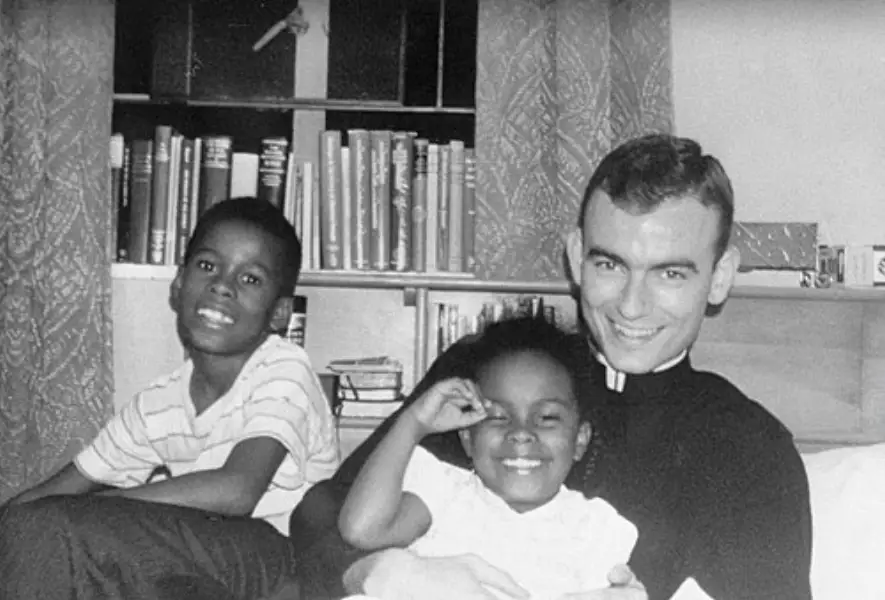
Jonathan Myrick Daniels — Episcopal seminarian and civil rights worker — died in Hayneville, Alabama, on August 20, 1965, giving his life to shield seventeen-year-old Ruby Sales from a racist attack. Born in Keene, New Hampshire, to a physician father and educated at the Virginia Military Institute, where he graduated valedictorian, Daniels considered the ministry from his high school years. A renewed sense of calling at an Easter service in Boston in 1962 led him to ordination studies at the Episcopal Theological School in Cambridge, Massachusetts. In March 1965 he answered Martin Luther King Jr.'s call for clergy and students to join the voting-rights campaign in Selma, and he stayed on, working with the Student Nonviolent Coordinating Committee to register Black voters in Lowndes County after the passage of the Voting Rights Act. Arrested with other picketers at Fort Deposit, he was held six days in the Hayneville jail; upon release he stepped in front of a shotgun aimed at Ruby Sales and was killed instantly. His death stirred broad support for the movement. In 1991 the Episcopal Church designated him a martyr, remembered each August 14, and in 2025 he was named patron of the Episcopal Diocese of Alabama.
The Complete Life
A Valedictorian from Keene
Jonathan Myrick Daniels was born in Keene, New Hampshire, on March 20, 1939, whose father, Phillip Brock Daniels, practiced medicine as a Congregationalist, and whose mother was Constance Weaver. The church drew him early: the thought of a ministerial career came to him in high school, and in young manhood he entered the Episcopal Church. The Virginia Military Institute enrolled him after graduation, and his college years brought both distinction and testing. During his studies doubts about pursuing ministry beset him, and hardship compounded them: his junior year brought his father's death, and his sister's illness strained the family's finances. He nonetheless finished at the head of his class, graduating from VMI as valedictorian. In the fall of 1961 he entered Harvard University to study English literature, a path that appeared to lead toward scholarship rather than ordination. The decisive change came at Easter: during a service at the Church of the Advent in Boston in the spring of 1962, Daniels came away newly convinced that God was calling him to his service, and within a short time had resolved on ordination.
§ Background
From Cambridge to Selma
Once his Easter conversion had settled, Daniels passed a year at home in Keene, taking odd jobs to keep his family afloat, then won admission to the Episcopal Theological School in Cambridge, Massachusetts, starting there in 1963 with graduation expected in 1966. His seminary years coincided with the crisis of the civil rights movement, and in March 1965 he answered the call of Martin Luther King Jr., who was recruiting students and clergy to join the campaign in Selma, Alabama, for the voting-rights march to Montgomery. Daniels and several seminary classmates left for Alabama intending to stay only a weekend. Circumstances intervened: Daniels and his friend Judy Upham, delayed on the march, missed the bus home and began to rethink their plan for a brief stay. Back at the seminary they asked for and received leave to devote the remainder of the semester to Selma — a decision that turned a gesture of solidarity into a vocation. Through the Selma spring the two pressed for the integration of the local Episcopal church, bringing young African Americans to its services in groups, and met a cold reception from the congregation; in May Daniels came back to Cambridge, passed his semester examinations, and turned south again.
§ Background
Registering Voters in Lowndes County
Daniels went back to Alabama in July 1965 to continue the work. He compiled a directory of agencies — federal, state, and local alike — whose aid was available to people in need, and he labored alongside the Student Nonviolent Coordinating Committee to help Black residents register to vote in Lowndes County, where he was staying. The county's Black citizens had been effectively disenfranchised, a condition the Voting Rights Act, enacted by Congress on August 2, 1965 to police the constitutional right to vote with sweeping federal enforcement, was designed to remedy. Registration work in the Black Belt carried real danger, and Daniels soon shared the risks borne by those he served. On August 14, 1965, he joined a group of twenty-nine protesters, SNCC members among them, who went to Fort Deposit to picket its whites-only stores; all were arrested and transported in a garbage truck to the jail in nearby Hayneville. Five juveniles among the protesters walked free the next day; the rest endured six days in a sweltering facility, for the authorities would take no one's bail unless bail was posted for all.
§ Civil rights work
The Door of Varner's Cash Store
Released from the Hayneville jail on August 20, 1965, without transport back to Fort Deposit, Daniels and his companions waited near the courthouse while one of their number arranged a ride. Daniels, a white Catholic priest, and two Black women activists walked to Varner's Cash Store nearby to buy a cold soft drink, one of the few local shops that served non-whites. Tom L. Coleman, an unpaid special deputy, barred the front, holding a shotgun with a pistol holstered at his side. Coleman threatened them and swung his gun toward seventeen-year-old Ruby Sales. Daniels shoved the girl to the ground and took the shotgun's full charge himself, dying on the spot. Father Richard F. Morrisroe seized Joyce Bailey and fled, a second shot tearing into his lower back and gravely wounding him before the firing ended. A grand jury indicted Coleman for manslaughter; Attorney General Richmond Flowers Sr. believed the charge should have been murder but was thwarted by trial judge T. Werth Thagard, who refused to wait for Morrisroe's recovery and removed Flowers from the case. Claiming self-defense against unarmed people, Coleman was acquitted by an all-white jury and continued as a highway engineer until his death in 1997.
§ Murder
Martyr of the Episcopal Church
News of the killing drew from Martin Luther King Jr. a tribute ranking Daniels's act among the most heroic Christian deeds he had witnessed in his long ministry. In 1991 the Episcopal Church formally designated Jonathan Myrick Daniels a martyr and set August 14 as a day of remembrance honoring his sacrifice and the whole company of the civil rights movement's martyrs, entering his name in its calendar of saints, where his name is recognized annually. He stands among the fifteen Episcopal martyrs designated since the start of the twentieth century, in the company of the church's other modern witnesses, and the church also honors Martin Luther King Jr. alongside him. The veneration has crossed denominational lines, a rare mark for a Christian of such recent memory: in 2013 the Order of Saint Luke, a religious order within the United Methodist Church, inscribed Daniels on its own calendar of saints, urging every United Methodist to keep his commemoration; and in January 2025 he was named patron of the Episcopal Diocese of Alabama, whose yearly Hayneville pilgrimage has walked the ground of his death each August since 1997.
§ Commemorations
Memory and Monuments
That a Northern seminarian of education should die shielding an unarmed girl stunned Episcopalians and many other white Americans, forcing them to face at last how violently the South upheld racial inequality. Ruby Sales, the young woman whose life Daniels saved, studied at the Episcopal Theological School, took up human rights advocacy in the capital, and founded an inner-city mission bearing his name. Memorials gathered across the decades: Walker Hancock's sculpture group The Garden of Gethsemani was dedicated to Daniels at the Abbey of Our Lady of Gethsemani in Bardstown, Kentucky; a memorial plaque was raised in the Hayneville town square in 1991 by the Promaji Club of the Virginia Military Institute; VMI created the Jonathan Daniels Humanitarian Award in 1998, with former president Jimmy Carter among the recipients, and set a memorial quote in its barracks; an elementary school in Keene bears his name; he is one of forty martyrs memorialized at the Southern Poverty Law Center's Civil Rights Memorial in Montgomery; and in 2015 Washington National Cathedral unveiled a sculpture of him on its Human Rights Porch, Ruby Sales looking on. A stained glass window at All Saints' Episcopal Church in Austin, Texas, depicts him standing beside Absalom Jones.
§ Commemorations
Timeline
- 20 Mar 1939
Born in Keene, New Hampshire, son of Phillip Brock Daniels and Constance Weaver.
§ Background
- 1961
Entered Harvard University in the fall to study English literature.
§ Background
- 1962
Felt a renewed conviction of a call to serve God during an Easter service in Boston and decided to pursue ordination.
§ Background
- 1963
Began studies at the Episcopal Theological School in Cambridge, Massachusetts.
§ Background
- Mar 1965
Answered Martin Luther King Jr.'s call and traveled to Selma, Alabama, for the voting-rights campaign.
§ Civil rights work
- Jul 1965
Returned to Alabama to continue voter registration work with SNCC in Lowndes County.
§ Civil rights work
- 2 Aug 1965
Congress passed the Voting Rights Act, providing federal oversight of the right to vote.
§ Civil rights work
- 14 Aug 1965
Arrested with twenty-eight other protesters picketing whites-only stores in Fort Deposit and jailed in Hayneville.
§ Murder
- 20 Aug 1965
Killed instantly by Tom Coleman's shotgun blast at Varner's Cash Store while shielding Ruby Sales.
§ Murder
- 1991
Designated a martyr by the Episcopal Church, with August 14 set as a day of remembrance.
§ Commemorations
- 1993
Charles Eagles's book Outside Agitator about Daniels won the Lillian Smith Award.
§ Commemorations
- 1997
Episcopal dioceses of Alabama began sponsoring a yearly pilgrimage in Hayneville each August 14.
§ Commemorations
- 1998
Virginia Military Institute created the Jonathan Daniels Humanitarian Award; recipients include Jimmy Carter.
§ Commemorations
- 2011
A New Hampshire historical marker about Daniels was erected in Keene.
§ Commemorations
- 2013
The Order of Saint Luke added Daniels to its calendar of saints and commended his commemoration to United Methodists.
§ Commemorations
- 2015
Washington National Cathedral dedicated a sculpture of Daniels on its Human Rights Porch, with Ruby Sales present.
§ Commemorations
- 2025
Named patron of the Episcopal Diocese of Alabama.
§ Commemorations
In Their Own Words
one of the most heroic Christian deeds of which I have heard in my entire ministry was performed by Jonathan Daniels
The Record
- Patron of
- Episcopal Diocese of Alabama
- Canonization
- Designated a martyr by the Episcopal Church in 1991; commemorated annually on August 14
Prayer
Bibliography
Show 7 sources
- Daniels, Jonathan Myrick (1992) [1967]. Schneider, William J. (ed.). American Martyr: The Jon Daniels Story. Harrisburg, PA: Morehouse Publishing. ISBN 978-0819215864.
- Eagles, Charles (2000) [1993]. Outside Agitator: Jon Daniels and the Civil Rights Movement in Alabama. Tuscaloosa: University of Alabama Press. ISBN 978-0817310691.
- Shattuck, Gardiner H. Jr. (2000). Episcopalians and Race: Civil War to Civil Rights. Lexington, Kentucky: The University Press of Kentucky. ISBN 0813121493.
- Hein, David; Shattuck, Gardiner H. Jr (2004). The Episcopalians. Church Publishing Incorporated. ISBN 0-89869-497-3.
- "Thomas Coleman, 86, Dies; Killed Rights Worker in '65". The New York Times. June 22, 1997.
- "50 Years Ago, A White Seminarian Gave His Life to the Civil Rights Movement". NPR. August 20, 2015.
- Campbell, Will D. (1977). Brother to a Dragonfly. New York: The Seabury Press. ISBN 0816493219.
Profile text adapted from the Wikipedia article, licensed CC BY-SA 4.0.
Pray with this saint every day
Save St. Jonathan Daniels to your favorites, read the full profile, and get feast-day reminders in the Saints app.
Get the Saints AppFree on the App Store for iPhone and iPad