
1888-1927·Feast May 21 (Saints of the Cristero War); June 26 (day of martyrdom)
St. José María Robles Hurtado
Priest, Martyr, Founder of the Sisters of the Sacred Heart of Jesus
Overview
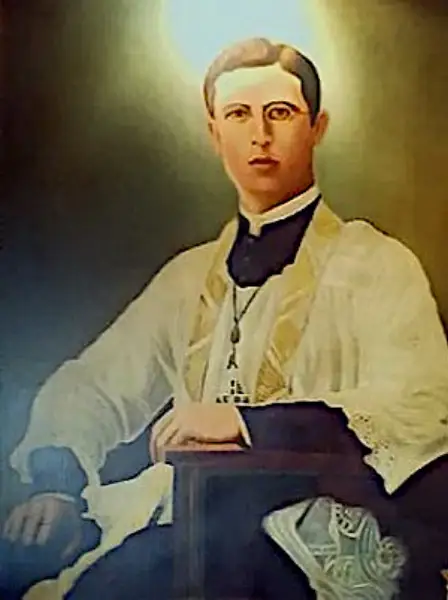
José María Robles Hurtado was born on 3 May 1888 at Mascota in Jalisco, the son of devout parents, and entered the Guadalajara seminary at twelve. Ordained in 1913 at twenty-five, he soon founded a religious congregation for women, the Sisters of the Sacred Heart of Jesus, and poured himself into catechesis at a time when Mexican law made the work dangerous. As pastor of Tecolotlán he preached devotion to the Sacred Heart and to Our Lady of Guadalupe with such fire that people called him the Madman of the Sacred Heart. He spent hours in the confessional and long nights at the bedsides of the sick, and belonged to the Knights of Columbus. When the Constitution of 1917 outlawed public worship, he answered with a bold plan: a giant cross at the geographic center of Mexico, proclaiming Christ the King of the nation. Some forty thousand Catholics gathered for the 1923 groundbreaking, and the government marked him for it. He refused invitations to go into exile, even voicing support for armed defense of the persecuted, and wrote a poem telling the Lord he wanted to love him to the point of martyrdom. Arrested on 25 June 1927 while praying in a house that sheltered him, he was hanged from an oak tree before dawn the next day, forgiving his executioners and placing the noose on his own neck so no one else would be burdened.
The Complete Life
Early Life
José María Robles Hurtado was born on 3 May 1888 at Mascota, a small town in the Sierra of Jalisco in western Mexico, the son of Antonio Robles and Petronilla Hurtado. The family was openly and staunchly Catholic, and the boy grew up in a Church still at peace with the Mexican state — the revolution that would put the two at war was more than a decade away. Drawn toward the altar while still a child, he entered the seminary at Guadalajara at the age of twelve and passed through its course of studies to ordination in 1913, when he was twenty-five. Of his boyhood and inner formation the surviving accounts say little; they were written to serve his cause, not to satisfy curiosity. What they do establish is the shape of the man: a devout son of a devout house, formed in devotion to the Sacred Heart, ordained into a priesthood that would soon be exercised under a constitution hostile to every part of his work.
§ Introduction
Conversion and Vocation
His vocation was not a turn from unbelief but a deepening of an early resolve, and its mature fruit was the founding of a religious family. A few years after ordination he established the Hermanas of the Sacred Heart of Jesus, a congregation of consecrated women through whom his pastoral energy could reach further than one parish allowed. The foundation belongs to the same years in which he was writing catechetical works to spread the faith — writing, and teaching, in ways that the laws of the country had already begun to forbid. Priesthood for him was never a career but a total gift, and the congregation he founded was its extension: he wanted the devotion he preached to outlive him, carried by women who would teach and nurse and pray when the priests could not be seen. That instinct — to build structures of faith that persecution could not reach — proved prophetic.
§ Early life
Mission and Ministry
As pastor of a parish at Tecolotlán in Jalisco he threw himself into every form of ministry the place allowed. He preached the Sacred Heart of Jesus with such intensity of word and example that people gave him the nickname by which he is still known: the Madman of the Sacred Heart. He sat in the confessional for hours at a stretch, went out to the sick at whatever hour they called, and worked to deepen his people's reverence for the Eucharist and for Our Lady of Guadalupe. He was a member of the Knights of Columbus, council 1979, one of the many Mexican knights who would supply both the charity and the defiance of the coming years. All of this he did while catechizing in ways the law made dangerous — teaching the faith quietly, steadily, and in the open wherever he judged the open was needed. His parish became a center from which devotion spread through the region.
§ Early life
Spirituality and Teaching
The heart of his spirituality is not hard to find: he wore it on his sleeve and in his nickname. The Sacred Heart of Jesus — the love of Christ made visible and wounded — was the center of his preaching, his writing, and his private prayer, and the Eucharist was its pledge. From that devotion flowed the rest: the long hours absolving sinners, the nights beside the sick, the tenderness toward the poor, and the Marian piety he shared with every Mexican Catholic of his generation. It also flowed, at the end, into something harder. He understood early that the price of fidelity might be death, and he did not treat that as a burden. In a poem written before his arrest he told the Lord plainly that he wanted to love him to the point of martyrdom — a prayer the liturgy of his life would answer within days of its being set down.
§ Early life
Trial and Final Years
The Constitution of 1917 had banned public processions and devotional practice; Robles answered it with a gesture of continental scale. He proposed raising an enormous cross at the geographic center of Mexico, a sign that the nation belonged to Christ its king, and he organized the laying of its cornerstone in open defiance of the law. In 1923 some forty thousand Catholics came to the hill then called La Loma — now known as the mountain of Christ the King — for the groundbreaking. The government responded by sharpening its persecution, and Robles in particular was marked. Invited repeatedly to leave the country, he stayed, comforting the families of the killed, and went so far as to defend the right of Catholics to take up arms in self-defense. Arrested on 25 June 1927, caught praying in the house of the Agraz family that had sheltered him, he was condemned to hang from an oak tree. Before dawn the next day he gave the executioners the votive candle from his pocket to light the way, forgave them, took the rope from the man carrying it with the words don't dirty your hands, kissed it, and set it on his own neck. He died at Quila on 26 June 1927, thirty-nine years old.
§ Persecution
Canonization
John Paul II beatified him at Rome on 22 November 1992, in the first large group of Cristero War martyrs, and canonized him on 21 May 2000 together with Cristóbal Magallanes Jara with his twenty-four companions, together with Saint María de Jesús Sacramentado Venegas — the group the Church now honors on 21 May as the Saints of the Cristero War, with his own day of martyrdom kept on 26 June. His major shrine is at Tecolotlán, the parish he served. In 2012 the Archdiocese of Guadalajara gave a first-class relic of the saint to Bishop James Wall for the chapel of the Diocese of Gallup in New Mexico — a gift with a fitting logic, since Gallup's own patron is the Sacred Heart that Robles spent his life preaching.
§ Introduction
Legacy
The congregation he founded as a young priest — the Hermanas of the Sacred Heart of Jesus — carried his work through the persecution and exist today, so that his pastoral instinct outlived the laws it defied. The cross he planted in the nation's center grew into a monumental shrine to Christ the King, the destination of pilgrimage and the standing emblem of the Catholic resistance he helped lead. Among the Cristero martyrs he is remembered as the Madman of the Sacred Heart — a nickname of mockery that devotion has kept as a title of honor — and his death has become one of the told stories of that war: the priest who took the noose from his executioner's hands so that no one else would have to carry it. For the Knights of Columbus he stands as the proof that their order's ordinary charity could be carried to the point of sacrifice.
§ Early life
Timeline
- 3 May 1888
Born at Mascota, Jalisco, to the devout Catholic family of Antonio Robles and Petronilla Hurtado.
§ Early life
- 1913
Ordained to the priesthood at Guadalajara at the age of twenty-five.
§ Early life
- 1923
About 40,000 Catholics gathered at La Loma for the groundbreaking of the Christ the King cross he had proposed.
§ Persecution
- 25 Jun 1927
Seized while praying at the house of the Agraz family, who had been sheltering him.
§ Death
- 26 Jun 1927
Hanged from an oak tree before dawn, forgiving his executioners and placing the noose around his own neck.
§ Death
- 22 Nov 1992
Beatified by Pope John Paul II.
§ Veneration
- 21 May 2000
Canonized by Pope John Paul II together with Cristóbal Magallanes and his companions, martyrs of the Cristero War.
§ Veneration
- 27 Feb 2012
The Archbishop of Guadalajara granted a first-class relic of the saint to the Diocese of Gallup for its chapel altar.
§ Relics
In Their Own Words
I want to love you until martyrdom.
Don't dirty your hands.
The Record
- Major works
- Founded the Sisters (Hermanas) of the Sacred Heart of Jesus·Wrote works of Catholic catechesis and devotion, and a poem of consecration to martyrdom
- Patron of
- Victims of religious persecution·Founders of religious congregations·The Diocese of Gallup relic chapel (Sacred Heart patrons)
- Symbols
- Priest's cassock·Noose (instrument of his martyrdom)·Sacred Heart emblem
- Canonization
- Beatified 22 November 1992 by Pope John Paul II; canonized 21 May 2000 by Pope John Paul II
Prayer
Bibliography
Show 4 sources
- 1 2 3 4 5 6 7 8 St. José María Robles Hurtado by Pedro A. Moreno Archived 2007-09-27 at the Wayback Machine
- 1 2 Patron Saints Index:Jose Maria Robles Hurtado Archived 2012-10-25 at the Wayback Machine
- ↑ Homily of Pope John Paul II at the canonization
- ↑ Letter from Patrick T. Mason, State Advocate of the NM Council of the Knights of Columbus (April 12, 2012)
Profile text adapted from the Wikipedia article, licensed CC BY-SA 4.0.
Pray with this saint every day
Save St. José María Robles Hurtado to your favorites, read the full profile, and get feast-day reminders in the Saints app.
Get the Saints AppFree on the App Store for iPhone and iPad