
1864-1929·Feast May 2
St. José María Rubio
Jesuit Priest, the 'Apostle of Madrid'
Overview
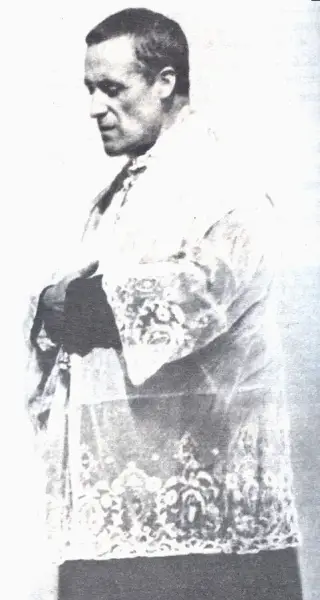
José María Rubio was born at Dalías in Almería on 22 July 1864, a farmer's son and eldest of thirteen. He entered the Almería seminary in 1876, continued at Granada under a patron who took him along to Madrid, and was ordained on 24 September 1887, singing his first Mass on the altar of Aloysius Gonzaga's conversion in Madrid's church of San Isidro. Degrees in theology and canon law followed. As a young priest he served the villages of Chinchón and Estremera with a marked austerity, teaching children catechism and seeking out the poorest; back in the capital he ministered in the suburbs among the cleaners and seamstresses and taught in the Madrid seminary. A 1904 pilgrimage in the Holy Land deepened a long-standing desire, and in 1906, aged forty-two, he entered the Jesuit novitiate at Granada, professing in 1908 and taking final vows at his Madrid residence after tertianship at Manresa. There his fame as confessor and preacher drew queues of hours; he preached responsibility for the poor, and under his guidance supporters opened tuition-free schools teaching both letters and trades, the 'Marys of the Tabernacles', and social schools in the Ventilla district. From its institution at the 1911 Eucharistic Congress he led the Sacred Heart's Guard of Honor. He died in Madrid on 2 May 1929 in an armchair, having first ordered his spiritual notes burned; the Archbishop promptly named him the Apostle of Madrid.
The Complete Life
Early Life
Jose Maria Rubio was born on 22 July 1864 at Dalias in Almeria, in the dry south-east of Spain, the eldest of thirteen children of farming parents. His intelligence marked him early, and his family directed him to the church's schools as the only ladder of learning available: he entered the diocesan seminary of Almeria in 1876 for humanities and philosophy, then moved in 1878 to the major seminary of Granada, where a professor and canon, Joaquin Torres Asensio, took him under his protection and followed him to Madrid. Rubio was ordained priest on 24 September 1887 and celebrated his first Mass on 12 October at the altar of the conversion of Saint Aloysius Gonzaga in the church of San Isidro in Madrid, a detail his biographers liked, given the Jesuit turn his life would take. His theology degree came in 1896, his Toledo doctorate in canon law in 1897, the complete formation of the learned diocesan clergy of Restoration Spain.
§ Childhood and adolescence
Conversion and Vocation
Rubio's first priesthood was spent in the villages and suburbs of the Madrid region: three years as curate at Chincon, then pastor at Estremera, ministries he performed with an austerity his contemporaries found extreme and a catechesis of children that became his signature. In Madrid, as chaplain to the Bernardine nuns and then as a curate at the parish of Almudena, he worked among the poor of the capital's outskirts, with the cleaners and seamstresses of its new industrial districts. He taught Latin, pastoral theology, and metaphysics at the seminary of Madrid from 1890, and served as notary and registrar of the vicariate. Through all of it he carried a desire, held since his student years, to enter the Jesuits. A Holy Land pilgrimage, undertaken in 1904, matured the desire, and in 1906, at forty-two, he entered the Jesuit novitiate at Granada, professing in 1908 and completing tertianship at Manresa in 1910.
§ Jesuit
Mission and Ministry
As a Jesuit priest in Madrid from 1911 until his death, Rubio became the most famous confessor and preacher in the city. He was attached to the church of the professed house in the calle de la Flor, where he heard confessions for hours daily, the queue of penitents, rich and poor, becoming one of the sights of Madrid. His preaching was plain and existential, aimed at conversion rather than display, and he organized the apostolate of the city into circles of the laity: the groups he formed for doctrine and works of charity, for students and for workers, anticipated the methods of Catholic Action. He was indifferent to his own celebrity, fled honors, and gave away what he received. Madrid called him, and remembers him as, the Apostle of Madrid, a title that survived the interruptions of the twentieth century in the city's memory.
§ Introduction
Spirituality and Teaching
Rubio's spirituality was that of the Ignatian Exercises internalized and communicated by direction. He was above all a director of souls, and the notes of his direction, published after his death, show a severe, exact, and compassionate method: the removal of attachments, the discipline of prayer as contact rather than consolation, and the testing of devotion by works. He taught the poor that their state was a way to holiness and the rich that theirs was a danger, with the same evenness to both in the confessional. His own life observed what he taught, in poverty, in the hiddenness of his austerities, and in the hours of prayer before dawn that his brother Jesuits witnessed. The characteristic lesson drawn from him is that the ordinary ministry of a parish church, done at full depth, can sanctify a whole city.
§ References
Trial and Final Years
Rubio's last years were consumed by his ministry and weakened by it. He continued to hear confessions and direct souls while his health declined, and in the spring of 1929 he retired to Aranjuez, south of Madrid, where the Jesuits had a house, and died there on 2 May. His funeral in Madrid was an enormous public event, the crowds of the city he had served for two decades claiming their apostle; the press of every shade reported the mourning. The speed of his reputation for holiness was unusual even for the period, and the cause that would lead to his beatification was opened within a few years.
§ Introduction
Canonization
Rubio was beatified by Pope John Paul II on 6 October 1985, and canonized by the same pope on 4 May 2003, at a ceremony in Madrid, one of the few canonizations held in Spain. The choice of Madrid for the rite recognized the local character of his holiness, the apostle of a single city rather than of a mission field. His feast is kept on 2 May, and his remains are venerated in the Jesuit church in Madrid.
§ Introduction
Legacy
Rubio's legacy is the model of the urban apostle, the priest whose sanctity was exercised entirely in the confessional and the pulpit of one great city. Madrid's Catholic memory holds him with the other confessors of the twentieth century, and his canonization in 2003 was received as a consecration of the ordinary parish apostolate. The methods he used, the organized circles of laity, the systematic direction, the preference for the poor, passed into the practice of Spanish Catholic Action and influenced the pastoral style of the Spanish church well beyond Madrid. For the Jesuits he exemplifies the late flowering of the professed-house apostolate, the Society's oldest work, performed at a level of intensity that made a single confessional a center of national devotion.
§ Introduction
Timeline
- 22 Jul 1864
Born at Dalías, Spain, son of farmers Francisco Rubio and Mercedes Peralta
§ Introduction
- 1876
Entered the diocesan seminary of Almería to study humanities and philosophy
§ Childhood and adolescence
- 1878
Began four years of philosophy and theology at the major seminary in Granada
§ Childhood and adolescence
- 24 Sep 1887
Ordained priest in Madrid
§ Childhood and adolescence
- 12 Oct 1887
Celebrated his first Mass at the Madrid cathedral of San Isidro
§ Childhood and adolescence
- 1889
Became pastor at Estremera after three years as curate at Chinchón
§ Priest in suburban Madrid
- 1890
Joined the Madrid seminary's faculty, lecturing in metaphysics, pastoral theology, and Latin letters
§ Priest in suburban Madrid
- 1896
Obtained a degree in theology
§ Childhood and adolescence
- 1897
Earned a doctorate in Canon Law from Toledo
§ Childhood and adolescence
- 1904
Made a pilgrimage to the Holy Land that marked a deep spiritual turning point
§ Jesuit
- 1906
Entered the Jesuit novitiate at Granada
§ Jesuit
- 1908
Made his religious profession as a Jesuit
§ Jesuit
- 1910
Completed tertianship at Manresa before being sent to Madrid
§ Jesuit
- 1911
Entrusted with the Guard of Honor of the Sacred Heart at Madrid's International Eucharistic Congress
§ Jesuit
- 2 May 1929
Died in Madrid, seated in an armchair, after asking that his spiritual notes be burned
§ Introduction
- 23 Dec 1952
His spiritual writings received theological approval
§ Canonization
- 6 Oct 1985
Beatified by Pope John Paul II in Rome
§ Canonization
- 4 May 2003
Canonized by Pope John Paul II in Madrid
§ Canonization
In Their Own Words
Do what God wants and want what God does.
You do very well in not seeking or wanting anything other than the fulfillment of the will of God. It is the surest way to sanctify the soul.
The Record
- Major works
- Tuition-free schools of academic and trade instruction in Madrid's suburbs·The 'Marys of the Tabernacles' association·Social schools in the Ventilla neighborhood of Madrid
- Symbols
- Confessional with a queue of penitents·Jesuit cassock
- Canonization
- Beatified by Pope John Paul II in Rome on 6 October 1985; canonized by the same pope in Madrid on 4 May 2003
Prayer
Bibliography
Show 8 sources
- 1 2 Proper Calendar of the Society of Jesus
- 1 2 3 "José Maria Rubio", Jesuits Global
- 1 2 3 4 "José María Rubio Peralta(1864-1929), 4 May 2003, biography" . www.vatican.va . Retrieved 2018-08-24 .
- 1 2 3 "Jose Maria Rubio y Peralta", Saints Resource, RCL Benziger
- ↑ "Saint Jose Maria Rubio, Priest SJ", Living Space , the Irish Jesuits
- 1 2 "Saint José María Rubio", Guard of Honor of the Sacred Heart USA
- ↑ Index ac status causarum beatificationis servorum dei et canonizationis beatorum (in Latin). Typis polyglottis vaticanis. January 1953. p. 128.
- ↑ "Patron Saints Index: Saint José María Rubio y Peralta" . 2008-06-03. Archived from the original on 2008-06-03 . Retrieved 2018-08-24 .
Profile text adapted from the Wikipedia article, licensed CC BY-SA 4.0.
Pray with this saint every day
Save St. José María Rubio to your favorites, read the full profile, and get feast-day reminders in the Saints app.
Get the Saints AppFree on the App Store for iPhone and iPad