
1902 – 1975·Feast June 26
St. Josemaría Escrivá
Founder of Opus Dei, saint of ordinary life
Overview
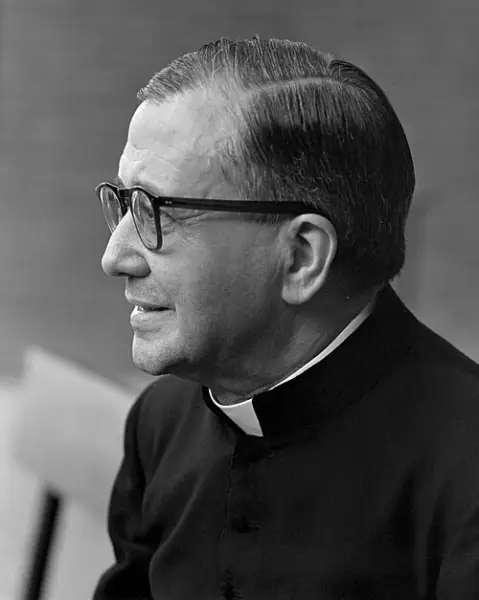
A Spanish Catholic priest, Josemaría Escrivá de Balaguer y Albás (1902–1975) established Opus Dei, a body of laypeople and priests built on the conviction that holiness belongs in ordinary daily life. Born at Barbastro in Huesca, he sensed a calling as a boy — pious tradition places it at the sight of a barefoot monk's footprints in the snow — studied in Logroño and Zaragoza, and was ordained a priest in 1925. In Madrid, where he pursued a doctorate in civil law, he received on 2 October 1928 the founding intuition of Opus Dei, a path by which laypeople might sanctify their secular work. He steered the young work through the Spanish Civil War — fleeing Madrid by way of Andorra and France to Nationalist Burgos — and after 1939 guided its growth toward Rome, where he settled in 1946 and won pontifical approval in 1947 and 1950. He founded colleges, the University of Navarre, and the University of Piura, and wrote The Way, his bestselling book of spiritual maxims. When he died in 1975, Opus Dei counted some 60,000 members across eighty countries. John Paul II beatified him in 1992 and canonized him in 2002, ceremonies that drew both worldwide attention and sharp controversy.
The Complete Life
A Boy of Barbastro
José María Mariano Escrivá y Albás came into the world at Barbastro, in the province of Huesca, on 9 January 1902, the second of six children of José Escrivá, a merchant holding a share in a textile firm, and his wife María de los Dolores Albás. When the firm went under, the household moved in 1915 to Logroño, in La Rioja, where the father took a clerk's post in a clothing shop. There, as an adolescent, Josemaría first sensed that God was asking something of him; pious tradition locates the moment at the sight of footprints stamped in the snow by a monk who walked barefoot. With his father's blessing he prepared for the priesthood, studying at Logroño first and Zaragoza afterward; in Zaragoza he was made a deacon on 20 December 1924 and a priest on 28 March 1925. From 1922 he had also been reading law at the University of Zaragoza, taking the licenciate in 1927. After a short assignment to a rural parish at Perdiguera he settled in Madrid to read for a civil-law doctorate at the Central University, supporting himself by tutoring privately and serving as chaplain to the Foundation of Santa Isabel.
§ Early life
Seeing the Work
A prayerful retreat in 1928 settled for Escrivá what he believed God was asking of him. On 2 October of that year he 'saw' Opus Dei — the Work of God — a way by which Catholics could learn to make holy the ordinary work of their secular lives, and he founded the work in that same year. The foundation began among the poor and the sick of Madrid's slums and hospitals, alongside the professional circles its founder now moved in as priest and lawyer. It was a novel undertaking: not a community gathering monks behind cloister walls, but a spiritual family sending laypeople back into their trades, classrooms, and homes with the conviction that those very places were already holy ground. Escrivá gave himself to this mission without reserve, as the Congregation for the Causes of Saints would later testify in its decree on his life, and his apostolate reached into social settings of every kind. Juridical consolidation came by patient steps rather than a single act: the work received its definitive approval from Pius XII in 1950, by which time its founder had already led it through civil war, exile, and the first beginnings of its spread beyond Spain.
§ Mission as the founder of Opus Dei
War, Rome, and Expansion
The Spanish Civil War nearly ended the young work before it could grow. When anti-clerical Republicans held Madrid in 1936, Escrivá escaped the city, crossed into Andorra and France, and made his way to Burgos, headquarters of General Franco's Nationalist forces. Once the war closed in 1939 with Franco's victory he came back to Madrid, completed his legal doctorate, defending a thesis about the jurisdiction historically held by the abbess of Santa María la Real de Las Huelgas, and brought out the first edition of The Way, printed that year in Valencia. On 14 February 1943 he established the Priestly Society of the Holy Cross, united to Opus Dei, and in 1946 he relocated to Rome, the center from which the work would grow worldwide. Recognition as an institution of pontifical right arrived in 1947 and, in fuller form, on 16 June 1950. In 1948 he founded the Roman College of the Holy Cross for the work's men, in 1953 the Roman College of Saint Mary for its women — institutions since joined as the Pontifical University of the Holy Cross — and he went on to establish the University of Navarre in Pamplona and the University of Piura in Peru as secular institutions affiliated with the work.
§ Mission as the founder of Opus Dei
Prayer, Liturgy, and the Cross
Escrivá's spirituality centered on making ordinary life holy: work offered up in union with Christ, he taught, becomes itself a path to God. John Paul II, at his canonization, praised him as a master of prayer, which he counted an extraordinary weapon for the world's redemption, and noted that the fruitfulness of any apostolate rests on prayer and a constant sacramental life. From his teens he carried brief aspirations in Latin — Domine, ut videam!, Omnes cum Petro ad Iesum per Mariam!, Regnare Christum volumus!, Deo omnis gloria! — short arrows of prayer that his biographers trace through every season of his life. He regarded the Mass as the wellspring and peak of the interior Christian life, and when the liturgy was reformed after the Second Vatican Council he obeyed the new rites, though he missed the old gestures; Annibale Bugnini eventually allowed him to celebrate the older form privately with a single server. He taught that joy is rooted in the shape of a cross and that suffering tests love, convictions embodied in his own practice of corporal mortification — a practice that has drawn admirers and critics alike. His love of the Virgin ran from the rosary carried in his boyhood pocket to the image of Our Lady of Guadalupe in the room where he died.
§ Prayer
The Roman Years
The last decades of Escrivá's life unfolded in Rome, directing a work that had become global. Pius XII named him an Honorary Domestic Prelate in 1950, entitling him to be addressed as Monsignor; in 1955 he took a doctorate in theology at the Pontifical Lateran University; and he served as a consultor to two Vatican congregations and as an honorary member of the Pontifical Academy of Theology. As an adult he suffered from type 1 diabetes and, by some accounts, epilepsy as well. In 1968 he petitioned successfully for the rehabilitation of the aristocratic title Marquess of Peralta — a step that stirred criticism then and since — and in 1972 he passed the title to his brother Santiago. He toured Latin America in 1974, Chile among his stops. Entering his study on 26 June 1975 — the room held a picture of the Virgin of Guadalupe — he collapsed and died of cardiac arrest at seventy-three; the great shrine he had promoted at Torreciudad, in his native Aragon, opened barely two weeks later and remains Opus Dei's spiritual center. By then the work counted roughly 60,000 members in eighty countries, and the future John Paul I had already celebrated how original a contribution he had made to Christian spirituality.
§ Later years
A Swift Road to the Altars
Escrivá's cause moved with remarkable speed. After his death the postulation received testimonies and petitions from around the world; a full third of the world's bishops asked for his beatification, a number without precedent, and on 19 February 1981 the cause was formally introduced in Rome, resting on the evidence of a seemingly miraculous cure worked in 1976 for Sister Concepción Boullón Rubio, stricken with lipomatosis. On 9 April 1990 John Paul II judged that his practice of Christian virtue had attained heroic degree; on 6 July 1991 the physicians' board unanimously accepted the cure as genuine. Beatification followed in Saint Peter's Square on 17 May 1992, with the Sudanese nun Josephine Bakhita raised to the altars beside him. A second wonder — the 1992 healing of Dr. Manuel Nevado Rey, a country doctor stricken with cancerous chronic radiodermatitis — won papal approval in December 2001, and on 6 October 2002 John Paul II canonized Escrivá before 42 cardinals and 470 bishops. The speed drew fire: journalists and scholars questioned the haste, the sealed 6,000-page positio, and the thin space given to critical testimony, while defenders cited the streamlined post-1983 procedures and the vast popular following behind the cause.
§ Beatification and canonization
A Contested and Enduring Message
Escrivá's reputation remains contested. John Paul II hailed him as a very human saint and the saint of ordinary life, and Cardinal Ratzinger praised his insistence that the work was God's doing and not his own; the monk Thomas Merton judged that the book's simplicity would accomplish real good, simplicity being the true medium of the Gospel message. Against such praise stand the verdicts of critics: Hans Urs von Balthasar belittled The Way as little more than a scouting manual in Spanish dress, and other commentators have questioned the originality of his published theology. The controversies touch politics as well — allegations of secrecy, elitism, and closeness to General Franco's dictatorship have trailed Opus Dei for decades, though defenders such as John L. Allen Jr. argue that many charges are unproven and that Escrivá cannot fairly be labeled either pro-Franco or anti-Franco. His books — The Way, Furrow, Christ Is Passing By, The Forge — continue to be read in dozens of languages, carrying the message that daily work, done for God, sanctifies the one who does it, a theme the Second Vatican Council itself would amplify. Beatified and canonized amid unprecedented publicity, he remains among the most influential and most debated Catholic figures of the twentieth century.
§ Teachings and legacy
Timeline
- 9 Jan 1902
Born at Barbastro in Huesca, second of the six children of José Escrivá and María de los Dolores Albás.
§ Early life
- 1915
Moved with his family to Logroño after his father's textile partnership failed.
§ Early life
- 1922
Began reading law at the University of Zaragoza.
§ Early life
- 20 Dec 1924
Ordained a deacon in Zaragoza.
§ Early life
- 28 Mar 1925
Ordained a priest in Zaragoza.
§ Early life
- 1927
Moved to Madrid for civil-law doctoral studies at the Central University.
§ Early life
- 2 Oct 1928
Received the founding intuition of Opus Dei during a prayerful retreat and established the work.
§ Mission as the founder of Opus Dei
- 1936
Fled Republican-controlled Madrid as civil war broke out, reaching Burgos by way of Andorra and France.
§ Mission as the founder of Opus Dei
- 1939
Returned to Madrid after Franco's victory, finished his law doctorate, and saw The Way through its first printing.
§ Mission as the founder of Opus Dei
- 14 Feb 1943
Founded the Priestly Society of the Holy Cross, joined to Opus Dei.
§ Mission as the founder of Opus Dei
- 1946
Took up residence in Rome.
§ Mission as the founder of Opus Dei
- 1947
Opus Dei gained from the Holy See recognition as an institution of pontifical right.
§ Mission as the founder of Opus Dei
- 1948
Founded the Roman College of the Holy Cross, the work's Roman house of studies for men.
§ Later years
- 16 Jun 1950
Won fuller papal approval for Opus Dei; Pius XII also made him an Honorary Domestic Prelate.
§ Later years
- 1953
Founded the Roman College of Saint Mary for the women's section of the work.
§ Later years
- 1955
Received a doctorate in theology from the Pontifical Lateran University.
§ Later years
- 1968
Requested and obtained rehabilitation of the aristocratic title Marquess of Peralta.
§ Title of nobility
- 1972
Ceded the Marquessate of Peralta to his brother Santiago.
§ Title of nobility
- 1974
Traveled in Latin America, including a visit to Chile.
§ Alleged support for right-wing leaders
- 26 Jun 1975
Died of cardiac arrest in Rome, aged seventy-three.
§ Later years
- 7 Jul 1975
The Torreciudad shrine he had championed was inaugurated, soon becoming Opus Dei's spiritual center.
§ Later years
- 19 Feb 1981
His beatification cause was formally introduced in Rome.
§ Beatification and canonization
- 9 Apr 1990
Declared by Pope John Paul II to have practiced Christian virtue to a heroic degree.
§ Beatification and canonization
- 17 May 1992
Beatified by Pope John Paul II in Saint Peter's Square, alongside Josephine Bakhita.
§ Beatification and canonization
- 6 Oct 2002
Canonized by Pope John Paul II in Saint Peter's Square.
§ Beatification and canonization
In Their Own Words
One could say that he was the saint of ordinary life.
Escrivá evidently lived totally in the present moment, he opened out to it completely, and gave himself entirely to it.
he was in a permanent dialogue, a real contact with the One who created us and works for us and with us
The Record
- Major works
- The Way·Furrow·Christ Is Passing By·The Forge·Friends of God·The Holy Rosary·Conversations with Monsignor Josemaría Escrivá·In Love with the Church·The Way of the Cross
- Patron of
- Opus Dei·People with diabetes
- Symbols
- Priest attire·Rosary
- Canonization
- Canonized by Pope John Paul II on 6 October 2002 in Saint Peter's Square, Vatican City
Prayer
Bibliography
Show 6 sources
- Vázquez de Prada, Andrés (2001). The Founder of Opus Dei: the Life of Josemaría Escrivá. Princeton: Scepter Publishers. ISBN 978-1-889334-25-7.
- Berglar, Peter (1994). Opus Dei. Life and Work of its Founder. Princeton: Scepter Publishers. ISBN 0-933932-65-0.
- Estruch, Joan (1995). Saints and Schemers: Opus Dei and Its Paradoxes. New York: Oxford University Press. ISBN 0-19-508251-6.
- Allen, John L. (2005). Opus Dei: An Objective Look Behind the Myths and Reality of the Most Controversial Force in the Catholic Church. Garden City: Doubleday. ISBN 0-385-51449-2.
- Woodward, Kenneth L. (1996). Making Saints: How the Catholic Church Determines Who Becomes a Saint, Who Doesn't, and Why. Touchstone. ISBN 978-0-684-81530-5.
- Tapia, María del Carmen (2006). Inside Opus Dei: The True, Unfinished Story. New York: Continuum. ISBN 978-0826419309.
Profile text adapted from the Wikipedia article, licensed CC BY-SA 4.0.
Pray with this saint every day
Save St. Josemaría Escrivá to your favorites, read the full profile, and get feast-day reminders in the Saints app.
Get the Saints AppFree on the App Store for iPhone and iPad