
1st century BC – 1st century AD·Feast March 19
St. Joseph
Husband of the Blessed Virgin Mary
Overview
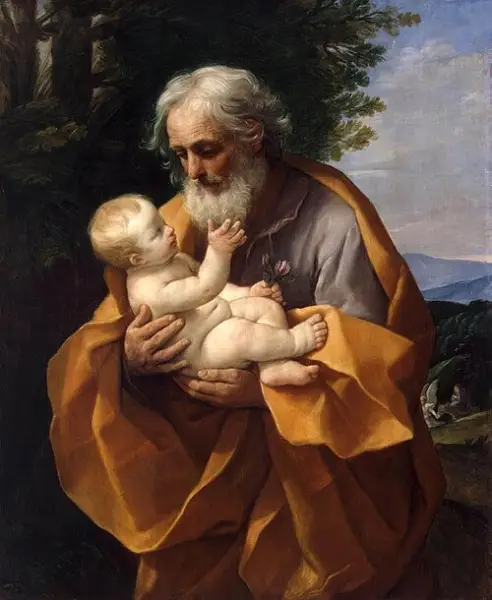
Joseph appears in the Gospels of Matthew and Luke as a descendant of King David, resident of Nazareth in Galilee, a craftsman — a tekton, traditionally a carpenter — betrothed to Mary. In Matthew, an angel bids him take her as his wife despite her mysterious pregnancy; after the birth of Jesus at Bethlehem, warned in further dreams, he carries the child and his mother to Egypt to escape Herod's massacre and later settles them at Nazareth. In Luke, he travels with Mary to Bethlehem for the census of Caesar Augustus and presents the infant in the Temple. Joseph speaks not a single recorded word in the New Testament. His last appearance is the Passover visit to Jerusalem when Jesus is twelve, after which he disappears from the narrative; his absence at Cana and at the Cross, where Jesus entrusts his mother to John, indicates that he had died before the public ministry began. From these spare materials the Church built a towering devotion: earliest formal cult around the year 800, promotion by Bernardine of Siena and Gerson in the fifteenth century, Leo XIII's 1889 encyclical commending him as patron of the Church, and John Paul II's 1989 apostolic exhortation Redemptoris Custos. He is invoked above all as a model of the worker, the father, and a happy death in the arms of Jesus and Mary.
The Complete Life
The Joseph of the Gospels
Joseph appears in the Gospels of Matthew and Luke as a descendant of King David, resident of Nazareth in Galilee, a craftsman — the Greek tekton, traditionally a carpenter — betrothed to Mary. The two evangelists give complementary infancy narratives. In Matthew, an angel bids him take Mary as his wife despite her mysterious pregnancy; after the birth of Jesus at Bethlehem, warned in further dreams, he carries the child and his mother to Egypt to escape Herod's massacre and later settles them at Nazareth. In Luke, he travels with Mary to Bethlehem for the census of Caesar Augustus and presents the infant in the Temple. The dream-obedience of Matthew's Joseph — each instruction received at night and carried out by morning — is the whole of his characterized action.
§ External links
The Hidden Ministry
The New Testament gives Joseph no recorded word. His last appearance is the Passover visit to Jerusalem when Jesus is twelve; after that he disappears from the narrative, and his absence at Cana and at the Cross — where Jesus entrusts his mother to John — indicates that he had died before the public ministry began. What the texts show is a man who held the legal paternity by which Jesus was 'son of David', who named and raised and taught him, and who accepted, on the strength of dreams, a family whose explanation he could not give anyone. The Church's reading of this silence is the whole of Josephine spirituality: the sanctity of hidden work and unexplained obedience.
§ External links
Devotion and Cult
Joseph's is a pre-congregation cult of slow growth. Formal devotion is attested from about the year 800, spread widely from the fourteenth century, and was given its decisive promotion by Bernardine of Siena and Jean Gerson in the fifteenth century. He was inserted into the Roman Canon of the Mass in 1962 by John XXIII. Leo XIII, in the 1889 encyclical Quamquam pluries, commended him as patron of the universal Church; Pius XII instituted the feast of St Joseph the Worker on 1 May in 1955; John Paul II devoted to him the 1989 apostolic exhortation Redemptoris Custos, guardian of the Redeemer. He is patron of the universal Church, of workers, of fathers and families, of a happy death, and of numerous countries.
§ Veneration
Legacy
From the sparsest materials in the New Testament the Church built one of its largest devotions. Joseph is invoked above all as the model of the worker — the tekton whose labour is the setting of the Incarnation — and of the father, a guardian rather than a begetter, whose authority was service. The tradition of a happy death in the arms of Jesus and Mary rests on the inference that he died before the public ministry, cared for by them. Christian art's Joseph — the older man at the manger, the workman's bench at Nazareth, the sleeping man of the dreams — is all inference too, and all of it has proved durable. His solemnity is 19 March, with the feast of St Joseph the Worker on 1 May.
§ External links
Timeline
- 800
Oldest surviving evidence of an organized devotional following in his honor appears in the records
§ Veneration
- 800
Ninth-century writers begin styling him Nutritor Domini, the guardian and educator of the Lord
§ Veneration
- 900
19 March becomes his principal observance across Western Christianity and keeps that rank thereafter
§ Saint Joseph's Day
- 1400
Bernardine of Siena, Pierre d'Ailly, and Jean Gerson take major steps to promote his cult
§ Veneration
- 9 Jun 1687
The Croatian Sabor proclaims him a patron saint of the Kingdom of Croatia
§ Places, churches, and institutions
- 8 Dec 1870
Pope Pius IX names him patron of the Universal Church and institutes a solemnity in his honor
§ Patris corde and Year of Saint Joseph
- 15 Aug 1889
Pope Leo XIII issues the encyclical Quamquam pluries, urging prayer to Joseph as the church's patron
§ Veneration
- 1 May 1955
Pope Pius XII answers International Workers' Day by creating a 1 May observance honoring Joseph as worker
§ Saint Joseph the Worker
- 1962
Pope John XXIII inserts Joseph's name into the Canon of the Mass directly after the Blessed Virgin Mary
§ Veneration
- 2013
Pope Francis has Joseph's name added to the three remaining Eucharistic Prayers
§ Veneration
- 8 Dec 2020
Pope Francis publishes Patris corde and proclaims a Year of Saint Joseph lasting until December 2021
§ Patris corde and Year of Saint Joseph
The Record
- Patron of
- The Universal Church (Pius IX, 1870)·Fathers·Workers and carpenters·Married people·Expectant mothers and unborn children·The dying and a happy death·Emigrants, travelers, and house hunters·The New World
- Symbols
- Carpenter's square or tools·Staff blossoming with lilies·Holding the Christ Child·Two turtle doves
- Canonization
- Pre-congregation; formal devotion attested from about AD 800, widespread by the 14th century; proclaimed patron of the Universal Church by Pope Pius IX in 1870
Prayer
Bibliography
Show 1 sources
- ↑ Hebrew : יוסף , romanized : Yosef ; Greek : Ἰωσήφ , romanized : Ioséph
Profile text adapted from the Wikipedia article, licensed CC BY-SA 4.0.
Pray with this saint every day
Save St. Joseph to your favorites, read the full profile, and get feast-day reminders in the Saints app.
Get the Saints AppFree on the App Store for iPhone and iPad