
1811 – 1860·Feast June 23
St. Joseph Cafasso
Turin's 'Priest of the Gallows', Former of Priests
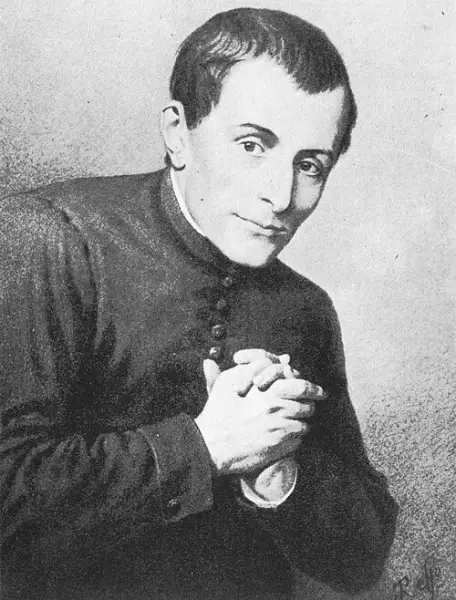
Overview
Joseph Cafasso (Giuseppe Cafasso, 1811–1860) was a priest of Turin numbered among the 'Social Saints' who confronted the miseries of that industrializing city, and he is best remembered by the grim title 'Priest of the Gallows' for his unfailing attendance on prisoners awaiting execution. A peasant's son from Castelnuovo d'Asti, born January 15, 1811 as the third of four children, he carried a deformed spine all his life that left him short and physically frail. Ordained on September 21, 1833, he spent his whole career at the Institute of Saint Francis of Assisi in Turin, a college for forming diocesan priests in the aftermath of the Napoleonic devastation, rising from student to lecturer to chaplain and, in 1848, successor to its co-founder Luigi Guala as rector. As a moral theologian he combated the rigidity of Jansenism with the gentler teaching of Alphonsus Liguori and Francis de Sales, and in the confessional and the rectory he shaped a generation of founders — Don Bosco above all, whom he directed spiritually from 1841 until his death, and also Giulia Falletti di Barolo, Francesco Faà di Bruno, and Clemente Marchisio. His austerity was relentless — he lived on the plainest food, touched neither tobacco nor coffee nor wine, and celebrated Mass at 4:30 each morning — yet it was the condemned cells of Turin that drew his deepest charity: he accompanied some sixty converted prisoners to the gallows, calling them his 'hanged saints'. Worn out at forty-nine, he died of pneumonia and a stomach hemorrhage on June 23, 1860, leaving everything to Cottolengo's Little House of Divine Providence. Pope Pius XII canonized him on June 22, 1947 and named him patron of Italian prisons and prisoners.
The Complete Life
Early Life and Formation
Giuseppe Cafasso entered the world at Castelnuovo d'Asti on January 15, 1811, the third of four children born to peasants; the youngest, his sister Marianna, would one day be the mother of Blessed Giuseppe Allamano. A deformed spine made him short and weak from birth, yet childhood memory held nothing against him — those who knew him could not recall a sin in the boy. Feeling drawn to the priesthood, he pursued his studies at Turin and Chieri, and there met Giovanni Bosco, then fourteen, the beginning of a lifelong friendship. Ordained in the archdiocesan cathedral on September 21, 1833, he added further theological study in Turin and in 1834 came under the influence of Luigi Guala, co-founder of the Institute of Saint Francis of Assisi, a college raised to re-train diocesan priests after the wreckage of the Napoleonic era. He remained attached to that house for the rest of his life.
§ Life
Teacher and Director of Souls
From 1836 Cafasso was a celebrated lecturer in moral theology, steeped in the French school of Bérulle and Vincent de Paul and convinced that the formation — and continuing formation — of priests was the church's great need. Against the Jansenist gloom he found among his students he set the balanced teaching of Alphonsus Liguori and Francis de Sales, and he also resisted state intrusion into church affairs. In the same years he took his place as a spiritual director of unusual reach: Bosco, whom he guided from 1841 to 1860 and encouraged in his work for Turin's street boys; Giulia Falletti di Barolo, champion of women prisoners; Francesco Faà di Bruno; Clemente Marchisio. He had at some point professed membership in the Third Order of Saint Francis, and he never let teaching excuse him from the works of a parish priest, helping impoverished students with books and other necessities.
§ Life
The Priest of the Gallows
Turin's prisons were the theater of his most distinctive charity. He ministered so constantly to those sentenced to die that the city gave him his nickname, the 'Priest of the Gallows.' The stories told of him mix toughness with tenderness: once he seized a huge inmate by the beard and would not release him until the man yielded to confession — which he did, weeping, and left the confessional praising God. On another occasion he walked sixty converted condemned men to the gallows; most went straight from absolution to the scaffold, and Cafasso spoke of them as 'hanged saints.' Behind all of it lay a severe asceticism: no tobacco, no drink but water, no coffee, no food between meals, complaints of toothache and headache silenced as his personal cross borne without murmur, and Mass offered every morning at half past four, followed by hours in the confessional and chapel.
§ Life
Death and Bequest
Cafasso died on June 23, 1860, at forty-nine, of pneumonia joined to a stomach haemorrhage and the complications of his congenital ailments. Don Bosco preached at his old friend's funeral Mass and afterwards wrote an account of his life. In his will he left all his possessions to the Little House of Divine Providence, the work founded decades earlier by Giuseppe Benedetto Cottolengo. When his college relocated to the Santuario della Consolata in 1870, his body was brought there as well.
§ Life
Sainthood
The cause moved swiftly by the standards of the Roman curia. Pius X signed the decree formally introducing it on May 23, 1906; the confirmation of heroic virtue brought the title Venerable under Benedict XV; and on November 1, 1924 Pius XI approved two miracles, in the same decree styling him 'the educator and formation teacher of priests.' Pius XI beatified him on May 3, 1925, and Pius XII, after two further miracles, canonized him in Saint Peter's Basilica on June 22, 1947. The following year, on April 9, 1948, the same pope proclaimed him patron of all Italian prisons and prisoners, and in the 1950 apostolic exhortation Menti Nostrae held him up as a model for confessors and spiritual directors everywhere.
§ Sainthood
Monuments and Memory
Turin honors him at the crossing of Corso Regina Margherita, Corso Principe Eugenio and Corso Valdocco — the spot grimly known as the Rondò della Forca, the Gallows Roundabout, near the scene of his executions ministry. In 1968 a church in Rome's Tuscolano district was dedicated to him.
§ Monuments and buildings
Timeline
- 15 Jan 1811
Born at Castelnuovo d'Asti, third of four children of peasant parents, with a deformed spine
§ Life
- 21 Sep 1833
Ordained a priest in the archdiocesan cathedral
§ Life
- 1834
Came to know Luigi Guala, co-founder of the Institute of Saint Francis of Assisi, the Turin college for priests
§ Life
- 1836
Began teaching moral theology, drawing on the French school of spirituality and countering Jansenist rigorism
§ Life
- 1841
Became spiritual director to Giovanni Bosco, a guidance that would continue for nineteen years
§ Life
- 1848
Named rector of the Institute of Saint Francis of Assisi as Guala's successor
§ Life
- 23 Jun 1860
Died in Turin of pneumonia, a stomach haemorrhage and congenital complications, aged 49
§ Life
- 1870
His college relocated to the Santuario della Consolata, where his remains were later re-interred
§ Life
- 23 May 1906
Formal introduction of his canonization cause by decree of Pope Pius X
§ Sainthood
- 1 Nov 1924
Pius XI confirmed two miracles and praised him as 'the educator and formation teacher of priests'
§ Sainthood
- 3 May 1925
Beatified by Pope Pius XI at Saint Peter's Basilica
§ Sainthood
- 22 Jun 1947
Canonized by Pope Pius XII in Saint Peter's Basilica
§ Sainthood
- 9 Apr 1948
Declared patron of all Italian prisons and prisoners by Pius XII
§ Sainthood
In Their Own Words
Our rest will be in Heaven
The Record
- Patron of
- Italian prisons·Prison chaplains·Prisoners·Those condemned to death
- Symbols
- Priest's attire
- Canonization
- Beatified 3 May 1925 by Pope Pius XI; canonized 22 June 1947 by Pope Pius XII
Prayer
Bibliography
Show 9 sources
- "Saint Giuseppe Cafasso". Saints SQPN. 23 June 2017. Retrieved 29 August 2017.
- Meg Hunter-Kilmer (22 June 2017). "The holy priest who left hardened sinners weeping for joy". Aleteia. Retrieved 29 August 2017.
- "Saint Joseph Cafasso (1811-1860)". Salesians UK. Archived from the original on 20 July 2017. Retrieved 29 August 2017.
- "San Giuseppe Cafasso" (in Italian). Santi e Beati. Retrieved 29 August 2017.
- "The life of St. Joseph Cafasso". Catholic Tradition. Retrieved 29 August 2017.
- "St. Joseph Cafasso". Catholic Online. Retrieved 29 August 2017.
- Elder, Joseph Mary, O.F.M. Cap. "All Saints of the Seraphic Order", Capuchin Franciscans. Archived from the original on 15 June 2018.
- Fr. Don Miller, O.F.M. "Saint Joseph Cafasso". Franciscan Media. Archived from the original on 29 August 2017.
- "Giulia di Barolo" (PDF). Commune of Turin (in Italian). Retrieved 29 August 2017.
Profile text adapted from the Wikipedia article, licensed CC BY-SA 4.0.
Pray with this saint every day
Save St. Joseph Cafasso to your favorites, read the full profile, and get feast-day reminders in the Saints app.
Get the Saints AppFree on the App Store for iPhone and iPad