
1557 – 1648·Feast August 25
St. Joseph Calasanz
Founder of the Piarists and patron of Christian schools
Overview
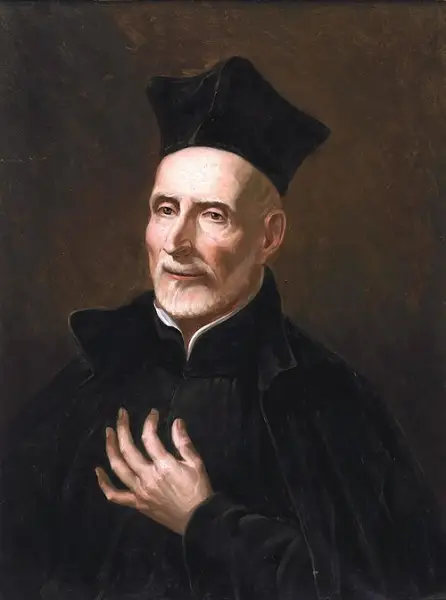
Joseph Calasanz was a Spanish priest who devoted his long life to schooling children whom nobody else would teach. Born into a minor noble family in Aragon in 1557 and ordained in 1583, he served several dioceses in his homeland before moving to Rome in 1592. Alarmed by the numbers of neglected and homeless boys in the city, he opened in 1597 what is regarded as the first free public school in Europe. Around this work he built a religious community, approved by Pope Paul V in 1617 and raised by Gregory XV in 1621 to an order of solemn vows: the Piarists, whose members add a fourth vow binding themselves to the education of youth. Calasanz championed the teaching of mathematics and science, defended the vernacular languages, and befriended Galileo, sending his religious to study under him. His last decades were darkened by internal conflict and by the scandal surrounding Stefano Cherubini, whose elevation to superior general in 1643 displaced the aged founder; in 1646 the order was stripped of its privileges, though it recovered them a decade later. Calasanz died in Rome on 25 August 1648, was beatified in 1748, and was canonized in 1767.
The Complete Life
A Son of Aragon
Joseph was born on 11 September 1557 at Peralta de Calasanz in the Kingdom of Aragon, the last of eight children and second of the sons. His father, Pedro de Calasanz y de Mur, was a minor nobleman who served as mayor of the town; his mother was María Gastón y de Sala, and Joseph had two sisters, Marta and Cristina. He grew to an unusual height, approaching two meters in his youth. His first schooling came at home and in the elementary school of Peralta. In 1569 his parents sent him to Estadilla for classical studies at a college conducted by friars of the Trinitarian Order, and there, at the age of fourteen, he determined to become a priest — a resolve his parents declined to encourage. He read philosophy and jurisprudence at the university of Lleida, earning a doctorate in laws with honors, and afterward studied theology at Valencia and at Alcalá de Henares, where the Complutense still resided on its founding ground. Once his mother and one of his brothers had died, the elder Calasanz urged marriage upon him to continue the family; in 1582 a grave sickness nearly carried Joseph off, and his father yielded at last. On 17 December 1583 he was ordained priest by Hugo Ambrosio de Moncada, Bishop of Urgel.
§ Early biography
Priest of the Aragonese Church
His service began at Albarracín, whose prelate, Gaspar Juan de la Figuera, named Joseph to serve as his theologian and confessor, as synodal examiner, and as procurator. When that prelate moved on to Lerida, Joseph went with him, and in those years he passed considerable time at La Seu d'Urgell. Serving as the cathedral chapter's secretary, he bore wide administrative duties, and at Claverol, a village lying northeast of Lerida, he set up a charitable work providing food to those in need — an early sign of the charitable bent of his whole career. In October 1585 he accompanied the bishop, sent as apostolic visitor, to the Abbey of Montserrat, serving once more as his secretary. The bishop died the following year; though urgently asked to remain, Calasanz departed and hurried to Peralta de Calasanz to attend his father's death. Next the Bishop of Urgel called upon him to serve as vicar general over the Tremp district. In 1592, then thirty-five, he moved to Rome in hope of advancing his ecclesiastical career and securing a benefice, and there he spent most of his remaining fifty-six years. Cardinal Marcoantonio Colonna became his protector, choosing him as theologian and, once Joseph had learned to express himself in Italian, entrusting him with the spiritual direction of the cardinal's household.
§ Early biography
The First Free School in Europe
Rome offered abundant occasion for charity, above all the care of boys left neglected and homeless on its streets. Calasanz joined the Confraternity of Christian Doctrine and began gathering street children for religious instruction and other schooling, but the poorly paid schoolmasters refused the added labor without remuneration. When Anthony Brendani, pastor of Santa Dorotea in Trastevere, placed two rooms beside the parish sacristy at his disposal and two other priests promised similar help, Calasanz opened on 27 November 1597 what is thought to have been the first free public school in Europe. On Christmas Day of the following year the Tiber rose to historic heights, nearly twenty meters above its normal level; some two thousand died, and hundreds of poor families along the banks were left homeless and hungry. Calasanz joined the labor of clearing and rebuilding the stricken city. In 1600 his Pious School opened in central Rome, and further premises soon answered the call for places. Pope Clement VIII started an annual subvention, and before long roughly a thousand children were entrusted to his care. In 1602 he took a house near Sant'Andrea della Valle, formed his helpers into a community, and laid the groundwork of what became the Piarist order. A first tuition-free school opened at Frascati on his initiative on 15 September 1616, and on 6 March 1617 Paul V confirmed the community as a religious congregation — the first institute whose essential purpose was teaching. Nineteen days later Joseph and fourteen assistants received the habit, invested by the Cardinal Protector Justiniani in his palace chapel — the first priests to make elementary teaching their primary ministry. On 18 November 1621 Gregory XV raised the congregation to an order of solemn vows, granting it the privileges of the mendicant orders and recognizing Calasanz as superior general; at his request its religious add a fourth vow binding themselves to the instruction of the young. In October 1628, a guest of the Conti di Segni family at Poli, he established the Pious Schools there as well, and houses spread to various parts of Europe.
§ In Rome
A Revolutionary Pedagogy
For Calasanz, education was the surest means of transforming society, and everything he wrote is marked by his Christian ideal of the teacher. In the Documentum Princeps of 1610 he laid out the principles of his educational philosophy, accompanied by regulations for teachers and pupils. He organized primary instruction into progressive levels or cycles, devised a system of vocational training, and structured public secondary education at a time when hardly anyone else took an interest in public schooling. He had pupils learn to read in both Latin and the vernacular, was a strong defender of the vernacular languages, and even had textbooks for teaching Latin composed in them — an advance over most of his contemporaries. Mathematics and the sciences held a central place in his schools for students and teachers alike, and he attended to physical education and hygiene, directing school heads to monitor the children's health. In discipline he advocated the preventive method, holding it better to anticipate mischievous behavior than to punish it — an approach John Bosco would later develop — and he urged the mildest correction available, insisting that gentleness and charity must anchor every discipline. He wrote a version of the prayer 'The Crown of Twelve Stars' and established continuous prayer in all his schools. His prestige ran so far that the Ottoman Empire asked him to found schools there, a request he regretfully could not meet for lack of teachers; Jewish children were received in his classrooms on equal terms with the others, and Protestant pupils enrolled in his German schools.
§ Educational ideas
Trial, Scandal, and Courage
Teaching every child without regard to means, maintaining classrooms for the destitute, and championing the astronomy of Galileo drew hostility from powerful figures in both civil and church circles. In 1642, in the midst of internal turmoil within the congregation and of scheming against it from without, the Inquisition detained and questioned him for a time. A graver wound followed: Stefano Cherubini, who directed the Piarist school at Naples, had been abusing the boys entrusted to him. Cherubini was the son and brother of powerful papal lawyers, and he warned that exposure would bring the Order to destruction; Calasanz moved him away from where the offenses had occurred, giving as stated grounds only his lavish table and his neglect of prayer, though he admitted in correspondence that the sole aim was to conceal the shame. Cherubini became visitor general and, in 1643, superior general of the Order, while the aged founder lost his office; when the appointment was announced, Calasanz laid out in a public record the years of abuse he had known about, but the decision held. Entangled in church politics and opposed by the Jesuits partly for its association with Galileo, the Order was deprived of its privileges by Pope Innocent X in 1646, though it was restored ten years later. Joseph had shown the same fortitude in plague seasons, when he and St. Camillus rivaled in serving the sick and burying the dead, and his patience under persecution won him the name of a second Job. He remained faithful to the Church to the end and died at Rome on 25 August 1648, ninety years of age, mourned and honored by pupils, relatives, fellow religious, and the ordinary Romans who revered his goodness and bravery. He was buried in the Church of San Pantaleo.
§ Death and legacy
Raised to the Altars
Eight years after his passing, Alexander VII restored the good standing of the Pious Schools, and the recognition of their founder followed in due course. Benedict XIV beatified Joseph Calasanz on 7 August 1748 in Rome, and Clement XIII canonized him there on 16 July 1767. On 13 August 1948 Pius XII named him heavenly protector of Christian popular schools across the globe, a title that compresses into one phrase the labor of his long life. His heart and tongue are preserved incorrupt in a devotional chapel at the Piarist motherhouse in Rome, and his major shrine is the Church of San Pantaleo, where he was buried. His feast was kept on 27 August in the calendars of 1769 to 1969, the nearest free day to the anniversary of his death, and since the reform of 1969 it has been celebrated on 25 August itself. Pope John Paul II later recalled that the saint modeled himself on Christ and labored to give the young, alongside secular learning, the Gospel's own wisdom, so that they might perceive how lovingly God's design holds all things together.
§ Veneration
A Heritage in Every Schoolroom
The work Calasanz began survived every crisis that befell it. The Piarists recovered their standing within a decade of their suppression and went on conducting schools across Europe and beyond. Parishes dedicated to him stand in Jefferson, Ohio; North Battleford, Saskatchewan; Granada in Spain; and Lockney, Texas, and numerous schools around the world bear his name under the care of the Piarists and other institutes that honor him as patron. Because 25 August falls within the summer holidays in many countries, the Order keeps 27 November as the Patrocinium of its founder — the date chosen in memory of the day in 1597 when he opened his first free school — so that teachers and students may honor him together during the school year. Historians of education credit him with establishing modern Europe's earliest tuition-free public school — Ludwig von Pastor rendered that verdict — and call his undertaking a drastic rupture with the class privileges that had left the masses impoverished and excluded. His graded instruction, his advocacy of the vernacular, his attention to health and physical training, and his preventive discipline place him among the pioneers of modern pedagogy, while the fourth vow he gave his Order remains its distinguishing mark.
§ Veneration
Timeline
- 11 Sep 1557
Born at Peralta de Calasanz in the Kingdom of Aragon, the youngest of eight children.
§ Early biography
- 1569
Sent to Estadilla for classical studies at a college of the Trinitarian friars; at fourteen he resolved to become a priest.
§ Early biography
- 17 Dec 1583
Ordained a priest by Hugo Ambrosio de Moncada, Bishop of Urgel, after a grave illness reconciled his father to his vocation.
§ Early biography
- 1592
Moved to Rome at the age of thirty-five and found a protector in Cardinal Marcoantonio Colonna, who made him his theologian.
§ In Rome
- 27 Nov 1597
Opened what scholars regard as Europe's earliest tuition-free public school, housed in two rooms by the sacristy of Santa Dorotea in Trastevere.
§ In Rome
- 25 Dec 1598
The Tiber flooded to historic levels on Christmas Day; he threw himself into relief for the roughly two thousand dead and the homeless poor.
§ In Rome
- 1600
Established his Pious School in central Rome; further premises soon followed as demand for places grew.
§ In Rome
- 1602
Took a house close to Sant'Andrea della Valle, gathered his helpers into a common life, and gave the Pious Schools their organizational beginnings.
§ In Rome
- 1610
Composed the Documentum Princeps, presenting the foundational ideas of his educational vision together with norms for instructors and students.
§ In Rome
- 15 Sep 1616
The first public and free school at Frascati opened on his initiative.
§ In Rome
- 6 Mar 1617
Pope Paul V gave formal approval to his community as a religious congregation devoted to the Pious Schools.
§ In Rome
- 25 Mar 1617
Received the Piarist habit with fourteen assistants from Cardinal Protector Justiniani, the first priests whose chief ministry was elementary teaching.
§ In Rome
- 18 Nov 1621
Gregory XV raised the congregation to an order of solemn vows, the Order of Poor Clerics Regular of the Mother of God of the Pious Schools.
§ In Rome
- 1642
Briefly held and interrogated by the Inquisition amid an internal crisis of the congregation and outside intrigue.
§ Death and legacy
- 1643
Cherubini attained the office of superior general of the Order, and the aged founder lost all real authority.
§ Death and legacy
- 1646
Pope Innocent X deprived the Order of its privileges; they were restored ten years later.
§ Death and legacy
- 25 Aug 1648
Died in Rome at the age of ninety and was buried in the Church of San Pantaleo.
§ Death and legacy
- 7 Aug 1748
Beatified in Rome by Pope Benedict XIV.
§ Veneration
- 16 Jul 1767
Canonized in Rome by Pope Clement XIII.
§ Veneration
- 13 Aug 1948
Pius XII named him heavenly protector of Christian popular schools across the globe.
§ Veneration
In Their Own Words
to cover up this great shame in order that it does not come to the notice of our superiors
The Record
- Major works
- Documentum Princeps (1610)·Pious Schools, the first free public schools in Europe·Order of the Piarists (Pious Schools)·A version of the prayer 'The Crown of Twelve Stars'
- Patron of
- Universal Patron of all Christian popular schools in the world·Teachers and students of the Piarist schools
- Canonization
- Beatified 7 August 1748 by Pope Benedict XIV; canonized 16 July 1767 by Pope Clement XIII.
Prayer
Bibliography
Show 9 sources
- "Joseph Calasanz", Prospects, vol. XXVII, no. 2, June 1998, pp. 327-339. UNESCO: International Bureau of Education
- Mershman, Francis. "St. Joseph Calasanctius". The Catholic Encyclopedia. Vol. 8. New York: Robert Appleton Company, 1910
- Giner-Guerri, Severino, Sch.P. Saint Joseph Calasanz, translated by Father Salvador Cudinach, Sch.P., published by the Argentinian Province of the Piarist Fathers in India, 1993
- "Saint Joseph Calasanz", The Piarist Order
- "Aquae Urbis Romae: the Waters of the City of Rome". University of Virginia
- "Saint Joseph Calasanz", Franciscan Media
- "A Brief History of the Piarist Order", The Piarist School of Martin, Kentucky
- Karen Liebreich, Fallen Order: Intrigue, Heresy and Scandal, London, 2005
- Calendarium Romanum (Libreria Editrice Vaticana 1969), p. 102
Profile text adapted from the Wikipedia article, licensed CC BY-SA 4.0.
Pray with this saint every day
Save St. Joseph Calasanz to your favorites, read the full profile, and get feast-day reminders in the Saints app.
Get the Saints AppFree on the App Store for iPhone and iPad