
1852 – 1908·Feast January 29
St. Joseph Freinademetz
Divine Word Missionary to Shandong, China
Overview
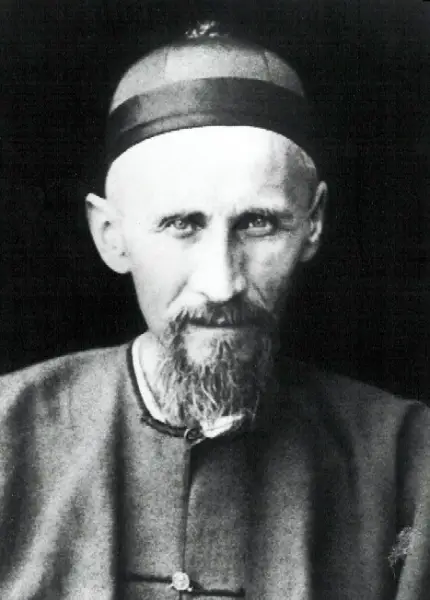
Joseph Freinademetz (1852–1908) was a Ladin-speaking priest of the Society of the Divine Word who gave twenty-nine years to the missions of China and died there of typhus. He was born on April 15, 1852 at Oies in the parish of Badia, in the County of Tyrol of the Austrian Empire — the fourth of the thirteen children of Giovanmattia and Anna Maria Freinademetz — in country that belongs to Italy today. Ordained at Brixen on July 25, 1875 after seminary studies there, he served briefly at San Martin de Tor near his home, but the missionary call would not leave him. Placing himself under Arnold Janssen, founder of the Divine Word missionaries at Steyl in the Netherlands, he left for Steyl in August 1878 with his bishop's blessing and his parents' consent. In March 1879 he sailed with Johann Baptist von Anzer for Hong Kong, working on the Sai Kung peninsula and building a chapel on the island of Yim Tin Tsai, before the two moved in 1881 to southern Shandong, a province of twelve million souls among whom only 158 were baptized. There Freinademetz threw himself into forming Chinese clergy and catechists and composed a catechism in Chinese that he counted among the essentials of the mission. Broken by laryngitis and tuberculosis, he was sent to Japan to recover in 1898; when Anzer, by then bishop, traveled to Europe in 1907, the diocese's administration fell to Freinademetz in the midst of a typhus outbreak. He nursed the sick until he caught the disease himself, returned to Daijiazhuang to die on January 28, 1908, and was buried there at the twelfth station of the Way of the Cross. Canonized by Pope John Paul II on October 5, 2003 alongside Arnold Janssen, he remains among the most honored of the China missionaries.
The Complete Life
Early Life
Freinademetz grew up in Oies, a hamlet of Badia in the Dolomites, in a Ladin-speaking family of thirteen children of which he was the fourth; the Tyrol of his birth belonged to the Austrian Empire, though the ground lies in Italy now. He prepared for the priesthood in the seminary of Brixen and was ordained on July 25, 1875, then took up his first assignment at San Martin de Tor, close to his birthplace. Three years there were enough to convince him that his vocation lay overseas. He wrote to Arnold Janssen, whose Society of the Divine Word at Steyl in the Netherlands existed precisely to train missionaries, his parents and his bishop consented, and in August 1878 he went to Steyl.
§ Early life
Missionary Work in China
In March 1879 Freinademetz and his confrere Johann Baptist von Anzer boarded ship for Hong Kong, landing five weeks later. For two years he worked on the Sai Kung peninsula and in 1879 raised a chapel on the island of Yim Tin Tsai, where a St Joseph's Chapel still commemorates him. In 1881 the missionaries moved to their true field, the south of Shandong province — a land of some twelve million inhabitants of whom 158 were Catholics. Freinademetz understood that the mission would stand or fall on a native church: he educated Chinese lay leaders and seminarians untiringly and wrote a catechism in Chinese that he regarded as indispensable to the work. In 1898 illness forced him to Japan to recover from laryngitis and tuberculosis; he came back diminished but stayed. When Anzer — now the region's bishop — sailed for Europe in 1907, administration of the diocese devolved on Freinademetz just as typhus swept the district.
§ Missionary work
Death
He served the typhus victims wherever he was needed until the disease found him. He withdrew to Daijiazhuang in the Rencheng district of Jining, in southern Shandong — historically spelled 'Taikia' — and died there of typhus on January 28, 1908. His grave is at Daijiazhuang, at the twelfth station of the Way of the Cross.
§ Death
Legacy
The cause moved at the church's deliberate pace: theologians approved his spiritual writings on November 20, 1940, and the formal opening on June 22, 1951 made him a Servant of God. Paul VI beatified him on October 19, 1975, and on October 5, 2003 John Paul II canonized him in the same ceremony as his founder Arnold Janssen — joining him also with Daniele Comboni, canonized alongside them as founder of the Comboni Missionaries. In Beijing, the German National Parish under his patronage serves the city's German-speaking residents and visitors to this day.
§ Legacy
Timeline
- 15 Apr 1852
Born at Oies, in the town of Badia, County of Tyrol, in the Austrian Empire, fourth of thirteen children
§ Early life
- 25 Jul 1875
Ordained a priest at Brixen after studies in the diocesan seminary; assigned to San Martin de Tor
§ Early life
- Aug 1878
Left home for the Society of the Divine Word at Steyl, Netherlands, to train as a missionary
§ Early life
- Mar 1879
Sailed from Europe with Johann Baptist von Anzer, reaching Hong Kong five weeks later
§ Missionary work
- 1879
Built a chapel on the island of Yim Tin Tsai while based on the Sai Kung peninsula
§ Missionary work
- 1881
Moved with Anzer to southern Shandong, a province of 12 million people with only 158 baptized Catholics
§ Missionary work
- 1898
Stricken with laryngitis and tuberculosis, sent to Japan to recuperate; returned uncured
§ Missionary work
- 1907
Given charge of the diocese's administration when Bishop Anzer departed for Europe, during a typhus outbreak
§ Missionary work
- 28 Jan 1908
Died of typhus at Daijiazhuang, Jining, in southern Shandong; his grave lies at that town's twelfth station of the Way of the Cross
§ Death
- 20 Nov 1940
Theologians approved his spiritual writings
§ Legacy
- 22 Jun 1951
Cause formally opened, giving him the title Servant of God
§ Legacy
- 19 Oct 1975
Beatified by Pope Paul VI
§ Legacy
- 5 Oct 2003
Canonized by Pope John Paul II together with Arnold Janssen
§ Legacy
The Record
- Major works
- Sanctissimum Novae Legis Sacrificium (Yenchowfu, 1915; English: The Most Holy Sacrifice of the New Covenant, 1980)·A catechism written in Chinese for the Shandong mission·Berichte aus der China-Mission (reports from the China mission, published posthumously)·Über den Geist der Societas Verbi Divini (On the Spirit of the Society of the Divine Word, 1977)
- Patron of
- German-speaking Catholics of Beijing (St. Joseph Freinademetz German National Parish)
- Symbols
- Missionary's cross and crucifix·Chinese catechist's book
- Canonization
- Beatified 19 October 1975 by Pope Paul VI; canonized 5 October 2003 by Pope John Paul II
Prayer
Bibliography
Show 11 sources
- "Celebrating the feast of St. Joseph Freinademetz". Archived from the original on 2020-01-29. Retrieved 2020-01-29.
- "University of San Carlos".
- "Biography of St. Joseph Freinademetz", Pontifical Missionary Societies.
- "Joseph Freinademetz (1852-1908)".
- "CANONIZATION OF THREE BLESSEDS".
- "Joseph Freinademetz - Serving the People of China".
- "Humble Beginnings on Yim Tin Tsai". Archived from the original on 2009-09-16. Retrieved 2009-06-27.
- "Yim Tin Tsai Village and St. Joseph's Chapel". Archived 2008-09-29 at the Wayback Machine.
- "Saint Joseph Freinademetz: The Saint of Alta Badia".
- Index ac status causarum beatificationis servorum dei et canonizationis beatorum (in Latin). Typis polyglottis vaticanis. January 1953. p. 125.
- "The Chinese Church's Response to Migration within Mainland China (Part II)".
Profile text adapted from the Wikipedia article, licensed CC BY-SA 4.0.
Pray with this saint every day
Save St. Joseph Freinademetz to your favorites, read the full profile, and get feast-day reminders in the Saints app.
Get the Saints AppFree on the App Store for iPhone and iPad