
1803-1835·Feast November 30 (with the Vietnamese Martyrs on November 24)
St. Joseph Marchand
Priest and Martyr (Paris Foreign Missions Society)
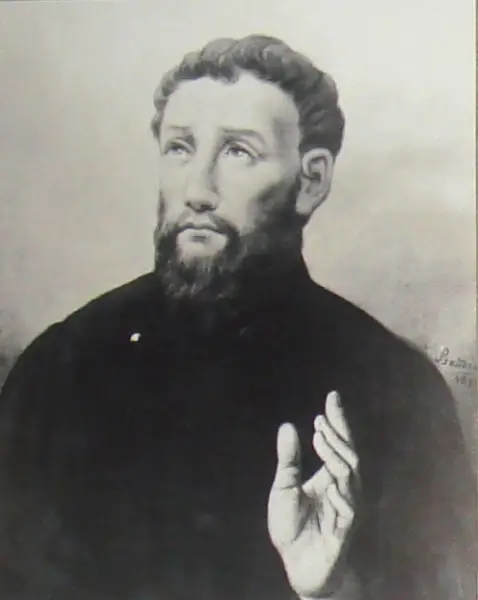
Overview
Joseph Marchand was born on 17 August 1803 at Passavant in the Doubs department of France, and at twenty-five joined the Paris Foreign Missions Society with the aim of evangelizing the nations of Asia. Sent to Vietnam, he was working there when Lê Văn Khôi seized the Citadel of Saigon in 1833 in revolt against the Emperor Minh Mạng. The rebels hoped to replace the emperor with his Catholic nephew and appealed to Vietnamese Catholics to join them; Marchand was drawn into association with the rising, which held the citadel through two years of war. Arrested in 1835 on suspicion of complicity in the rebellion, he was taken to the capital at Huế and executed there on 30 November 1835; accounts describe a death of prolonged cruelty, the flesh torn from his body with irons, before he was put to death. Pope Gregory XVI spoke of him in 1840, praising his courage as a champion of Christ. He was beatified in 1900 and canonized by Pope John Paul II on 19 June 1988 among the martyrs of Vietnam, with an individual feast on 30 November and a joint feast with his companions on 24 November.
The Complete Life
Early Life
Joseph Marchand was born on 17 August 1803 at Passavant in the Doubs, in the French Republic, and was formed for the priesthood in the years when the Paris Foreign Missions Society was rebuilding after the revolutionary suppression. At twenty-five he joined the MEP with the declared purpose of evangelizing Asia, and was sent to Vietnam, where the reign of Minh Mạng had begun to turn systematically against the Christian mission.
§ Introduction
Mission and Ministry
Marchand's ministry in Vietnam coincided with the Lê Văn Khôi revolt. In 1833 an invitation came to him to take part in the rising headed by Lê Văn Khôi, whose father was the late southern governor Lê Văn Duyệt; the rising seized the Citadel of Saigon, which it held for two years. The rebels' aim was to overthrow Minh Mạng and replace him with Mỹ Dương, the young son of the emperor's late elder brother Nguyễn Phúc Cảnh — both of them Catholics — and Khôi appealed to Catholics to join on those grounds. Marchand's actual role in the revolt is the contested point of his biography: the court charged that he stood at the head of the Catholic rebels, and the six chief men of the rising were conveyed to Huế for execution, Marchand included, alongside Nguyễn Văn Trấm, who took command after Khôi's death in 1834, and the Chinese leader Lưu Tín.
§ Vietnam
Trial and Final Years
Marchand was arrested in 1835 for his supposed association with the rebellion and taken to the capital. His execution took place at Huế on 30 November 1835, at the age of thirty-two, after his flesh had been torn from his bones with tongs — the death the sources describe as one by a thousand cuts. Whether or not he was the political actor the court alleged, the manner of his death placed him in the front rank of the Vietnamese martyrs' witness. In the allocution Afflictas in Tonkino of 1840, Pope Gregory XVI praised Marchand's courage, calling him a champion of Christ.
§ Vietnam
Canonization
Marchand was beatified on 27 May 1900 with the Vietnamese group of that year and canonized by Pope John Paul II on 19 June 1988 among the 117 Vietnamese Martyrs. His individual feast is 30 November, and he is commemorated with the whole body on 24 November.
§ Introduction
Legacy
Marchand's case is the politically hardest of the Vietnamese martyrdoms: a missionary executed on a charge of rebellion rather than mere preaching. His inclusion in the canon of 1988 asserts the religious character of the persecution even where the court's charges were political — and his torture-death made him, in Gregory XVI's own words, the nineteenth century's most visible MEP martyr at the moment when the European public was first learning of the Vietnamese persecutions.
§ Vietnam
Timeline
- 17 Aug 1803
Born at Passavant in the Doubs department of France.
§ Introduction
- 1828
At twenty-five he joins the Paris Foreign Missions Society, aiming to evangelize Asia.
§ Personal life
- 1833
Invited to join the Lê Văn Khôi revolt, whose rebels quickly seize the Citadel of Saigon.
§ Vietnam
- 1835
Taken into custody on suspicion of complicity in the uprising.
§ Vietnam
- 30 Nov 1835
Executed at Huế by a thousand cuts, dying a martyr at thirty-two.
§ Vietnam
- 1840
Pope Gregory XVI praises his courage as a champion of Christ.
§ Vietnam
- 27 May 1900
Beatified.
§ Introduction
- 19 Jun 1988
Canonized by Pope John Paul II.
§ Introduction
The Record
- Symbols
- Martyr's palm
- Canonization
- Beatified on 27 May 1900; canonized by Pope John Paul II on 19 June 1988 among the Vietnamese Martyrs
Prayer
Bibliography
Show 5 sources
- 1 2 Bunson, Matthew (2003), Encyclopedia of Saints , Our Sunday Visitor, p. 459, ISBN 1-931709-75-0 .
- ↑ Vo, Nghia M (2011), Saigon: A History , p. 53, The six principal leaders were sent to Huế to be executed. Among them was the French missionary Marchand, accused of being the leader of the Catholic rebel group; Nguyễn Văn Trấm, the leader
- ↑ Bunson, Matthew; Bunson, Margaret (1999), John Paul II's Book of Saints , Our Sunday Visitor, p. 61, ISBN 0-87973-934-7 .
- ↑ Pope Gregory XVI, Allocuzione: Afflictas in Tunquino (Tonkin) (in Italian), delivered on 27 April 1840, accessed on 19 October 2025
- ↑ "Saint Joseph Marchand" . Patron Saints Index . Retrieved 2009-06-25 .
Profile text adapted from the Wikipedia article, licensed CC BY-SA 4.0.
Pray with this saint every day
Save St. Joseph Marchand to your favorites, read the full profile, and get feast-day reminders in the Saints app.
Get the Saints AppFree on the App Store for iPhone and iPad