
died 1st century·Feast August 31
St. Joseph of Arimathea
Disciple Who Buried Jesus After the Crucifixion
Overview
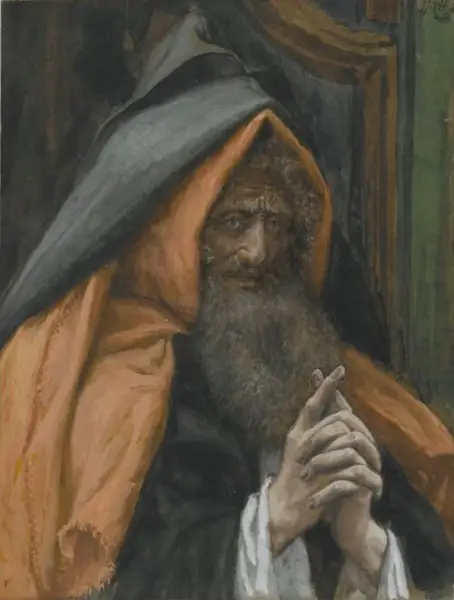
Joseph of Arimathea stands in the Gospel record as the man who took it upon himself to bury Jesus after the crucifixion. Three of the four Gospels describe him as a respected member of the Sanhedrin who was himself awaiting the kingdom of God, while Matthew calls him a rich disciple; Luke notes that he had not agreed to the council's decision against Jesus. Hearing of the death, he went boldly to Pilate, asked for the body, bought a linen shroud, and with Nicodemus took Jesus down from the cross, wrapping the body with myrrh and aloes and laying it in a rock-hewn tomb before the Sabbath began. Christians have long seen in this act the fulfillment of Isaiah's word that the Suffering Servant would be buried with a rich man. Venerated from the earliest centuries by Catholic, Orthodox, and Anglican traditions, he is numbered among the Myrrhbearers and is honored as patron of funeral directors and undertakers. From the second century onward a mass of legend gathered around him: medieval texts placed him in prison for burying Christ and miraculously freed, made him one of the Seventy, first keeper of the Holy Grail, and missionary to Britain, though historians treat these stories as pious fiction.
The Complete Life
A Town in Judea
The Gospels preserve surprisingly little about where Joseph came from. Arimathea, his home town, is not otherwise documented in ancient sources, though Luke describes it simply as a town of Judea. Over the centuries scholars have tried to locate it, and the effort itself reveals how obscure the place was even to early Christians. The most common identifications are with Ramleh, in the coastal plain, or with Ramathaim-Zophim, the village in the hill country of Ephraim where David came to Samuel in the nineteenth chapter of the first Book of Samuel. A different proposal came from Colonel Claude Conder, the British surveyor and engineer, who argued that Arimathea lay roughly three miles southwest of Jerusalem, near the Hill of Rachel and the Hill of Elijah in the district now called Ramat Rahel, just off the ancient Road of the Patriarchs, the route followed by today's Highway 60. Research by T. M. West has since argued for the plausibility of Conder's site. What the Gospels do make clear is Joseph's social standing: he was wealthy, respected, and a member of the Sanhedrin, the supreme religious council of the Jewish nation, yet his expectations were set on something beyond that august body, for he was waiting for the kingdom of God.
§ Arimathea
A Secret Disciple Comes Forward
Each evangelist paints Joseph with his own stroke. Matthew's Gospel describes him simply as a rich man and a disciple of Jesus. Mark describes him as an honored member of the council, himself awaiting the kingdom of God. Luke adds the telling detail that he had not consented to the decision and action of the other members of the Sanhedrin when they condemned Jesus. John identifies him as a secret disciple, one who followed Jesus quietly, out of fear or caution, but whose discipleship was real. His defining hour came when that hidden allegiance was suddenly tested. Upon hearing that Jesus had died, Joseph went to the Roman governor and asked the governor for the body of Jesus, and Pilate granted it. This was no small request: claiming the corpse of a man executed under charge of sedition was a public act, an open declaration that could cost a member of the council his standing. The disciple who had followed in secret now acted in the full view of Jerusalem. Immediately he purchased a linen shroud and made his way to Golgotha to take the body down from the cross, a task of ritual and physical labor that fell to him precisely because he had the means and the standing to undertake it.
§ Gospel narratives
The Burial of the Lord
At the place of execution Joseph was joined by Nicodemus, the Pharisee who had earlier come to Jesus by night. Together the two men took the body of Jesus and bound it in linen with the spices, myrrh and aloes, which Nicodemus had supplied, while Luke records that the women who had come with Jesus from Galilee prepared spices and ointments as well. Speed was essential, for the Sabbath was drawing on, and the burial had to be completed before the holy day began. The disciples then carried the body to a nearby garden and laid it in a cave cut from the rock, and Matthew alone adds the intimate detail that this tomb was Joseph's own, a grave prepared for himself and now surrendered to his Lord. There they laid Jesus, rolled a stone against the door of the tomb, and departed. Many Christians have seen in this act the fulfillment of Isaiah's prophecy about the Suffering Servant, that his grave would be with the wicked and with a rich man at his death, though violence was never his and no deceit had marked his mouth. In giving his own tomb to Jesus, Joseph unknowingly became part of a prophecy written centuries before, and the grave he lent became the grave the world would remember as empty.
§ Gospel narratives
Prophecy Fulfilled in a Borrowed Tomb
The Church has always read Joseph's deed through the lens of the Old Testament. Isaiah chapter fifty-three, the great Man of Sorrows passage, foretold that the Suffering Servant's grave would be with the wicked and with a rich man at his death, though violence was foreign to him and his mouth knew no deceit. Many Christians, across the centuries and the confessions, have understood these words as pointing to the Messiah and as finding their fulfillment in the burial Joseph provided. Even the Greek Septuagint text carries the same expectation: the wicked were given over to be his burial, the rich to be his death, since he had practiced no iniquity. In this reading, Joseph's wealth is not incidental but providential; a rich man's tomb, freely given, becomes the sign that the prophetic word has not fallen to the ground. His piety also speaks through the manner of the burial itself. He was a man who was looking for the kingdom of God, and that longing expressed itself not in speeches before the council but in an act of reverence: clean linen, spices, haste out of respect for the Sabbath, and a rock-hewn grave in a garden. Reverence for the dead body of the Lord, at the very moment when all hope seemed buried with it, is the spiritual signature Joseph left to the Church.
§ Old Testament prophecy
Imprisoned for the Burial, Freed by the Risen Christ
The Gospel of Nicodemus, a text appended to the Acts of Pilate, preserves the most elaborate ancient account of what befell Joseph after the burial. In it, the Jewish elders are furious that he begged the body of Jesus and laid it in his own new tomb, and they seize him, throw him in prison, seal the door of his cell, and post a guard. Joseph warns them that the Son of God whom they had nailed to the cross is able to rescue him from their hands. When the elders return, the seal is intact but Joseph is gone, and word comes that he has returned home to Arimathea. Chastened, the elders send a letter of apology by seven of his friends, and Joseph travels back to Jerusalem to meet them. His account of his deliverance is one of the most vivid passages in early Christian literature: at midnight, as he stood praying, the house was lifted up by its four corners, a flashing light filled his eyes, and Jesus himself appeared to him, washed him, and set him back within his shut house, telling him to remain there forty days. Joseph then testified before Annas and Caiaphas that Jesus had risen and ascended, and the elders journeyed with him to Arimathea to question the sons of Simeon, who had been raised with Christ.
§ Gospel of Nicodemus
Venerated by East and West
Joseph of Arimathea has been honored as a saint from the earliest generations of Christianity, and he belongs to that company of biblical saints whose cult rests on pre-congregation veneration rather than any formal process. He is venerated by the Catholic Church, the Eastern Orthodox Churches, the Oriental Orthodox Churches, and in some Protestant traditions as well, and his name appears in the liturgical calendars of the Armenian Apostolic Church, the Syriac Orthodox tradition, and Lutheranism, his chief shrine being the Syriac Orthodox Chapel in the Church of the Holy Sepulchre, built around the tomb his Gospels say he gave to Jesus. The older Roman calendar marked his feast on the seventeenth of March, but the current Martyrologium Romanum lists him together with Saint Nicodemus, his companion in the burial, on the thirty-first of August. The Eastern Orthodox churches commemorate him twice, on the Third Sunday of Pascha, the second Sunday after Easter, which is kept as the feast of the Myrrh-bearing Women, and again on the thirty-first of July, a date the Lutheran churches share. He is included among the Myrrhbearers, those who lovingly prepared the body of the Lord. Although a series of medieval legends tied him to Britain and the Holy Grail, he is not on the abbreviated calendar of the Church of England, though the Episcopal Church in the United States keeps him on the first of August.
§ Veneration
Glastonbury, the Grail, and the Growth of a Legend
From the second century onward, a mass of legendary detail accumulated around Joseph far beyond the Gospel witness. Apocryphal works such as the Acts of Pilate and the Gospel of Peter named him; church historians like Irenaeus, Hippolytus, Tertullian, and Eusebius added details of their own; and John Chrysostom was the first to write that Joseph belonged to the Seventy appointed in Luke's Gospel. In the late twelfth century the poet Robert de Boron attached him to Arthurian romance, making him the first keeper of the Holy Grail, a vessel that sustained him in prison before his followers carried it to the Vale of Avaron, identified with Avalon. Later romances sent Joseph himself to Britain as the first Christian bishop there, a claim the Catholic Encyclopedia dismissed as fable. The Glastonbury traditions were built in the same spirit: the stories of Joseph appear only in interpolated later editions of William of Malmesbury's chronicle, and his first appearance in the abbey's records can be pinned to a margin-note of 1247. Yet the legend had real power. It flowered into the Glastonbury Thorn, staff miraculously rooted; it fed claims that King Arthur descended from Joseph; and it served English polemic, for Queen Elizabeth herself cited Joseph's supposed mission when telling Catholic bishops that the Church of England predated Rome in England. Modern scholarship, following A. W. Smith's 1989 study, finds little reason to credit any of it.
§ Development of legends
Timeline
- 1125
William of Malmesbury completes his history of the English kings, crediting Glastonbury's church to preachers sent by Pope Eleuterus without mentioning Joseph
§ Britain
- 1247
The story of Joseph's voyage to Britain first appears in the Glastonbury records, inserted into the margin of Malmesbury's chronicle
§ Britain
- 1350
John of Glastonbury assembles his abbey chronicle, relating that Joseph brought to Britain vessels holding Christ's blood and sweat
§ Holy Grail
- 1502
A series of miraculous cures at Glastonbury Abbey is attributed to Saint Joseph
§ Holy Grail
- 1520
Printer Richard Pynson publishes a Lyfe of Joseph of Armathia, mentioning the Glastonbury Thorn for the first time
§ Holy Grail
- 1546
John Bale argues that Joseph's early mission made original British Christianity purer than Rome, a view embraced by English Protestants
§ Holy Grail
- 1989
Folklore scholar A. W. Smith critically examines the accreted legends, finding little reason to believe an oral tradition of Jesus's visit to Britain
§ Britain
In Their Own Words
Why are you angry against me because I begged the body of Jesus? Behold, I have put him in my new tomb, wrapping in clean linen; and I have rolled a stone to the door of the tomb.
All the limits of the Spains, and the diverse nations of the Gauls, and the haunts of the Britons—inaccessible to the Romans, but subjugated to Christ.
The Record
- Patron of
- Patron of funeral directors and undertakers
- Canonization
- Pre-Congregation (venerated as a saint from antiquity by East and West)
Prayer
Bibliography
Show 6 sources
- Thomas Craughwell (2005). "A Patron Saint for Funeral Directors". Catholicherald.com.
- "Joseph of Arimathea". The Catholic Encyclopedia. Vol. 8. New York: Robert Appleton Company. 1910.
- Denova, Rebecca (28 February 2022). "Joseph of Arimathea - World History Encyclopedia". World History Encyclopedia.
- Kinnaman, Scott A. (2010). Lutheranism 101. St. Louis, Missouri: Concordia Publishing House. p. 278. ISBN 978-0-7586-2505-2.
- Smith, "'And Did Those Feet...?': The 'Legend' of Christ's Visit to Britain" Folklore 100.1 (1989), pp. 63–83.
- Stout, Adam (2020) Glastonbury Holy Thorn: Story of a Legend Green & Pleasant Publishing. ISBN 978-1-9162686-1-6.
Profile text adapted from the Wikipedia article, licensed CC BY-SA 4.0.
Pray with this saint every day
Save St. Joseph of Arimathea to your favorites, read the full profile, and get feast-day reminders in the Saints app.
Get the Saints AppFree on the App Store for iPhone and iPad