
1603 – 1663·Feast September 18
St. Joseph of Cupertino
The Flying Friar of Apulia
Overview
Joseph of Cupertino, born Giuseppe Desa, was an Italian Conventual Franciscan friar and mystic remembered as much for his humiliations as for his ecstasies. Born into poverty in Apulia after his father fled from creditors and the family home was seized, he experienced ecstatic visions from childhood that drew scorn from family and neighbors alike. Rejected by the Conventual Franciscans for his lack of education and dismissed by the Capuchins because his ecstasies made him unfit for work, he found a place at last mending the stables of the friars near Cupertino, whose devotion and simplicity so impressed the community that he was clothed in the habit in 1625. His path to the priesthood was marked by two remarkable coincidences at his examinations, and he was ordained in 1628. Assigned to the convent of Santa Maria della Grotella, he began, according to traditional accounts, to levitate during Mass and the Divine Office, winning a reputation for holiness across the region and, in equal measure, the suspicion of church authorities. Denounced to the Inquisition, he was transferred from friary to friary for observation for nearly two decades before being allowed to settle at Osimo, where he died in 1663. Canonized in 1767, he is the patron of students, examination takers, aviators, and astronauts.
The Complete Life
Born in a Stable
Joseph entered the world in circumstances as humble as any saint's. He was born the son of Felice Desa and Francesca Panaca in the village of Cupertino, in the region of Apulia, then part of the Kingdom of Naples and now in the Italian province of Lecce. His father had fled from his creditors, and the family home had been seized to settle the heavy debts he left behind, so his mother had to bring him into the world in a stable. Poverty was only the beginning of his troubles. As a child he began to experience ecstatic visions, the first of the mystical episodes that would continue throughout his life, and rather than winning him reverence they made him an object of scorn in his village. His frequent outbursts of anger made his situation harder still. In time his uncle bound him apprentice to a shoemaker, hoping perhaps that trade would steady a boy who seemed unfit for anything else. Yet already the pattern of his whole life was visible: a mind the world called slow, a temper he could barely govern, and a soul irresistibly drawn toward God, visited by experiences that his neighbors could neither understand nor forgive.
§ Life
Rejected, Dismissed, and Admitted at Last
Feeling drawn to religious life, Joseph applied in 1620 to the Conventual Franciscan friars, who turned him away because of his lack of education. He then sought admission to the Capuchin friars at Martino, near Taranto, who accepted him in 1620 as a lay brother, but his recurring ecstasies left him unable to carry out the work demanded of him, and he was dismissed. He returned home to the scorn of his family and appealed once more to the Conventual friars near Cupertino, begging only to be allowed to work in their stables. There, mule-keeping became his novitiate. After several years of this hidden labor his devout and uncomplicated way of life had won the friars over, and in 1625 they admitted him to their Order, destined for the priesthood. Even then his studies nearly defeated him: he could not comment on any passage of scripture except one, the words of Luke's Gospel, Blessed be the womb that bore Thee. Providence arranged the rest. At his diaconate examination the bishop opened the Gospels at random and landed on the one verse Joseph knew, and he expounded it well. At his priestly examination the bishop, satisfied by the excellent answers of the first candidates, questioned no one further, and Joseph was ordained a priest on 28 March 1628 and appointed to Santa Maria della Grotella, the convent just beyond Cupertino.
§ Life
The Friar Who Rose in the Air
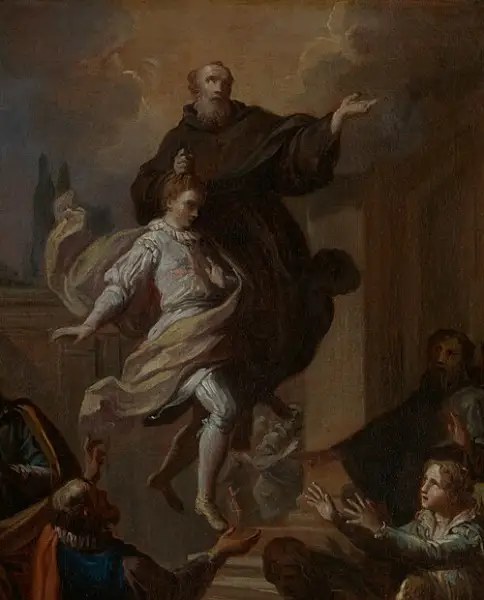
At the Grotella convent, where he would spend the next fifteen years, Joseph's ecstasies took the form for which he is remembered. According to traditional Franciscan accounts he began to levitate at Mass and during the community's recitation of the Divine Office, sometimes spectacularly: the most famous report describes him flying from a doorway across some seventy yards to the summit of a cross thirty-six feet high his friars were building, though skeptics note that feat was recorded only after his death, without eyewitness testimony. The phenomena drew crowds and made him famous for holiness throughout the region and farther afield, but they also made him a problem. His religious superiors and church authorities deemed him disruptive; he was shut up in a tiny cell and barred from every public assembly of the community. Because such flight was commonly thought to be a form of witchcraft, he was denounced to the Inquisition, which ordered him moved from friary to friary within the region for observation, beginning at Assisi, then briefly to Pietrarubbia and finally Fossombrone. Historians still argue over the reports: some suggest exaggeration, athletic leaps, or even ergot poisoning, while others find the quantity and standing of the eyewitnesses compelling testimony that something extraordinary was seen.
§ Alleged levitation
A Discipline of Bitterness and Prayer
Beneath the marvels recorded of Joseph lay a life of severe and hidden asceticism. He practiced harsh self-denial throughout his days, taking solid food generally just two days a week and stirring bitter powders into what meals he took, a regimen he followed for some thirty-five years. Such discipline was not theatrical; it was practiced in friaries where he was regarded less as a wonder-worker than as a difficulty to be managed, confined to his cell, forbidden the company of his community, and shuffled from house to house under the eye of the Inquisition. His spirituality was rooted in the ordinary round of Franciscan life, Mass and the Divine Office, which were precisely the occasions on which his ecstasies were said to overtake him, lifting him from the floor while he stood in prayer. What his contemporaries testified to in the canonization inquests conducted from 1664 to 1695 was not only the levitations but the visible union of this simple soul with God in those moments. His confessor Roberto Nuti, who composed the earliest life in 1678, and the later hagiographers Bernino, Agelli, and Pastrovicchi, all drew on the sworn testimony of those who had watched him. The picture that emerges is of a man whom learning had rejected and whom God, the tradition holds, had not.
§ Life
Osimo, the Last Harbor
The long circuit of confinement and observation ended in mercy. On 9 July 1657 Joseph was at last permitted to go back to a Conventual house, being assigned to the friary at Osimo in the Marche, where he would spend his remaining years. He was then in his mid-fifties, worn by decades of fasting, bitter powders, prison-like cells, and the strain of being examined, denounced, and moved about like a problem in theology. At Osimo he at last lived openly as a Conventual Franciscan among his own brothers, and there his extraordinary life closed quietly. He died on 18 September 1663, aged sixty, in the city whose patron he would become alongside his native Copertino. His basilica in Osimo now stands at Piazza Gallo as his major shrine, receiving the devotion of pilgrims, while his memory traveled as far as California, where the creek and the city of Cupertino bear his name. So complete was the veneration that followed his death that canonization inquests gathered testimony from 1664 to 1695, while numerous witnesses of his life were still alive to swear to what they had seen, evidence on which his earliest biographers, beginning with his confessor in 1678, built the accounts that carried him to the altars.
§ Life
From Inquisition to the Altars
Few saints traveled so far in the judgment of the Church as Joseph of Cupertino. In life he was denounced to the Inquisition as a suspected practitioner of witchcraft, confined, restricted, and moved from friary to friary under surveillance. After his death in 1663 the tide turned: the inquests conducted from 1664 to 1695 collected the sworn testimony of living witnesses to his ecstasies and virtues, and hagiographers beginning with his confessor Roberto Nuti in 1678 shaped the record that Rome would weigh. He was beatified on 24 February 1753 in Rome by Pope Benedict XIV, a pontiff celebrated for the rigor he brought to causes of canonization, which made the honor a judgment on the decades of suspicion the friar had endured. On 16 July 1767, Pope Clement XIII canonized him in Rome, fourteen years later, sealing the Church's verdict that the poor stable-born friar from Apulia had lived a life of heroic holiness. His feast is kept on 18 September, the day of his death, in the Roman Catholic Church, where he is especially honored by the Franciscans. The man whom the Inquisition once examined as a possible witch is now lifted in paint and stone above the basilica at Osimo, depicted in the flight that made him famous.
§ Life
Patron of Students, Pilots, and Astronauts
The curious accidents of Joseph's life became the basis of his patronage. His two providential escapes at the examinations that stood between him and ordination, the Gospel opened by chance to the one verse he knew, the bishop who stopped questioning before he reached the unprepared candidate, earned him the title of patron of students facing examinations and of persons with learning difficulties or disabilities, and millions have prayed to him before tests and studies ever since. His levitations earned him an even more modern honor: he is invoked by pilots, air travelers, and astronauts, the flying friar becoming heavenly patron of those who fly. The cities of Copertino, his birthplace, and Osimo, where he died, both claim him as patron, and his name marks places far from Apulia, including Cupertino Creek and the city of Cupertino in California. His story has also reached beyond devotion into art and argument: a 1962 film, The Reluctant Saint, told his life for the cinema, and his alleged flights remain a touchstone in the debate between skeptics and believers, examined by writers from Gordon Stein and Joe Nickell to the historian Carlos Eire, who found the testimony of the witnesses too weighty to dismiss as lies or mass hysteria.
§ Patronage
Timeline
- 17 Jun 1603
Born Giuseppe Desa in the village of Cupertino in Apulia; his mother, driven from the seized family home, gives birth in a stable
§ Life
- 1620
Rejected by the Conventual Franciscans for lack of education, he is accepted as a lay brother by the Capuchins at Martino near Taranto, then dismissed for his ecstasies
§ Life
- 1625
After years of tending the stables of the Conventual friars, he is received into their Order, on the path to the priesthood
§ Life
- 28 Mar 1628
Ordained a priest after two providential turns at his examinations, and appointed to Santa Maria della Grotella, the convent outside his native town
§ Life
- 1639
Denounced to the Inquisition, he is transferred to the friary at Assisi for observation, where he remains until 1653
§ Life
- 1653
Moved briefly to Pietrarubbia and then to Fossombrone, where he lives under the supervision of the Capuchin friars until 1657
§ Life
- 9 Jul 1657
Allowed at last to return to a Conventual community, and is sent to Osimo
§ Life
- 18 Sep 1663
Dies at Osimo in the Papal States, aged sixty
§ Life
- 24 Feb 1753
Beatified in Rome by Pope Benedict XIV
§ Life
- 16 Jul 1767
Canonized by Pope Clement XIII in Rome
§ Life
The Record
- Patron of
- Patron of the cities of Copertino and Osimo·Patron of aviation, astronauts, and pilots·Patron of those with mental handicaps·Patron of examinations and students
- Symbols
- Depicted lifted in flight, as in Placido Costanzi's painting·Franciscan habit
- Canonization
- Canonized 16 July 1767 by Pope Clement XIII in Rome
Prayer
Bibliography
Show 6 sources
- Pastrovicchi, Angelo (1980). Saint Joseph Copertino. TAN Books and Publishers. ISBN 0-89555-135-7.
- Mershman, Francis. "St. Joseph of Cupertino." The Catholic Encyclopedia. Vol. 8. New York: Robert Appleton Company, 1910.
- Eire, Carlos (2023). They Flew: A History of the Impossible. Yale University Press. ISBN 978-0300259803.
- Stein, Gordon (1989). "The Lore of Levitation". Skeptical Inquirer. 13: 277–288.
- Nickell, Joe (2018). "Secrets of the 'Flying Friar': Did St. Joseph of Copertino Really Levitate?". Skeptical Inquirer. 42 (4): 20–22.
- Roullet, Hervé (2020). St. Joseph of Copertino (in French). AVM Diffusion, Paray-le-Monial, France.
Profile text adapted from the Wikipedia article, licensed CC BY-SA 4.0.
Pray with this saint every day
Save St. Joseph of Cupertino to your favorites, read the full profile, and get feast-day reminders in the Saints app.
Get the Saints AppFree on the App Store for iPhone and iPad