
1556 – 1612·Feast February 4
St. Joseph of Leonessa
Capuchin Preacher and Missionary to Constantinople
Overview
Joseph of Leonessa, born Eufranio Desiderio, was an Italian Capuchin friar whose life joined harsh penance, fearless preaching, and a dramatic brush with martyrdom. Orphaned at twelve and educated by an uncle in Viterbo and Spoleto, he was destined for an arranged marriage until a fever in his sixteenth year changed everything; upon recovering he joined the Capuchin reform of the Franciscans without consulting his guardian, making his profession in 1573 under the name Joseph. After years of preaching through the small towns of Umbria, Lazio, and the Abruzzi, where he won some success even among the bandits around Arquata del Tronto, he was sent in 1587 to Constantinople to minister to Christians enslaved in the galleys of the Ottoman navy. There he tended plague victims, preached daily in the city, was imprisoned, and finally, having tried to reach Sultan Murad III himself, was condemned to death and hung for three days on a gallows by hooks driven through his hand and foot, before being cut down near death. Back in Italy from 1589 he gave himself to home missions, preaching up to seven times a day, feeding and teaching pilgrims in the Jubilee of 1600, founding a Monti di Pietà and a hospice. He died of cancer at Amatrice in 1612 and was canonized in 1746.
The Complete Life
The Boy from Leonessa
The future Joseph of Leonessa first saw the world under another name entirely. He was born Eufranio Desiderio on January 8, 1556, at Leonessa, a small town then belonging to Umbria and now part of Lazio, the child of Giovanni Desideri and Serafina Paolini. Those who wrote his earliest lives reported that even as a boy he was strikingly drawn to religion. His childhood was cut short by sorrow: at twelve he lost both parents, and his uncle took charge of him, seeing to his education first in Viterbo and then at Spoleto. The uncle had made careful plans for his nephew's future, including a suitable marriage that would secure him a place in the world. But God, the Franciscan tradition holds, had other designs. In his sixteenth year the young man fell sick of a fever, and the illness became for him a passage from one life to another. Upon his recovery he acted with startling decisiveness: without consulting the guardian who had raised him, he joined the Capuchin reform of the Franciscan Order and entered the novitiate at the Carcerelle friary outside Assisi, in the shadow of the town where Francis himself had begun.
§ Biography
The Capuchin Habit and the Name Joseph
Eufranio pronounced his vows in January 1573, receiving the religious name Joseph, and continued his studies at Lugnano in Teverina. The choice of the Capuchins, at that time the newest and most austere branch of the Franciscan family, set the pattern of his whole religious life. His abstemiousness set him apart even among friars, and the discipline of fasting would remain the constant undertone of everything he did. Once formed, he was sent out to preach, and he gave himself to it among the small towns of Umbria, Lazio, and the Abruzzi, walking the roads of central Italy in the Capuchin habit. His preaching had power even in unlikely places: he is credited with some success among the bandits who infested the mountains around Arquata del Tronto, outlaws whom respectable society had abandoned. Years later, in 1599, the year before the great Jubilee, he fasted the whole year as preparation for gaining the indulgence, a feat that sums up the man: he prepared for grace as an athlete prepares for contest, believing that the mercy of God deserved the full exertion of those who asked for it.
§ Biography
Constantinople: Captives, Plague, and the Gallows
In 1587 the Minister General of the Order sent Joseph to Constantinople to serve the Christians imprisoned in that city. He and his companions took up lodging in the Galata district, in a house left derelict that had belonged to Benedictine monks, and from that precarious base he threw himself into the service of the enslaved. He was untiringly solicitous for the captive Christians who rowed in the galleys of the Ottoman Empire's navy, and when plague swept through the penal colonies, the friars went immediately to tend the sick and dying. Joseph himself caught the disease but recovered. Daily he entered the city to preach, and the boldness of his preaching eventually landed him in prison, from which he was released only at the intervention of the Venetian agent. Freed, he did not moderate his course but pressed it further: urged on by zeal, he tried to make his way into the palace to confront Sultan Murad III himself. For this he was arrested and sentenced to die. For three days he hung from a gallows, suspended by two hooks pushed through his right hand and his foot; on the third evening, at the point of death, he was taken down, alive but marked forever.
§ Constantinople
Penance, Poverty, and the Poor
Joseph's spirituality was forged in the Capuchin conviction that friars must live the Gospel before they preach it. His great abstinence was the first thing his contemporaries noticed about him; the year-long fast he undertook in 1599, in preparation for the Jubilee indulgence, was only the most spectacular expression of a lifelong habit of bodily discipline. But his penance never curdled into harshness toward others; it issued instead in tenderness for the poor. When he preached the Lenten sermons at Otricoli in the Jubilee year of 1600, the town stood on a road along which crowds of pilgrims traveled toward Rome, and many of these travelers were destitute. Joseph fed them from his own resources, washed their clothes with his own hands, and taught them catechism while they rested. At Todi he cultivated a garden with his own hands so that its produce would go entirely to the poor. And he thought of poverty structurally as well as personally: he organized a Monti di Pietà, a cooperative for loans that protected the needy from usurers, and erected a modest hospice to shelter travelers and pilgrims. Prayer, fasting, and mercy were for him a single movement of the heart.
§ Return to Italy
Home Missions and a Quiet Death
Joseph returned to Italy in 1589, his missionary dreams in the East ended by the gallows but his apostolic energy unbroken. He gave himself to home-mission preaching across his native province, preaching to the towns and villages of central Italy with astonishing stamina, sometimes delivering six or seven sermons in a single day. The famous friar who had hung from hooks in Constantinople now wore himself out in pulpits at Otricoli, Todi, and the small towns of the Abruzzi, where his preaching had begun years before. The remaining two decades of his life followed this rhythm of mission, fasting, and care for the poor, and it ended as unpretentiously as it had been lived. He died of cancer at Amatrice in 1612, at the age of fifty-six, in the town that would one day claim him as its patron. The hooks of his martyrdom had left their permanent mark on his body, but what killed him was an illness borne patiently at home, a final penance accepted without a pulpit or a crowd, in the Franciscan conviction that suffering borne for love of the crucified completes what preaching begins.
§ Return to Italy
Raised to the Altars
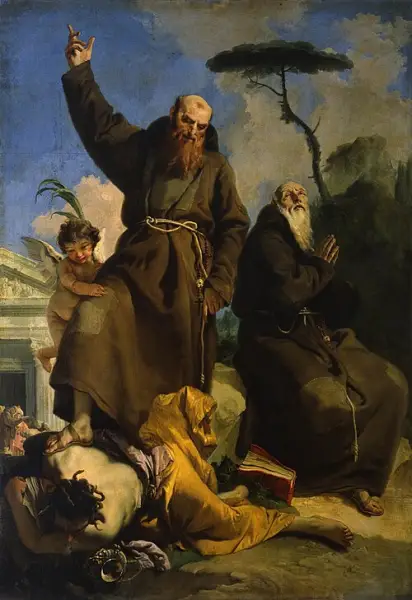
Devotion to Joseph grew steadily in the century after his death, centered on the towns of central Italy that had known his preaching. He was beatified on 22 June 1737 by Pope Clement XII, and less than a decade later, on 29 June 1746, he was canonized by Pope Benedict XIV, the great scholar-pope whose reign did much to codify the Church's procedures for recognizing sanctity. His feast is celebrated on February 4, the anniversary of his death, within the Franciscan family. The hooks through which he had suffered his three-day martyrdom in Constantinople entered his iconography, so that artists depict him with the hook of his torment or with a crucifix in his hand, as Tiepolo shows him alongside Saint Fidelis of Sigmaringen. Centuries after his death his patronage expanded with the Church's missionary consciousness: Pope Pius XII proclaimed him patron of the Missions in Turkey, honoring the friar who had given his blood in Constantinople, and he ranks among the patron saints of the Capuchin province of Abruzzo. The ecclesiastical verdict of 1746 confirmed what the poor pilgrims of Otricoli and the galley slaves of the Ottoman fleet had already known.
§ Veneration
Memory in Central Italy and Beyond
Joseph's cult remains rooted in the hills where he preached and suffered. He is the patron saint of Amatrice, where he died, and of Leonessa, his birthplace, whose main thoroughfare, the Corso San Giuseppe, bears his name, and where a church and sanctuary of San Giuseppe da Leonessa welcome pilgrims. His devotion is concentrated in central Italy, and traces of it survive in the painted images of him preserved in churches at Otricoli, at San Lorenzo Nuovo, and at the Madonna Della Valle in Rivodutri. His reputation, however, reaches far beyond that geography. As patron of the Missions in Turkey, he is invoked for the Church in the lands where he nearly died; as a patron of the Abruzzo Capuchins, he stands at the head of the friars of the region he evangelized; and his story, preserved by the Capuchin Franciscans and told in the Catholic Encyclopedia and by Franciscan Media, continues to be proposed as a model of missionary boldness. Painters, too, kept his memory: Giambattista Tiepolo placed him beside Saint Fidelis of Sigmaringen, binding the preaching friar of Leonessa into the great gallery of Franciscan saints.
§ Veneration
Timeline
- 8 Jan 1556
Born Eufranio Desiderio at Leonessa, son of Giovanni Desideri and Serafina Paolini
§ Biography
- Jan 1573
Pronounces his vows among the Capuchins at the Carcerelle friary outside Assisi, taking the name Joseph
§ Biography
- 1587
Dispatched by his Order's Minister General to Constantinople to serve Christians held captive in the city
§ Constantinople
- 1589
Returns to Italy and devotes himself to home missions across his native province, as often as six or seven sermons in a single day
§ Return to Italy
- 1599
Fasts for the entire year in preparation for gaining the indulgence of the coming Jubilee
§ Biography
- 1600
Preaches the Lenten sermons at Otricoli during the Jubilee year, feeding poor pilgrims and teaching them catechism
§ Return to Italy
- 4 Feb 1612
Dies of cancer at Amatrice
§ Return to Italy
- 22 Jun 1737
Beatified by Pope Clement XII
§ Veneration
- 29 Jun 1746
Canonized by Pope Benedict XIV
§ Veneration
The Record
- Patron of
- Patron saint of Amatrice and Leonessa·Patron of the Missions in Turkey, proclaimed by Pope Pius XII·One of the patrons of the Capuchin province of Abruzzo
- Symbols
- The hook of his martyrdom·A crucifix in his hand
- Canonization
- Canonized 29 June 1746 by Pope Benedict XIV
Prayer
Bibliography
Show 6 sources
- "Saint Joseph of Leonessa", Capuchin Franciscans, Province of St. Mary.
- Hess, Lawrence. "St. Joseph of Leonessa." The Catholic Encyclopedia Vol. 8. New York: Robert Appleton Company, 1910.
- "Saint Joseph of Leonissa", Franciscan Media. Archived from the original on August 11, 2020.
- "St. Joseph of Leonissa", Catholic News Agency.
- Cargnoni, Costanzo, Sulle orme dei santi, Rome, 2000, p. 21-28.
- Madey, Johannes (1999). "Joseph von Leonessa". In Bautz, Traugott (ed.). Biographisch-Bibliographisches Kirchenlexikon (BBKL). Vol. 15. Herzberg: Bautz. cols. 774–776. ISBN 3-88309-077-8.
Profile text adapted from the Wikipedia article, licensed CC BY-SA 4.0.
Pray with this saint every day
Save St. Joseph of Leonessa to your favorites, read the full profile, and get feast-day reminders in the Saints app.
Get the Saints AppFree on the App Store for iPhone and iPad