
1737-1811·Feast November 14
St. Joseph Pignatelli
Jesuit Priest and Restorer of the Society of Jesus
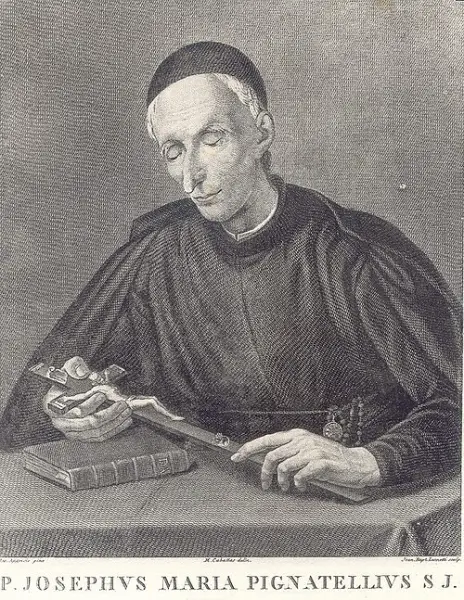
Overview
Joseph Mary Pignatelli, born at Zaragoza on 27 December 1737 into a family of Neapolitan nobility, entered the Society of Jesus at fifteen against his family's wishes, and carried tuberculosis for the rest of his life. Teaching at Zaragoza in 1766, he faced down a crowd intent on burning the governor's palace over a threatened famine — and the king's thanks did not prevent the decree of 1767 that expelled the Jesuits from Spain. Offered the right to remain as a nobleman if he would leave the Society, he chose exile with his brethren instead, organizing shelter, studies, and religious observance for some six hundred priests and seminarians on Corsica, then at Genoa and Ferrara, until Clement XIV suppressed the Society altogether in 1773. In a retired Bologna he began collecting the books and manuscripts of Jesuit history. When Pius VI allowed the survivors to attach themselves to the Jesuits kept alive in the Russian Empire, Pignatelli rebuilt the Order piece by piece: re-established in Parma, master of novices at Colorno from 1799, provincial superior for Italy from 1800, with houses in Naples, Sicily, Rome, Tivoli, and Orvieto, and the Society restored in Sardinia in 1807 — all without an oath of allegiance to Napoleon. He died at Rome on 15 November 1811, under French occupation, before the universal restoration of 1814, and is honored as the Society's second founder.
The Complete Life
Early Life
Joseph Pignatelli was born in Zaragoza on 27 December 1737, of Neapolitan descent and noble lineage. He studied at the Jesuit College of Zaragoza with his brother Nicolas, and there contracted the tuberculosis that would plague him for the rest of his life. Against his family's opposition he entered the Society of Jesus at fifteen, on 8 May 1753 at Tarragona, and after theological studies was ordained and assigned to teach at the college of his native city. In 1766, when the Governor of Zaragoza was blamed for a threatened famine and the crowd stood ready to set his palace on fire, Pignatelli's sway over the populace averted the calamity; though King Charles III sent a letter of thanks, the Jesuits were accused of instigating the riot, and his refutation of the charge was followed anyway by the decree expelling the Jesuits of Zaragoza on 4 April 1767.
§ Early life
Conversion and Vocation
The Count of Aranda, the royal favorite who drove the expulsion, offered to let Joseph and Nicolas, as noblemen, remain in the city if they would leave the Society. Though Joseph's health was fragile, the two brothers would not yield: they chose exile alongside their confreres. That refusal is the hinge of Pignatelli's life: a man of the highest aristocracy who chose the common lot of a suppressed order, and who then spent four decades holding that order together while it had no legal existence. His vocation, in effect, became the Society itself.
§ Early life
Mission and Ministry
Denied a landing at Civitavecchia by Clement XIII, the Aragonese Jesuits sailed to Corsica, where Pignatelli displayed a marked organizational ability in providing for six hundred priests and seminarians, aided with money and provisions by his sister, the Duchess of Acerra; studies were so arranged that regular observance was maintained. When France took Corsica in 1770 the Jesuits moved to Genoa, and then to the legation of Ferrara, and there the community was dissolved by Clement XIV's suppression of the entire Society in August 1773. The brothers took refuge in Bologna, forbidden to exercise ministry, devoting themselves to study as Pignatelli collected books and manuscripts on the Society's history. When Pius VI allowed ex-Jesuits to reunite with the Society surviving in the Russian Empire, Pignatelli obtained fathers from Catherine II's Russia and, with the permission of Ferdinand, Duke of Parma, re-established the Society in his duchy in 1793. He renewed his vows in 1797, became master of novices at Colorno in 1799, and in 1800 Pius VII named him provincial superior of the Jesuits for Italy; in 1804 a papal brief let the Jesuits serve in the Kingdom of Naples.
§ Restoration
Trial and Final Years
Pignatelli's final years were consumed by the rebuilding he would not live to see completed. He was in Rome from 1801 as the recognized head of the Italian Jesuits, negotiating with courts that had expelled the order a generation before, receiving back survivors now scattered in ecclesiastical posts, and preparing for the universal restoration. His tuberculosis never left him. He died in Rome on 15 November 1811, with the Society canonically restored everywhere only three years away, in 1814, under Pius VII.
§ Introduction
Canonization
Pignatelli's cause was among those of the modern Jesuit pantheon: he was beatified in 1933 and canonized by Pius XII on 12 May 1954. The judgment of history, following the judgment of his order, calls him the second founder of the Society of Jesus, the man under whose supervision the restoration was prepared; his canonization formalized that title of honor.
§ Introduction
Legacy
The Society of Jesus that exists today passed through Pignatelli's hands: the refounded provinces of Parma, Naples, and then Italy were his work, and the continuity of vows, novitiates, and studies between the old Society and the restored one was preserved by him in the years when the order had no legal existence. He is also remembered for the collection of books and manuscripts bearing on the Society's history, begun in the enforced idleness of Bologna, which served the order's memory when little else did.
§ Restoration
Timeline
- 27 Dec 1737
Born at Zaragoza, Spain, of Neapolitan noble lineage
§ Introduction
- 8 May 1753
Entered the Society of Jesus at Tarragona at fifteen, despite his family's opposition
§ Early life
- 1766
Calmed the populace of Zaragoza and averted the burning of the governor's palace during the famine unrest
§ Early life
- 4 Apr 1767
Royal decree expelled the Jesuits of Zaragoza; he declined an exemption and chose exile with his brother
§ Early life
- 1770
After France took Corsica, helped lead the exiled Jesuits to shelter in Genoa
§ Exile
- Aug 1773
The Society was suppressed by Pope Clement XIV; he retired to Bologna, collecting books on Jesuit history
§ Exile
- 1793
Re-established the Society in the Duchy of Parma with Jesuit fathers obtained through Empress Catherine II of Russia
§ Restoration
- 6 Jul 1797
Renewed his religious vows
§ Restoration
- 1799
Appointed master of novices for the new novitiate at Colorno
§ Restoration
- 1800
Named provincial superior of the Jesuits in Italy by Pope Pius VII
§ Restoration
- 30 Jul 1804
Papal brief authorized the Jesuits to serve in the Kingdom of Naples
§ Restoration
- 1807
Secured the restoration of the Society in Sardinia
§ Restoration
- 15 Nov 1811
Died in Rome, occupied by France, of hemorrhaging brought on by tuberculosis
§ Death and veneration
- 21 May 1933
Beatified by Pope Pius XI
§ Death and veneration
- 19 Jun 1935
His cause for canonization was formally opened
§ Death and veneration
- 12 Jun 1954
Canonized by Pope Pius XII
§ Death and veneration
The Record
- Major works
- Collected books and manuscripts on the history of the Society of Jesus
- Symbols
- Jesuit cassock·Books and manuscripts of Jesuit history
- Canonization
- Beatified by Pope Pius XI on 21 May 1933; canonized by Pope Pius XII on 12 June 1954
Prayer
Bibliography
Show 4 sources
- 1 2 3 "St. Joseph Pignatelli, SJ (1737-1811)", Ignatian Spirituality
- ↑ Kempf, Konstantin (1916). The Holiness of the Church in the Nineteenth Century: Saintly Men and Women of Our Own Times . Benziger brothers. pp. 117 –124. Sardinia.
- ↑ Index ac status causarum beatificationis servorum dei et canonizationis beatorum (in Latin). Typis polyglottis vaticanis. January 1953. p. 128.
- ↑ Martínez de la Escalera, José (1994-12-30). "El Padre Isla y su familia en Santiago" . Cuadernos de Estudios Gallegos . 41 (106): 167– 186. doi : 10.3989/ceg.1994.v41.i106.279 . ISSN 1988-8333 .
Profile text adapted from the Wikipedia article, licensed CC BY-SA 4.0.
Pray with this saint every day
Save St. Joseph Pignatelli to your favorites, read the full profile, and get feast-day reminders in the Saints app.
Get the Saints AppFree on the App Store for iPhone and iPad