
1897 – 1959·Feast August 16
St. Joseph the Hesychast
Athonite Elder and Spiritual Father of Monks
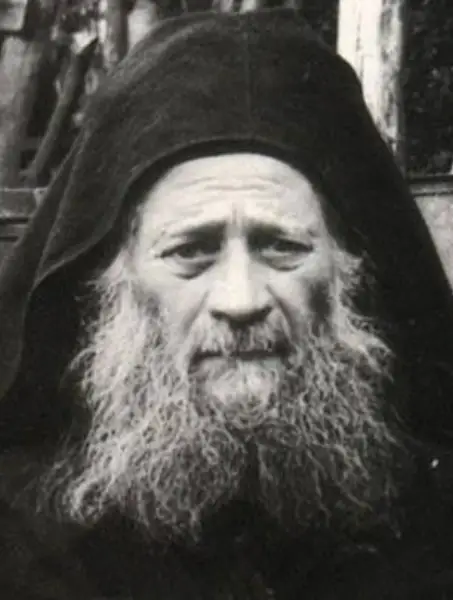
Overview
Joseph the Hesychast, born Fragkiskos Kottis on the Aegean island of Paros, became one of the most influential Athonite elders of the twentieth century. Orphaned of his father in childhood and schooled only to the second grade, he worked in the Greek Navy and as a vendor in Piraeus and Athens before reading the lives of the saints awakened in him a longing for the desert. At about the age of twenty-three he went to Mount Athos, joining the brotherhood of Daniel of Katounakia before moving on to ever greater solitude, receiving the monastic name Joseph of Vigla in the cave of Athanasius the Athonite in 1925. With Arsenios the Cave Dweller as his fellow ascetic he lived in caves and remote cells, and from the 1930s a growing brotherhood gathered around him at Little St. Anne's Skete and later the New Skete. His disciples included Ephraim of Arizona, founder of more than nineteen monasteries in North America, Joseph of Vatopedi, and Ephraim of Katounakia. He died on the feast of the Dormition in 1959, having foretold the hour of his death. Canonized by the Ecumenical Patriarchate in 2020, he is honored for his teaching on the Jesus Prayer and his role in the spiritual repopulation of Mount Athos.
The Complete Life
The Poor Boy from Paros
The man the Church would come to call Joseph the Hesychast began life as Fragkiskos, Francis, Kottis, born on 12 February 1897 in the village of Lefkes on Paros, a Greek island of the Aegean, the third of the seven children of Georgios and Maria Kottis. His childhood was marked by loss: his father died while he was still a child, and his mother Maria was left to raise the large family by herself. His formal education was almost nothing, lasting only until the second grade, and as a teenager he stayed in the village, working beside his mother and siblings at whatever tasks brought in a living. He served in the Greek Navy, and by about the age of twenty-three he was working as a vendor in Piraeus and Athens, one more unlettered young man in the capital's crowds. Yet in Athens something decisive happened: he took up reading the lives of the saints and hermits, and the reading lit a fire. On Mount Penteli above the city he passed whole nights in prayer inside caves, and even in trees, imitating in his own body the medieval anchorites and stylites he had read about. From those sleepless nights on the mountain, the road led inevitably to the Holy Mountain itself, where he presented himself for the monastic life.
§ Early life
Katounakia and the Name Joseph
In 1921 the young Francis arrived at Mount Athos, and his first destination was Katounakia, the most austere ledge of the peninsula, where hermits lived in cells too small to be called houses. He joined the Danielaioi Brotherhood and spent some months in their skete, directed spiritually by Daniel Katounakiotis of Smyrna, the brotherhood's founder, one of the celebrated elders of the era. When he left, it was with Daniel's blessing, in search of a still stricter asceticism. The next year he climbed to the very summit of the Holy Mountain on the Feast of the Transfiguration, celebrated in the Chapel of the Transfiguration at the peak, and there he met Arsenios the Cave Dweller, a monk of Stavronikita Monastery who would become his lifelong fellow ascetic and disciple. Looking for a disciplined elder to help him in asceticism, he went in 1924 with Arsenios into the Annunciation Cell of the Virgin Mary at Katounakia, to place themselves under the two elders Ephraim and Joseph. There, on 31 August 1925, then twenty-eight years old, he received the monastic name Joseph of Vigla in the cave of Athanasius the Athonite, the name under which he would be sanctified.
§ Monastic life
Into the Wilderness with a Brotherhood
Joseph's idea of the monastic calling led him ever deeper into the desert places of Athos. In mid-1928 he and Arsenios withdrew into wilder, lonelier country near the Skete of St. Basil, and there for about ten years they practiced intensive spiritual discipline, fasting, and prayer, experiencing, the tradition records, many visits of divine grace. Joseph also served during those years as the spiritual guide of Ephraim Katounakiotis, and his influence widened when his own brother Nicholas Kottis renounced the world and entered his brother's company, taking the name Athanasios. After that decade of hiddenness, Monk Joseph consented to take under his guidance any monk willing to follow him. In January 1938 the small group went to Little St. Anne's Skete, into caves beside the chapel of Timios Prodromos, raised by their own hands, on cliffs above the sea. There disciples began to gather: the Cypriot Sophronios, his first disciple of that period, who would serve as elder of Vatopedi Monastery until 2009; Ephraim, later abbot of Philotheou and founder of more than nineteen monasteries in the United States and Canada; and Haralambos, future abbot of Dionysiou. In 1953 the group settled at the New Skete, Joseph's last home.
§ Monastic life
The Jesus Prayer and the Life of Stillness
Joseph's whole spirituality is gathered into the word hesychast, one who pursues stillness. He is known for his mystical approach to advocating the use of the Jesus Prayer at Mount Athos, the short invocation of the name of Jesus repeated unceasingly, and his own practice of it, passed on through decades of guidance, helped renew the contemplative tradition of the Holy Mountain in the twentieth century. His teaching reached the wider world through his letters: sixty-five of them, published by the Monastery of Philotheou, together with various books preserve his spiritual instruction, much of it transmitted by his disciple Elder Ephraim's account of his life and teaching. The pattern of his practice was radical: caves for dwellings, all-night prayer, severe fasting, and the kind of experiences of divine grace that the Philokalic tradition describes. He prayed through the nights on Mount Penteli even before he was a monk, and he never abandoned that vigilance. His letters, written to monks and nuns in Greek of great simplicity, have become classics of modern Orthodox spiritual literature, making him, a man with a second-grade education, one of the most influential teachers of prayer of his century.
§ Legacy
Dormition and Burial
Joseph's death carried the seal of the devotion that had shaped his life. A month before he died, he said the Virgin Mary herself had made known to him the precise hour. On 14 August 1959 he kept the vigil for the Dormition of the Mother of God and received the Blessed Sacrament, and on 15 August, the feast itself, he died of heart failure at the age of sixty-two. That same day he was buried in a tomb in the New Skete's chapel of the Annunciation on the Holy Mountain, near the tower of the skete, the feast of the Dormition becoming, as it were, his own feast of falling asleep. His relics, as the tradition of Athos expected, became an object of veneration and are now kept in various monasteries, including St. Anthony's Greek Orthodox Monastery in Florence, Arizona, one of the American houses founded by his disciples, and his remains are also kept at Vatopedi Monastery. Today his tomb, now enshrined in a chapel, stands at the northern limit of the New Skete, and the cliff-side hut of his hermitage, just north of Little Saint Anne's Skete, still looks out over the Aegean.
§ Death and burial
Elder Joseph, Inscribed in the Holy Calendar
Six decades after his death, the Church of Constantinople raised Joseph to the altar. On 20 October 2019, Ecumenical Patriarch Bartholomew I of Constantinople announced the glorification of Joseph the Hesychast at Karyes, the administrative capital of Mount Athos, an announcement made on the Holy Mountain itself, where the elder had lived and died. On 9 March 2020, by Patriarchal and Synodal Act, the Ecumenical Patriarchate's Holy and Sacred Synod enrolled Elder Joseph in the Orthodox Church's calendar of saints, canonizing him formally. His feast was set for 16 August, the day after the Dormition on which he died. The canonization belonged to a remarkable season in which the Patriarchate also glorified his own spiritual forebears and contemporaries, Daniel of Katounakia and Ephraim of Katounakia. Venerated in the Eastern Orthodox Church, he is now honored at his tomb in the New Skete, at Vatopedi, and across the diaspora monasteries of his spiritual family in North America, where his icons hang in Orthodox parishes and his letters are read as the teaching of a saint.
§ Canonization
The Elder Who Repopulated the Holy Mountain
Joseph's influence on monastic life, in Greece and far beyond it, has few twentieth-century parallels. He was instrumental in bringing six of Mount Athos's monasteries back to life, the ancient houses that had been thinning toward extinction in the mid-century, as well as of many nunneries in Greece, largely through the disciples he formed and sent out. Of these the most consequential was Ephraim of Arizona, abbot of Philotheou, who founded more than nineteen monasteries in the United States and Canada, carrying Joseph's teaching on the Jesus Prayer and hesychast practice to a new continent; others of his circle led Vatopedi and Dionysiou, and his influence is traced in Arsenios the Cave Dweller, Ephraim of Katounakia, and Joseph of Vatopedi. His own voice survives in the sixty-five letters published by Philotheou and in the books devoted to his life and teaching. Memory of him has even reached the cinema: the documentary film Elder Joseph the Hesychast, produced, written, and edited by the Monastery of Vatopedi in 2019, took four jury prizes at the London Greek Film Festival. The poor vendor from Athens ended as the spiritual grandfather of a monastic renewal spanning two continents.
§ Legacy
Timeline
- 12 Feb 1897
Born Fragkiskos Kottis at Lefkes on the island of Paros, third of the seven children of Georgios and Maria Kottis
§ Early life
- 1921
Arrives on Mount Athos and joins the Danielaioi Brotherhood at Katounakia under Daniel Katounakiotis of Smyrna
§ Monastic life
- 1922
Ascends the summit of Mount Athos on the Feast of the Transfiguration and meets Arsenios the Cave Dweller
§ Monastic life
- 1924
Settles with Arsenios at the Annunciation Cell of the Virgin Mary in Katounakia to follow the elders Ephraim and Joseph
§ Monastic life
- 31 Aug 1925
Receives the monastic name Joseph of Vigla in the cave of Athanasius the Athonite, at the age of twenty-eight
§ Monastic life
- 1928
Withdraws with Arsenios into wilder, lonelier country by the Skete of St. Basil
§ Monastic life
- Jan 1938
Leads his small group of monks to Little St. Anne's Skete, where they settle in caves near a chapel of Timios Prodromos they build themselves
§ Monastic life
- 1953
His group settles in the New Skete of Athos, the final home of his lifetime
§ Monastic life
- 15 Aug 1959
Dies of heart failure on the feast of the Dormition at Mount Athos, the day after attending the Dormition vigil, aged sixty-two
§ Death and burial
- 20 Oct 2019
Ecumenical Patriarch Bartholomew I announces his glorification at Karyes, Mount Athos
§ Canonization
- 9 Mar 2020
By Patriarchal and Synodal Act, the Ecumenical Patriarchate enrolls Elder Joseph in the Orthodox Church's calendar of saints
§ Canonization
The Record
- Major works
- 65 letters of spiritual teaching, published by the Monastery of Philotheou
- Canonization
- Canonized 9 March 2020 by the Ecumenical Patriarchate of Constantinople; glorification announced 20 October 2019 by Patriarch Bartholomew I
Prayer
Bibliography
Show 6 sources
- Ephraim of Arizona (2008). My Elder Joseph the Hesychast and Cave Dweller (1897-1959). Arizona, U.S. ISBN 978-960-93-0580-8.
- Monk Joseph Dionysaitis. Elder Arsenios the Cave-dweller (1886–1983): Fellow Ascetic of Elder Joseph the Hesychast. Transl. Angela Georgiou. 2005.
- Mesa Potamos Kyprou, Holy Monastery of Timios Prodromos (2018). Saint Elder Joseph the Hesychast. Athens: Athos Ltd. (Stamouli SA). ISBN 978-960-495-256-4.
- Elder Joseph of Vatopaidi (1999). Elder Joseph the Hesychast: Struggles, Experiences, Teachings (1898-1959). Mount Athos: The Great and Holy Monastery of Vatopaidi. ISBN 9789607735126.
- Triantaphyllos, Prot. Georgios (2007). Elder Joseph the Hesychast, the Neptic Father and Teacher. Paros: Panagia Myrtidiotissa Holy Hermitage. ISBN 9789608815759.
- Monastic wisdom: the letters of Elder Joseph the Hesychast. Florence, AZ: St. Anthony's Greek Orthodox Monastery. October 1999. ISBN 0-9667000-0-7.
Profile text adapted from the Wikipedia article, licensed CC BY-SA 4.0.
Pray with this saint every day
Save St. Joseph the Hesychast to your favorites, read the full profile, and get feast-day reminders in the Saints app.
Get the Saints AppFree on the App Store for iPhone and iPad