
c. 816 – 886·Feast April 3
St. Joseph the Hymnographer
Byzantine Greek monk and master liturgical poet
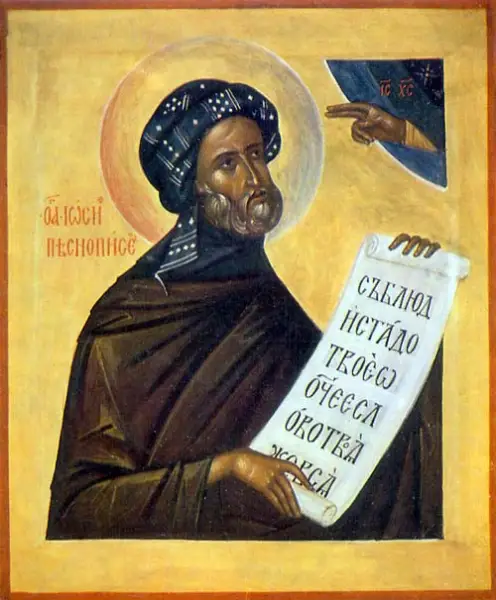
Overview
Joseph the Hymnographer was a ninth-century Greek monk honoured among the greatest liturgical poets of the Eastern Orthodox Church and remembered for his steadfast confession of the Orthodox faith during the resurgence of Iconoclasm. Born in Sicily around 816 to devout parents, he fled with his family before the Arab conquest of the island and took monastic vows as a youth at the Latomos Monastery in Thessalonica, where he was later ordained a priest-monk. Summoned to Constantinople by Gregory of Dekapolis, he was dispatched on a mission to Rome in 841, was captured by slave-trading pirates en route, and endured bondage in Crete before a vision of St. Nicholas restored him to freedom. In the capital he established a monastery in honour of his mentor, was exiled to Cherson in 858 for denouncing Caesar Bardas, and after his return served as keeper of the sacred vessels of the Great Church under Patriarch Ignatius and enjoyed the confidence of Patriarch Photius, who appointed him confessor to the clergy. His surviving canon of hymns, though difficult to distinguish from those of his older namesake Joseph of Thessalonica, reshaped the Byzantine chant books. He died on 3 April 886 in Thessalonica.
The Complete Life
A Childhood Uprooted by Invasion
Joseph was born in Sicily around the year 816, most probably shortly after that date, to devout parents named Plotinus and Agatha. The island of his birth was among the most cultivated corners of the Greek-speaking world, but it was also on the front line of the Arab expansion across the Mediterranean. While Joseph was still a boy the invasion of Sicily forced his family to abandon their home, and according to the hagiographer Theophanes they sought refuge in the Peloponnese. The traditions disagree about the details: one modern scholar places the family's departure in 831 from the port of Palermo and regards that city as his birthplace, while the later hagiographer Pediasimos named Syracuse instead. What is certain is that the upheaval of exile shaped him early, and that the family's faith survived the crossing. In Greece the refugee boy was drawn to the monastic life, and at about fifteen years of age he received the tonsure at the Latomos Monastery in Thessalonica, beginning the ascetic career that would carry him from the margins of the Byzantine world to its imperial capital.
§ Life
Monk and Priest of Thessalonica
Within the walls of the Latomos Monastery Joseph grew from a consecrated youth into a settled monk, and around 840 the bishop of Thessalonica advanced him to the priesthood as a hieromonk. His reputation for holiness of character was already such that when Gregory of Dekapolis, a distinguished ascetic of the age, visited Thessalonica, he was deeply impressed by the young priest-monk and invited him to join his monastery in Constantinople. This summons changed the course of Joseph's life. Gregory's community in the capital belonged to the circle of the Studite reform, the movement that had renewed Byzantine monastic discipline and hymnody in the generations after Theodore the Studite. Joseph's transfer to Constantinople placed him at the centre of that renewal, and it bound him in lasting discipleship to Gregory, whose memory he would later honour with a monastery of his own. From this period also dates his lifelong immersion in the liturgical poetry of the church, the craft for which he would eventually be called the Hymnographer.
§ Life
Captivity on the Road to Rome
When Byzantine Iconoclasm flared again under the emperors Leo V the Armenian and Theophilos, Joseph proved an active defender of the holy images. In 841, at Gregory's sending and in response to an invitation from Pope Leo III, he set out for Rome on behalf of the iconodule cause. The journey ended in disaster before it began: pirates who traded in slaves seized him on the way, and he was sold as a slave on the island of Crete. In bondage he endured more than a year of servitude, though later hagiographers, embellishing the tale, stretched his imprisonment to six years and cast the pirates as agents of the iconoclastic emperor. According to the vita, relief came through a heavenly visitor: St. Nicholas appeared to the captive Joseph, bade him sing in God's name, and commanded: "Arise and follow me!" Soon after the vision Joseph found his freedom. He got back to Constantinople once Theophilos was dead and the icons restored, reaching the capital, by one modern reckoning, in February 843, in time for the feast of Orthodoxy.
§ Iconodule mission to Rome
Founder, Ascetic, and Father of Monks
Joseph's spirituality was forged in the Studite tradition of disciplined asceticism joined to ceaseless liturgical prayer. After the death of his mentor Gregory, he settled with their common disciple John at the hermitage of St. Antipas, and when John died around 850 he withdrew for some years to a sanctuary of St. John Chrysostom, deepening his ascetic labours and drawing followers to himself. Out of this nucleus he raised, in 855, a monastery dedicated to Gregory of Dekapolis, enshrining the relics of his mentor in its church of St. Bartholomew the Apostle. Contemporaries credited him with the gift of discernment of spirits, and on that account Patriarch Photius made him father and confessor to his priests, commending him in his recommendation as God's own man, an angel clothed in flesh, and a father unto fathers. His authority was not confined to the cloister: he stood among those who inspired the first Christian missionaries sent to Russia, extending his influence from the chant books of Constantinople to the evangelization of the Slavic lands.
§ Monastic foundations
Exile, Honour, and a Peaceful Death
Joseph's outspokenness twice brought him into conflict with the powerful. In 858 he denounced Caesar Bardas, brother of the empress Theodora, for his illicit cohabitation, and for this candour he was banished to the theme of Cherson on the remote Crimean frontier. Only after Bardas was assassinated, in 867, was he able to return to Constantinople. His standing in the church then rose steadily: the favour of Patriarch Ignatius won him the post of skeuophylax, custodian of the sacred vessels, in Constantinople's Great Church, and he enjoyed the confidence no less of Ignatius's rival and successor, Photius the Great, whose banishment he accompanied in solidarity. Even in old age he remained a counsellor of clergy and a stimulus to the church's missionary outreach. He died on 3 April 886 in Thessalonica, the city of his monastic beginnings, and his disciple Theophanes, who had followed him as hegoumenos of his monastery, recorded his passing and composed the earliest account of his life.
§ Exile and recognition as an anachorete and saint
The Hymnographer's Enduring Corpus
Joseph's fame rests above all on his liturgical poetry, yet his legacy is complicated by a case of mistaken identity. Because he is so often confused with Joseph the Archbishop of Thessalonica, brother of Theodore the Studite and one generation his senior, the attribution of specific hymns remains a contested question among scholars. The most influential modern attribution, advanced by Tomadakes in 1971, assigns to the Sicilian Joseph roughly 385 canons with 9 kontakia for the menaion, 68 canons within the parakletike, six whole canons plus 34 triodes-tetraodes drawn from the triodion, and 2 canons with 24 more triodes-tetraodes belonging to the pentekostarion, together with additional canons and stichera that circulated as apocrypha outside the Studite chant books. Earlier sources recently discovered temper the claim that he invented the Parakletike outright, but they confirm that the repertoire was reordered under his initiative. His memory was served by a chain of Lives, from Theophanes's contemporary vita through an eleventh-century synaxarion to a Palaiologan encomium, and his feast is kept on 3 April in the Greek tradition and the modern Roman Martyrology, and on 4 April in the Slavic rite.
§ Hymnography
Timeline
- 816
Born in Sicily, most probably soon after this date, to the devout couple Plotinus and Agatha.
§ Life
- 831
His family fled Sicily for the Peloponnese to escape the Arab invasion of the island.
§ Life
- 831
Tonsured a monk as a youth of about fifteen at Thessalonica's Latomos Monastery.
§ Life
- 840
Ordained a hieromonk by the bishop of Thessalonica; Gregory of Dekapolis then summoned him to Constantinople.
§ Life
- 841
Sent to Rome on an iconodule mission, he was seized by pirates and sold into slavery in Crete.
§ Iconodule mission to Rome
- 843
Freed after a vision of St. Nicholas, he returned to Constantinople around this time, following the restoration of the icons.
§ Iconodule mission to Rome
- 850
His companion John, the shared disciple of himself and Gregory of Dekapolis, died at the hermitage of St. Antipas.
§ Monastic foundations
- 855
He founded a monastery in honour of his deceased mentor Gregory of Dekapolis, placing relics in its church of St. Bartholomew.
§ Monastic foundations
- 858
Exiled to the theme of Cherson for denouncing Caesar Bardas over his illicit cohabitation.
§ Exile and recognition as an anachorete and saint
- 867
Recalled to Constantinople after the assassination of Bardas, he later entered the service of the patriarchs.
§ Exile and recognition as an anachorete and saint
- 3 Apr 886
Died in Thessalonica, according to his hagiographer Theophanes.
§ Life
In Their Own Words
A man of God, an angel in the flesh and father of fathers.
The Record
- Major works
- 385 canons and 9 kontakia of the menaion (attributed)·68 canons of the parakletike (attributed)·6 complete canons and 34 triodes-tetraodes of the triodion (attributed)·2 canons and 24 triodes-tetraodes of the pentekostarion (attributed)·Monastery of St. Gregory of Dekapolis, Constantinople
- Canonization
- Pre-congregation; venerated in the Eastern Orthodox and Catholic churches since the ninth century
Prayer
Bibliography
Show 6 sources
- Anon. (1909). Bibliotheca Hagiographica Graeca. Brussels: Société des Bollandistes.
- Ioannes o Diakonos (1862). "Λόγος εἰς τὸν βίον τοῦ ἐν ἁγίοις πατρός ἡμῶν Ἰωσὴφ τοῦ ὑμνογράφου". Patrologia Graeca. 105: cc. 939–976.
- Mioni, Elpidio (1948). "I kontakia inediti di Giuseppe Innografo: studio introduttivo e testi". Bollettino della Badia Greca di Grottaferrata. 2: 87–88, 177–193.
- Papadopulos-Kerameus, Athanasios, ed. (1901). "Vie de saint Joseph l'Hymnographe par Théophane". Monumenta Graeca et Latina Ad Historiam Photii Patriarchae Pertinentia. 2: 1–14.
- Stiernon, Daniel (1973). "La vie et l'œuvre de S. Joseph l'Hymnographe. À propos d'une publication récente". Revue des études byzantines. 31: 243–266. doi:10.3406/rebyz.1973.1468.
- Treu, Maximilian, ed. (1899). "Θεοδώρου τοῦ Πεδιασίμου λόγος ἐγκωμιαστικὸς εἰς τὸν ὄσιον Ἰωσὴφ τὸν ὑμνογράφον". Programm des Victoria-Gymnasiums zu Potsdam. 84: 1–14.
Profile text adapted from the Wikipedia article, licensed CC BY-SA 4.0.
Pray with this saint every day
Save St. Joseph the Hymnographer to your favorites, read the full profile, and get feast-day reminders in the Saints app.
Get the Saints AppFree on the App Store for iPhone and iPad