
c. 1439 – 1515·Feast September 9
St. Joseph Volotsky
Abbot of Volokolamsk and defender of monastic landownership
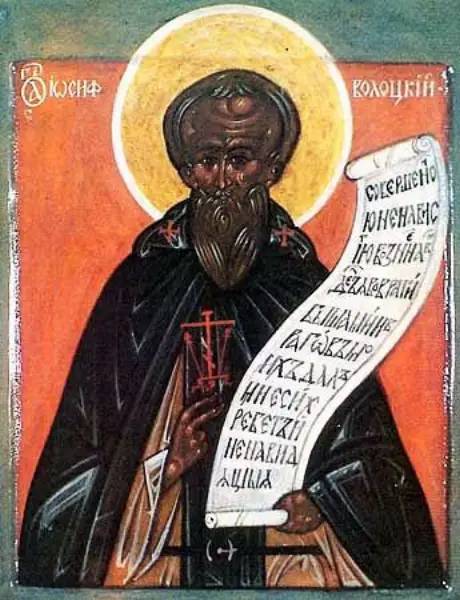
Overview
Joseph Volotsky, born Ivan Sanin, was a Russian theologian, monastic founder, and abbot whose career shaped the relations of Church and state in Muscovy. Born around 1439 or 1440 into the family of a wealthy landowner of the Volokolamsk region, he learned his letters at a local monastery and took the monastic habit at Borovsk in 1459. On the death of St. Paphnutius of Borovsk he succeeded him as abbot, but when the monks rejected the strict charter he tried to impose he left for good, and in 1479 he founded his own cloister near Volokolamsk, the future Joseph-Volokolamsk Monastery, where absolute obedience to the abbot governed every detail of life. At the Church Sobor of 1503 he led the possessors against the non-possessors of Nilus of Sora and saved monastic landholding; in 1504 he demanded that the heretics called Judaizers be executed by the state, refuting their teaching in his sixteen-chapter work The Enlightener. He articulated a doctrine of tsarist authority — the tsar is God's deputy on earth, yet legitimate only so long as he keeps the Church's rules — and in 1507 transferred his monastery to the patronage of Vasili III. Locally canonized in 1579 and nationally in 1591, he is commemorated on 9 September and 18 October.
The Complete Life
Ivan Sanin of Volokolamsk
The man the Russian Church remembers as Joseph Volotsky was born Ivan Sanin, around 1439 or 1440, into the household of a prosperous votchinnik — a landed proprietor — whose holding was the village of Yazvishche in the Principality of Volokolamsk, in what is now Moscow Oblast. His first learning came at the local monastery, where he was taught to read and write, an education that set the course of his life toward the cloister. In 1459 he traveled to the Borovsk Monastery and received the monastic tonsure there, placing himself under the discipline of its revered superior, St. Paphnutius of Borovsk. The monastery of Borovsk was a school of strict asceticism, and the young monk absorbed both its practices and the conviction that the religious life demanded a precise and demanding rule. When Paphnutius died, Joseph was chosen to take his place as abbot of the community — a remarkable trust in a young disciple — and it was in that office that the two great themes of his career first appeared: the reform of monastic life by a strict charter, and the resistance his rigor would meet even from his own brethren.
§ Background
Founding Volokolamsk
As abbot of Borovsk, Joseph attempted to introduce a strict monastic charter, but the monks rebuffed his idea and he was obliged to leave the monastery for good. He then passed through several other houses, and what he found deepened his disquiet: their lax morals convinced him that Russian monasticism needed not merely a new rule but new communities founded upon one. In 1479 he established his own cloister near Volokolamsk, the monastery that came to bear his name — the Joseph-Volokolamsk Monastery. Under his rule the monk's paramount virtue was total obedience to the abbot, and each detail of cloister life fell under regulation and supervision; nothing in a Volokolamsk monk's day was left to private choice. At first Joseph stood close to the appanage princes of Volokolamsk — Ivan III's own brothers — upholding the right of local churchmen and lay feudatories to resist the grand prince's authority. In his later years he broke with that opposition and rallied to the grand prince's side, cementing the new alignment in 1507 by transferring his monastery to the patronage of Vasili III — a decisive turn in the politics of Church and crown in Muscovy.
§ Background
The Possessors and the Non-Possessors
The great public struggle of Joseph's life was fought over the property of the monasteries. At the Church Sobor of 1503 a party known as the nestiazhateli, or non-possessors — Transvolgan elders led by Nilus of Sora and Vassian Patrikeyev — proposed the elimination of monastic landownership. Joseph and his supporters, the Josephites, managed to scrap the project. To the non-possessors he sent a series of epistles arguing that the estates of monasteries were lawful and that the lavish ornament of churches served a holy purpose, arguing from the Church's need for material means to sustain its work of prayer and charity. The dispute was not merely economic but spiritual, a question of what monastic poverty required and whether the treasures of the Church served God or corrupted his servants. In the end Joseph gained the upper hand, and the monasteries of Russia preserved their landholdings — a victory with consequences for centuries. The possessors' victory advanced together with Joseph's campaign to strengthen the standing of Russia's grand princes, who were increasingly called tsars, heirs of the universal emperors of Byzantium; the alliance he sealed with Vasili III in 1507 showed that the fate of his monastery and the fate of the Muscovite state had become, in his mind, one cause.
§ Struggle against the non-possessors
Theology of the Tsar
Joseph's theology of authority became his most consequential teaching. Restating the formula of the early Byzantine ecclesiastical writer Agapetus, he taught that the tsar is by nature a man, yet the might he wields belongs to God, and that the ruler serves as God's deputy on earth. Yet Joseph's doctrine was no blanket endorsement of royal will. The ruler's foremost obligation, as Joseph saw it, is to promote the Christian Church's welfare; only while he observes the Church's canons and moral duties, therefore, does his authority remain legitimate — a limiting clause that gave Joseph's tsarism its distinctive shape. This teaching served the rise of the grand princes, who now claimed the imperial inheritance of Byzantium, and it made Joseph an early proponent of tsarist autocracy; but it also subordinated the throne to the moral law of the Gospel. Within his own monastery the same rigor appeared in ecclesiastical miniature: his charter made absolute obedience to the abbot the monk's chief virtue, and regulated and controlled every aspect of the common life, so that the house at Volokolamsk embodied in discipline what Joseph preached for the empire in politics.
§ Ideas on the authority of the tsar
Against the Judaizers
Joseph was also a relentless opponent of the heretical sect spreading through Russia in his day, known as the Judaizers. At the Sobor of 1504 he called upon the state to put every heretic to death. His major work, The Enlightener (Prosvetitel), set out his case in sixteen chapters: it sought to demonstrate the wrongfulness of the 'new teaching' so that heretics could be prosecuted, and to persuade the faithful not to credit the sincerity of their repentance. He modeled his approach on the way Rome and Byzantium had handled heresiarchs, and on the inquisitions that Dominican friars directed in the Iberian peninsula; Joseph urged a civil inquisition against the heretics and championed their imprisonment and execution — a severity that placed him, characteristically, in sharp opposition to St. Nilus of Sora, his adversary in the landholding dispute as well. The national church confirmed his life's work soon after his death: his sainthood was officially accepted following his local canonization in 1579 and his national canonization in 1591, and his monastery stood as the shrine of a party whose victory he had defined.
§ Struggle against heresies
Saint of the Russian Church
The Russian Orthodox Church reckons Joseph Volotsky among its saints, and it honors him together with the adversary whose causes he fought, Nilus of Sora — a pairing that preserves in its calendar of saints the very debate the two men carried on in life. His veneration proceeded in two stages: a local canonization in 1579, within a lifetime of his death, and a national canonization in 1591, carried out under Patriarch Job of Moscow. His memory is celebrated on 9 September and 18 October, dates kept according to the Julian Calendar, the former being the anniversary of his death in 1515. His major shrine is the monastery he founded, the Joseph-Volokolamsk Monastery, and he is portrayed in icons vested as a monk, the habit in which he lived and died. In modern times the Church has added an unexpected patronage to his intercession: he is invoked as patron of businessmen, a title that arose from his defense of the Church's possessions and that has given his ancient witness a place in the commercial life of the present day.
§ Struggle against heresies
Timeline
- 1439
Born Ivan Sanin, in this or the following year, into the family of a wealthy landowner of the Principality of Volokolamsk.
§ Background
- 1459
Received the monastic tonsure at the Borovsk Monastery.
§ Background
- 1479
Founded his own cloister near Volokolamsk after other monasteries disappointed him with their lax morals, the future Joseph-Volokolamsk Monastery.
§ Background
- 1503
At the Church Sobor of 1503 his party defeated the project of the non-possessors to eliminate monastic landownership.
§ Struggle against the non-possessors
- 1504
Called at the Sobor of 1504 for the state to put every heretic to death.
§ Struggle against heresies
- 1507
Transferred the Joseph-Volokolamsk Monastery to the patronage of Vasili III, sealing his alliance with the grand prince.
§ Background
- 9 Sep 1515
Died on 9 September, the date on which his memory is still celebrated.
§ Background
- 1579
Canonized locally by the Russian Orthodox Church.
§ Struggle against heresies
- 1591
Canonized nationally, with Patriarch Job of Moscow presiding over the Russian Orthodox Church.
§ Struggle against heresies
The Record
- Major works
- The Enlightener (Prosvetitel)·Epistles to the non-possessors·Joseph-Volokolamsk Monastery, founded 1479
- Patron of
- Businessmen
- Symbols
- Vested as a monk
- Canonization
- Locally canonized by the Russian Orthodox Church in 1579; nationally canonized in 1591 under Patriarch Job of Moscow.
Prayer
Bibliography
Show 2 sources
- "Orthodox Businessmen Get a Patron Saint", 11 December 2009
- David M. Goldfrank, "Old and New Perspectives on Iosif Volotsky's Monastic Rules," Slavic Review, Vol. 34, No. 2 (Jun., 1975), pp. 279-301
Profile text adapted from the Wikipedia article, licensed CC BY-SA 4.0.
Pray with this saint every day
Save St. Joseph Volotsky to your favorites, read the full profile, and get feast-day reminders in the Saints app.
Get the Saints AppFree on the App Store for iPhone and iPad