
c. 1869 – 1947·Feast February 8
St. Josephine Bakhita
Former slave who became a Canossian sister
Overview
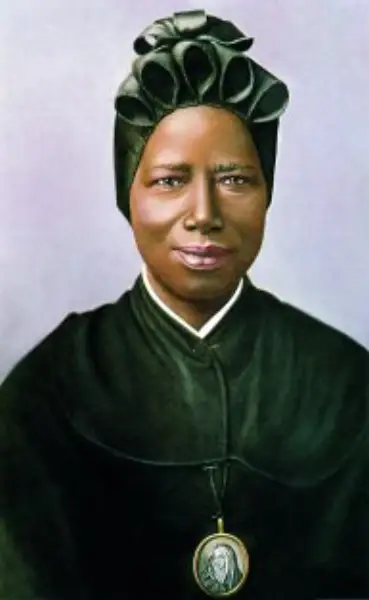
Josephine Margaret Bakhita was a Sudanese Catholic religious sister of the Canossian Daughters of Charity whose life carried her from childhood enslavement in Darfur to half a century of quiet service in Italy. Born around 1869 in the village of Olgossa to a respected Daju family, she was seized by slave traders at about the age of seven and forced to walk hundreds of miles to El Obeid. Over twelve years she was sold repeatedly, brutally scarified by one mistress, and finally purchased in Khartoum by the Italian consul Callisto Legnani, who treated her humanely. She reached Italy in 1885 and, entrusted to the Canossian sisters of Venice, met the Christian God she had sensed in her heart all her life. An Italian court ruled in 1889 that she had never lawfully been a slave, and she chose freely to remain with the sisters. Baptized in 1890 with Archbishop Giuseppe Sarto officiating, she entered the Canossians and took vows in 1896. Assigned to Schio in 1902, she served for forty-two years as cook, sacristan, and portress, beloved as Sor Moretta. She died on 8 February 1947 and in 2000 was canonized, thus becoming Catholicism's first female black saint of the modern age.
The Complete Life
A Carefree Childhood in Darfur
Josephine Bakhita was born around 1869 in Olgossa, a village of the Sultanate of Darfur lying west of Nyala and close to Mount Agilerei, in what is now western Sudan. She belonged to the Daju people, and her father, a brother of the village chief, was a respected and reasonably prosperous man. The household was full of life: three brothers and three sisters grew up together under the care of a loving family. Bakhita herself looked back on those earliest years with wonder, telling her autobiography's readers that she had lived a happy and carefree existence without knowing what suffering was. The peace did not last. Her elder sister had already been carried off by slave raiders, and in 1877, when Bakhita was seven or eight years old, Arab slave traders seized her as well. She was made to walk barefoot roughly nine hundred and sixty kilometres to El Obeid, being sold and bought twice before she even reached that market, and the trauma was so great that she lost the name her parents had given her. Her captors called her bakhita, Arabic for lucky or fortunate, and forced her conversion to Islam.
§ Early life
Freedom and the Call to Religious Life
The turning of Bakhita's fortunes came through her contact with the Canossian sisters in Venice, to whom she and the Michielis' little daughter were entrusted in November 1888. In that house she encountered Christianity for the first time, and she recognized in its God the presence she had felt in her heart since childhood without being able to name. When her mistress returned to reclaim her, Bakhita refused to leave, and after three days of pressure, an appeal to the attorney general of the King of Italy, and the intervention of the patriarch of Venice, an Italian court ruled on 29 November 1889 that she had never legally been a slave, since both British law in Sudan and Italian law had always forbidden the institution. For the first time in her life she controlled her own destiny, and she chose to stay with the Canossians. Baptized on 9 January 1890 as Josephine Margaret Fortunata, and confirmed and given her first Communion the same day by Cardinal Giuseppe Sarto, the future Pope Pius X, she entered the Canossian novitiate on 7 December 1893 and professed vows on 8 December 1896, welcomed by Sarto himself.
§ Conversion to Catholicism and freedom
Cook, Sacristan, and Portress of Schio
In 1902 Sister Josephine received in 1902 her assignment to the Canossians' convent at Schio, in Vicenza's northern Italian province, and there she remained for the rest of her life. Over forty-two years she worked in turn as cook, sacristan, and portress, and the daily traffic of the convent door brought her into constant contact with the townspeople, who came to cherish her gentleness, her calming voice, and her ever-present smile. In Vicenza she was remembered by two affectionate names, Sor Moretta and Madre Moretta — the little brown sister, the black mother. Her reputation for holiness spread far beyond the convent walls after the first publication of her life story, Ida Zanolini's Storia Meravigliosa, appeared in 1931 and made her famous throughout Italy. A missionary urgency marked her whole religious life, her thoughts forever with God, her heart forever in Africa, and between 1935 and 1939 she served at the Missionary Novitiate in Vimercate near Milan, visiting Canossian communities across Italy and helping ready young sisters for African labours. During the Second World War the people of Schio, bombed but without a single casualty, credited her presence with their protection.
§ Canossian sister
The Freedom She Found in Christ
Bakhita's spirituality was formed in the crucible of loss. Having been treated as merchandise for twelve years, she grasped with unusual clarity what it meant to belong to God, and she spoke of her deliverance from physical slavery as an image of every soul's deliverance from spiritual bondage. Those who knew her bore witness that her mind stayed fixed on God while her heart remained in Africa, a combination of contemplative attention and missionary longing that shaped her counsel to the young sisters she helped train for African missions. Her forgiveness remains her most startling trait: asked what she would do if she met the men who had kidnapped and tortured her, she answered without hesitation that she would kneel and kiss their hands, for without those deeds she would never have become a Christian and a religious. Her hope was grounded in providence rather than in circumstance. In her last illness, confined to a wheelchair yet still cheerful, she answered every inquiry with the same serene phrase: as the Master desires. Pope Benedict XVI would later present her life in his encyclical Spe Salvi as an outstanding example of Christian hope.
§ Legacy and canonization
Suffering and the Last Words
Bakhita's final years were marked by pain and sickness, and she moved about in a wheelchair, yet she kept her cheerfulness to the end. On her deathbed her mind was carried back to the terrors of her youth, and she cried out that the chains were too tight and begged that they be loosened. Coming round again, she was asked how she was, and told that it was Saturday, the day dedicated to Our Lady. Her answer — joyful, invoking Our Lady twice over — proved to be the last speech she uttered. She died at Schio at 8:10 in the evening of 8 February 1947, at the age of seventy-seven or seventy-eight. For three days her body lay in state while thousands of mourners came to pay their respects to the woman the town already reckoned a saint. In 1969 her remains were moved to the Church of the Holy Family within the Canossian convent of Schio, where they remain today, near the sculpture that modern artists have raised in her honour.
§ Canossian sister
From Petition to Sainthood
Petitions for Bakhita's canonization began immediately after her death, and the formal process began under Pope John XXIII in 1959, a dozen years after her death. Pope John Paul II declared her Venerable on 1 December 1978, the first step toward canonization, and beatified her at St Peter's Basilica on 17 May 1992, assigning 8 February as her feast day. News of the beatification was suppressed by the authorities in Khartoum, but the Pope visited Sudan nine months later and, on 10 February 1993, solemnly honoured Bakhita on her native soil, hailing Sudan's daughter, once sold off as a piece of living merchandise, yet free with the freedom of the saints. On 1 October 2000, in the same basilica, John Paul II canonized her as Saint Josephine Bakhita, making her the first female black Catholic saint of the modern era. She stands as a saint of modern Africa and a living protest against slavery's brutal history, and the Episcopal Church in the United States keeps her likewise on 8 February with a Lesser Feast.
§ Legacy and canonization
Patron of the Sudan and of the Trafficked
Bakhita's afterlife in the church has grown steadily since her canonization. She is honoured as patron saint of Sudan, of South Sudan, and of the Catholic Church in Sudan, and Catholics today teach that her legacy shows transformation is possible through suffering, her deliverance from physical slavery symbolizing the spiritual freedom for which every heart longs. Institutions for the vulnerable bear her name across the world: Caritas Bakhita House in London shelters women escaping human trafficking, refuges in Milwaukee, Hamilton in Ontario, and Westminster are dedicated to survivors of exploitation, and St Mary's University in Twickenham opened its Bakhita Centre for research on slavery, exploitation, and abuse in 2015. Radio Bakhita broadcasts in South Sudan. In 2023 the Canadian sculptor Timothy Schmalz centred his human-trafficking monument Let the Oppressed Go Free on her image, portraying her opening a trapdoor to free victims rising from underground; the bronze stands near her remains in Schio, with replicas at St. Patrick's Cathedral in New York and Regis College in Toronto. Painters and filmmakers have likewise carried her story to new audiences.
§ Legacy and canonization
Timeline
- 1869
Born in the village of Olgossa in Darfur, west of Nyala near Mount Agilerei, into a Daju family.
§ Early life
- 1877
Seized by Arab slave traders at about seven or eight years old and forced to walk to El Obeid.
§ Enslavement
- 1883
Bought in Khartoum by the Italian Vice Consul Callisto Legnani, who did not beat or punish her.
§ Enslavement
- 1884
Escaped with Legnani and Augusto Michieli from besieged Khartoum, travelling by camel to Suakin.
§ Enslavement
- Apr 1885
Arrived at Genoa and entered the service of the Michieli family at their villa at Zianigo, Veneto.
§ Enslavement
- 29 Nov 1888
Left in the care of the Canossian sisters in Venice, where she first encountered Christianity.
§ Conversion to Catholicism and freedom
- 29 Nov 1889
An Italian court ruled she had never legally been a slave, leaving her free to choose her own future.
§ Conversion to Catholicism and freedom
- 9 Jan 1890
Baptized Josephine Margaret Fortunata, and confirmed and given her first Communion by Cardinal Giuseppe Sarto.
§ Conversion to Catholicism and freedom
- 7 Dec 1893
Entered the novitiate of the Canossian Daughters of Charity.
§ Canossian sister
- 8 Dec 1896
Professed her vows as a Canossian sister, welcomed by Cardinal Sarto.
§ Canossian sister
- 1902
Assigned to the Canossians' Schio convent in Vicenza province; she remained there for life.
§ Canossian sister
- 1931
Publication of her story as Storia Meravigliosa by Ida Zanolini made her famous throughout Italy.
§ Canossian sister
- 1935
Moved to the Missionary Novitiate in Vimercate until 1939, preparing young sisters for work in Africa.
§ Canossian sister
- 8 Feb 1947
Died at 8:10 PM in Schio; thousands came to venerate her body during three days of repose.
§ Canossian sister
- 1959
The canonization process commenced under Pope John XXIII, twelve years after her death.
§ Legacy and canonization
- 1 Dec 1978
Pope John Paul II declared her Venerable, the first step toward canonization.
§ Legacy and canonization
- 17 May 1992
Beatified at St Peter's Basilica by Pope John Paul II, who assigned 8 February as her feast day.
§ Legacy and canonization
- 10 Feb 1993
Pope John Paul II honoured her in Khartoum, proclaiming to Africa that Bakhita had returned to her homeland.
§ Legacy and canonization
- 1 Oct 2000
Canonized by Pope John Paul II at St Peter's Basilica as Saint Josephine Bakhita.
§ Legacy and canonization
- 2023
Timothy Schmalz's sculpture Let the Oppressed Go Free, centred on Bakhita, was installed near her remains in Schio.
§ In art
In Their Own Words
I lived a very happy and carefree life, without knowing what suffering was.
During all the years I stayed in that house, I do not recall a day that passed without some wound or other. When a wound from the whip began to heal, other blows would pour down on me.
Those holy mothers instructed me with heroic patience and introduced me to that God who from childhood I had felt in my heart without knowing who He was.
If I were to meet those who kidnapped me, and even those who tortured me, I would kneel and kiss their hands. For, if these things had not happened, I would not have been a Christian and a religious today.
As the Master desires.
Rejoice, all of Africa! Bakhita has come back to you. The daughter of Sudan sold into slavery as a living piece of merchandise and yet still free. Free with the freedom of the saints.
The Record
- Major works
- Autobiography published as Bakhita Tells Her Story (Dictated to Maria Luisa Dagnino)
- Patron of
- Sudan·South Sudan·Catholic Church in Sudan·victims of human trafficking
- Symbols
- Canossian habit·cuffs and chains
- Canonization
- Canonized by Pope John Paul II on 1 October 2000 at St Peter's Basilica
Prayer
Bibliography
Show 7 sources
- Dagnino, Maria Luisa (1993). Bakhita Tells Her Story. Third edition, 142 p. Canossiane Figlie della Carità, Roma.
- Zanini, Roberto Italo (2009). Bakhita: From Slave to Saint. Ignatius Press. ISBN 9781586176891.
- Burns, Paul; Butler, Alban (2005). Butler's Lives of the Saints: Supplement of New Saints and Blesseds, Volume 1, pp. 52–55. Liturgical Press. ISBN 0-8146-1837-5.
- O'Malley, Vincent (2001). St. Josephine Bakhita. In: Saints of Africa, pp. 32–35. Our Sunday Visitor Publishing. ISBN 0-87973-373-X.
- Davis, Cyprian (2000). Black Catholic Theology: A Historical Perspective. In: Theological Studies, 61, pp. 656–671.
- Zanolini, Ida (2000). Tale of Wonder: Saint Giuseppina Bakhita. 8th edition, 255 p. ISBN 2-7468-0294-5.
- Maynard, Jean Olwen (2002). Josephine Bakhita: The Lucky One. London, 76 p. ISBN 1-86082-150-2.
Profile text adapted from the Wikipedia article, licensed CC BY-SA 4.0.
Pray with this saint every day
Save St. Josephine Bakhita to your favorites, read the full profile, and get feast-day reminders in the Saints app.
Get the Saints AppFree on the App Store for iPhone and iPad