
c. 990 – 1016·Feast May 22
St. Jovan Vladimir
Prince of Duklja and first Serbian royal martyr
Overview
Jovan Vladimir, ruler of Duklja from around 1000 to 1016, governed the most powerful Serbian principality of his age during the long war between Byzantium and the First Bulgarian Empire, and he died a martyr's death at the hands of the last Bulgarian tsar. Both the Chronicle of the Priest of Duklja and the Byzantine historian John Skylitzes remember this wise, pious, just, and peaceful ruler, who cultivated close ties with Constantinople that could not shield his land from the expansionism of Tsar Samuel of Bulgaria, who conquered Duklja around 1010 and carried the prince into captivity at Prespa. There, according to the chronicle, Samuel's daughter Theodora Kosara fell in love with the pious prisoner; the tsar granted their marriage and restored Vladimir to his throne as a vassal. He had no part in the wars of his wife's father, and when Samuel's successor Ivan Vladislav lured him to Prespa under pledge of safe conduct, Vladimir insisted on a wooden cross rather than a golden one as the token of his trust. Arriving on 22 May 1016, he was seized after praying in a church and beheaded. Soon recognized as a martyr, he became the first Serbian ruler elevated to sainthood, and his relics are venerated to this day.
The Complete Life
A Boy on the Throne of Duklja
Jovan Vladimir was born around 990 into the ruling house of Duklja, a principality of the early medieval Serbian world whose borders largely matched those of today's Montenegro. The state had risen greatly in power after the death of Prince Časlav of Serbia around 943, and it came to dominate the neighbouring Serbian lands of Travunia and Zachlumia, so much so that the Byzantines often referred to Duklja simply as Serbia. Around the year 1000, Vladimir, still a boy, took over rule of Duklja from his father Petrislav, whom surviving primary sources attest as that land's first verifiable ruler and a man who kept close relations with Byzantium. The realm contained two provinces — Zenta to the south, Podgoria to the north —, and local tradition locates the prince's court on Kraljič, a hillock by the village of Koštanjica hard by Lake Skadar, where the ruins of the Prečista Krajinska Church, already standing in his day, still mark the landscape of his childhood realm.
§ Life
A Just Ruler in a Time of Empires
Vladimir's reign unfolded amid the protracted struggle between the Byzantine emperor Basil II and Tsar Samuel of Bulgaria. Basil, seeking allies against Samuel, intensified diplomatic contacts with Duklja; a mission sent most probably from the principality reached Constantinople in 992, entering the record through a charter that the Great Lavra Monastery drew up in 993. After Basil recovered Dyrrhachium in 1004 or 1005, Duklja found itself aligned with Venice, the Dalmatian towns, and Croatia in a solidly pro-Byzantine grouping tied to the empire through that Adriatic stronghold. The Chronicle of the Priest of Duklja and the Byzantine historian John Skylitzes alike depict Vladimir as wise, pious, just, and peaceable, and this reputation, unusual among the warlords of the age, became the foundation of his later sanctity. His court was a Christian household anchored in the church of the Most Pure Theotokos of Krajina, and his rule was measured by the chronicler's testimony that he guided the people given into his care in the fear of God and with justice.
§ Life
Captivity, Love, and Restoration
The pro-Byzantine alignment did not save Vladimir from Samuel, whose assault on Duklja of 1009 or 1010 formed part of his campaign to shatter the bloc that menaced him. Vladimir drew back with his soldiers and crowds of his people to the fortress on the hill of Oblik near Lake Skadar, where the chronicle records a miracle: the hill swarmed with venomous snakes, but once the prince lifted a prayer to the Lord, their bites lost all harm. Besieged on the hill while Samuel's other forces assaulted the coastal town of Ulcinj, Vladimir surrendered, a decision the chronicle laid to his longing to spare his people both famine and the sword. He was dispatched to a prison at Prespa, Samuel's capital in the west of Macedonia, where he prayed day and night until an angel foretold that he would soon be freed but would die a martyr. It was there that Samuel's daughter Theodora Kosara, moved by beatific inspiration, came to bathe the heads and feet of the chained prisoners, was captivated by Vladimir's humility, gentleness, and wisdom, and asked her father for his hand. Consent given, the tsar set his son-in-law back upon Duklja's throne, and the marriage, whether born of romance or political calculation, gave Bulgaria a vassal rather than an enemy.
§ Life
The Wooden Cross
The spirituality of Jovan Vladimir was that of a ruler who saw his throne as a stewardship of God. The chronicle says the prince and Kosara shared a life of complete sanctity and chastity, giving God worship and service without ceasing, and that he took no part whatever in his father-in-law's war efforts. His imprisonment at Prespa was passed, according to the hagiographic account, in unceasing prayer, and the angel who visited him framed his whole life within the mystery of martyrdom. The most famous episode of his faith came at its end. When the usurper Ivan Vladislav sent him a golden cross as a pledge of safe conduct, Vladimir answered that the Lord who died for all of us had been hung up not on a golden cross but on one of wood, and demanded a wooden cross carried by religious men before he would trust the promise. Two bishops and a hermit brought the wooden cross, confirmed the pledge upon it, and Vladimir kissed it and clutched it to his chest before setting out. The cross he carried to Prespa became itself a relic, preserved through the centuries and honoured to this day in the procession to Mount Rumija.
§ Life
Martyrdom at Prespa
The war that had shaped Vladimir's reign ended in catastrophe for Bulgaria. Samuel's defeat by the Byzantines in 1014 was followed by his death of a heart attack on 6 October that year; his son Gavril Radomir reigned briefly before his cousin Ivan Vladislav murdered him in 1015 and seized the throne. Vladislav then sent messengers demanding Vladimir's attendance at Prespa. Kosara, suspicious, urged her husband not to go and went herself, receiving honour; but Vladislav pressed the invitation with a golden cross. Trusting the wooden cross and the pledge sworn upon it by the Bulgarian archbishop David, Vladimir gathered a few followers and set out. He came to Prespa on 22 May 1016, entered a church there to pray, and upon stepping out again he was struck down by the tsar's soldiers and beheaded before the church doors. The motive for the murder remains unclear, though Vladislav probably suspected that Vladimir meant to restore Duklja's alliance with Byzantium. The prince was buried in the same church, and according to the chronicle, the avenging vision of the martyr later appeared to Vladislav outside Dyrrhachium, where the tsar met his death in 1018.
§ Life
Martyr Without a Rite
Jovan Vladimir was venerated almost immediately after his death. His relics in Prespa became famous as miraculously healing, drawing crowds to his tomb, and shortly after his murder he was being honoured as martyr and saint alike, with commemoration on 22 May. In that age the church recognized its saints without any formal canonization rite, so no decree was required: the devotion of the churches was itself the canonization. Among rulers of Serbian states he was the first raised to sainthood, and the Nemanjić dynasty that later dominated Serbia would follow his precedent with an almost unbroken line of royal saints. Several years after his burial his widow Kosara transported the remains to Duklja and interred them in the Prečista Krajinska Church near his court, at whose feet she asked to be buried herself, never remarrying. A Bulgarian liturgical book of 1211 counted Vladimir with the ancient tsars of Bulgaria who inherited empires both earthly and heavenly, and later Greek and Church Slavonic services hail him as Great Martyr, Wonderworker, and true Myrrh-gusher, his relics gushing myrrh that cured the sick.
§ Sainthood
Relics, Processions, and an Enduring Cult
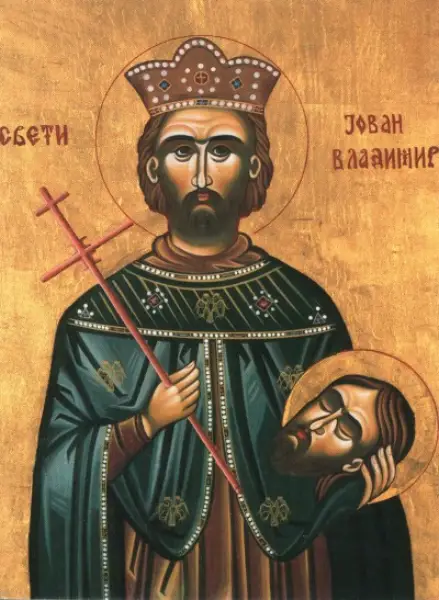
The relics of Saint Jovan Vladimir have travelled a long road. Presumably moved to Dyrrhachium around 1215, they were enshrined in 1381 in the church built near Elbasan by the Albanian prince Karl Thopia, around which an Orthodox monastery grew as the centre of his veneration. A Greek akolouthia was composed there and printed in Venice in 1690, followed by Church Slavonic editions in 1802 and 1861. The monastery was closed by Albania's Communist authorities in the 1960s, and in 1967 the reliquary was moved to St Mary's Church in Elbasan; since around 1995 the relics have rested in the Orthodox cathedral of Tirana, returning to the monastery near Elbasan each 22 May, when crowds of Christians and Muslims gather for the vigil, the procession, and the stories of healing. The saint's cross, kept by the Andrović family of Velji Mikulići, is carried each Pentecost to the summit of Mount Rumija in a procession joined by Catholics and Muslims alike. He is the patron of Bar in Montenegro, classically depicted with a crown, a cross, and his own severed head, and his cult spans Serbian, Bulgarian, Albanian, and Greek Orthodox tradition alike.
§ Sainthood
Timeline
- 990
Born in Duklja, the early medieval Serbian principality corresponding in large part to present-day Montenegro.
§ Life
- 992
A Serbian embassy, Duklja's most probably, reached Constantinople and afterwards entered a charter of the Great Lavra Monastery.
§ Life
- 1000
Still a boy, took over rule of Duklja from his father Petrislav, dominating the neighbouring Serbian lands.
§ Life
- 1010
Tsar Samuel of Bulgaria attacked Duklja; after the siege of his fortress on Oblik, Vladimir surrendered to spare his people and was imprisoned at Prespa.
§ Life
- 1010
Married Theodora Kosara, the tsar's daughter, who had fallen in love with him in prison; Samuel restored him to the throne of Duklja as his vassal.
§ Life
- 6 Oct 1014
Tsar Samuel died of a heart attack following his disastrous defeat by the Byzantines that year.
§ Life
- 1015
Gavril Radomir, Samuel's son and successor, was killed by his cousin Ivan Vladislav, who began sending for Vladimir.
§ Life
- 22 May 1016
Arriving at Prespa, he was struck down by Vladislav's soldiers as he left a church after praying, and was beheaded.
§ Sainthood
- 1215
The relics presumably left the Prečista Krajinska Church, carried off to Dyrrhachium by the troops of Despot Michael I of Epirus.
§ Sainthood
- 1381
Karl Thopia, Prince of Albania, dedicated his rebuilt church near Elbasan to Saint Jovan Vladimir and enshrined the relics there.
§ Sainthood
- 1690
A Greek hagiography and liturgical service for the saint was written at his monastery near Elbasan and printed in Venice.
§ Hagiography and iconography
- 1802
The Church Slavonic akolouthia on the saint was printed in Venice, spreading his cult among the Slavic churches.
§ Hagiography and iconography
- 1967
After Albania's Communist authorities closed his monastery, the reliquary with his relics was moved to St Mary's Church in Elbasan.
§ Sainthood
- 1995
The relics were placed in the Orthodox cathedral of Tirana, whence they return to the monastery near Elbasan each feast day.
§ Sainthood
- 2001
Bar, whose patron he is, set up Nenad Šoškić's bronze statue of King Jovan Vladimir in its main square.
§ Sainthood
In Their Own Words
We believe that our Lord Jesus Christ, who died for us, was suspended not on a golden cross, but on a wooden one. Therefore, if both your faith and your words are true, send me a wooden cross in the hands of religious men, then in accordance with the belief and conviction of the Lord Jesus Christ, I will have faith in the life-giving cross and holy wood. I will come.
Vladimir lived with his wife Cossara in all sanctity and chastity, worshipping God and serving him night and day, and he ruled the people entrusted to him in a Godfearing and just manner.
I carry the cross, I pray to God, Lord, have mercy.
The Record
- Major works
- Church of St Jovan Vladimir near Elbasan, which he is fabled to have built·Prečista Krajinska Church patronage at his court in Krajina
- Patron of
- Bar, Montenegro·Dyrrhachium (historical patron)
- Symbols
- Cross·his own severed head·crown and regal clothes
- Canonization
- Recognized as a martyr and saint shortly after his death, without a formal rite of canonization
Prayer
Bibliography
Show 7 sources
- Fine, John Van Antwerp (1991). The Early Medieval Balkans: A Critical Survey from the Sixth to the Late Twelfth Century. Ann Arbor: The University of Michigan Press. ISBN 0-472-08149-7.
- Živković, Tibor (2006). Портрети српских владара (IX-XII век). Belgrade: Zavod za udžbenike. ISBN 86-17-13754-1.
- Stephenson, Paul (2005). Byzantium's Balkan Frontier: A Political Study of the Northern Balkans, 900–1204. Cambridge: Cambridge University Press. ISBN 978-0-511-03402-2.
- Ostrogorsky, George (1969). History of the Byzantine State. Oxford: Basil Blackwell. ISBN 0-8135-0599-2.
- Cosmas (1858). Ακολουθια του αγιου ενδοξου βασιλεως, και μεγαλομαρτυρος Ιωαννου του Βλαδιμηρου και θαυματουργου. Venice: Saint George Greek Press.
- Novaković, Stojan (1893). Први основи словенске књижевности међу балканским Словенима: Легенда о Владимиру и Косари. Belgrade: Serbian Royal Academy.
- Rudger (2010). "Chronicle of the Priest of Duklja (Ljetopis Popa Dukljanina), Chapter 36". Ed. Paul Stephenson, Translated Excerpts from Byzantine Sources.
Profile text adapted from the Wikipedia article, licensed CC BY-SA 4.0.
Pray with this saint every day
Save St. Jovan Vladimir to your favorites, read the full profile, and get feast-day reminders in the Saints app.
Get the Saints AppFree on the App Store for iPhone and iPad