
1532 – 1611·Feast January 6
St. Juan de Ribera
Archbishop of Valencia and reforming viceroy of Spain
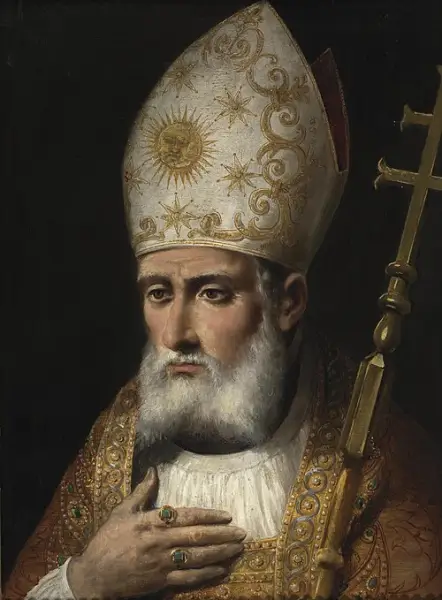
Overview
Juan de Ribera emerged from one of Seville's most powerful families: his father, Pedro Afán de Ribera, governed Naples as viceroy and held the duchy of Alcalá. Left motherless in early childhood, Juan pursued studies at the University of Salamanca and received priestly ordination in 1557. Pope Pius IV named him Bishop of Badajoz five years later, when he was only thirty. In that border see he taught the catechism and labored to check the spread of Protestant teaching. In December 1568 he was translated to the archbishopric of Valencia, and under King Philip III he became Viceroy of Valencia in 1602, uniting spiritual and civil authority in his hands. He ordained Alfonso Coloma for Barcelona in 1599 and likewise bore the Latin Patriarchate of Antioch, the post of Commander in Chief, the presidency of the Audiencia, and the chancellorship of Valencia's university. His enduring foundation was the Royal College of Corpus Christi, known to Valencians as the College of Saint John, established for forming priests in the spirit of the Council of Trent. His long tenure was shadowed by his part in the expulsion of the Moriscos, decreed in 1609. He died at Valencia on 6 January 1611, aged seventy-eight.
The Complete Life
Born to Rank, Drawn to the Altar
Juan de Ribera was born at Seville on 20 March 1532 into the highest rank of Castilian society. His father, Pedro Afán de Ribera, served the crown as Viceroy of Naples and bore the title Duke of Alcalá; his mother died while Juan was still a small child, and the boy grew up in a household long accustomed to power. Despite these advantages he turned away from a courtly future toward the service of the Church. He was sent to the University of Salamanca, the foremost center of Spanish sacred learning, where he applied himself to his studies with distinction. His talents marked him out early: in 1557, at twenty-five, he received priestly ordination. Five years later still only thirty, he was raised to the episcopate, Pope Pius IV appointing him Bishop of Badajoz on 27 May 1562. In that diocese near the Portuguese frontier he gave himself to instructing the faithful in the catechism and to countering the advance of Protestant teaching. Noble lineage, scholarly formation, and evident pastoral energy combined to make him a natural candidate for greater burdens, and his advancement continued steadily as the decrees of the Council of Trent reshaped the Spanish Church.
§ Biography
Bishop of the Reformation Age
Ribera's episcopal career moved in step with Catholic reform. After a dozen years governing Badajoz he was appointed Archbishop of Valencia on 3 December 1568, assuming charge of one of the wealthiest and most troubled sees in Spain, which he would direct for more than four decades. Further dignities accumulated around him: the Latin Patriarchate of Antioch, and, from King Philip III, the viceroyalty of Valencia in 1602, so that he stood at once as the religious and the civil authority of the kingdom, and taking on as well the roles of Commander in Chief, presiding officer of the Audiencia, and head of the city's university. In 1599 he ordained Alfonso Coloma to the see of Barcelona. His most lasting enterprise was educational. He founded the Royal College of Corpus Christi, remembered among Valencians as the College of Saint John and later as the Museum of the Patriarch, an institution charged with the formation of clergy in keeping with the mind and the provisions of the Council of Trent. Preaching, catechesis, clerical formation, and the daily government of a great province filled the long years of his Valencia ministry, and the college he built remains the most tangible monument to that labor.
§ Biography
The Morisco Tragedy
As archbishop, Ribera took up the plight of the numerous Moriscos in his province, people descended from Muslim families compelled to accept baptism or face banishment. A series of decrees had barred them from public office, from the priesthood, and from many other positions, keeping them separate from the Christian majority; rather than assimilating, they preserved their own culture, and some still practiced forms of crypto-Islam in secret. Ribera despised them as heretics and traitors, an attitude he shared with much of Valencia's Christian populace. Together with the Duke of Lerma he pressed Philip III to expel the Moriscos altogether, and he helped sell the scheme by arguing that confiscation of their property would enrich the royal treasury. His first proposal ran darker still: he favored enslaving the entire Morisco people for service in galleys, mines, and colonies abroad, assuring the king it could be done, in his words, without any scruples of conscience. When expulsion was chosen instead, he urged that at least the children be enslaved and Christianized for the good of their souls while the parents were banished. Both extremes were rejected, though children under sixteen were allowed to remain if they wished; almost none did. In 1609 the decree of expulsion was issued and carried out.
§ Expulsion of the Moriscos
A Cause Long in the Making
Efforts to canonize Ribera began shortly after his death, led by admirers who noted that the archbishop had himself labored for the canonization of Ignatius of Loyola. Two concerns clouded the cause from the start. Critics recalled that he had failed to hold a provincial council as the Council of Trent mandated, and they pointed to the part he had taken in driving out the Moriscos. His supporters met the first objection by stressing his fidelity to the other decrees of Trent, and met the second by portraying the Moriscos as beyond conversion, claiming that his preaching had moved them no more than if they had been stones. Various admiring biographies, the vidas, appeared to advance the cause, and beatification followed on 18 September 1796, conferred by Pope Pius VI in Saint Peter's Basilica. Thereafter the process rested for more than a century, an interval that reflected both the upheavals of European history and the sensitivities clinging to his public record. The formal cause of canonization was opened on 25 November 1925, and inquiry into a miracle attributed to his intercession began on 26 August 1934. Pope John XXIII brought the cause to its completion, enrolling Ribera among the saints on 12 June 1960.
§ Canonization
Memory at the Patriarch's College
Ribera's memory rests above all on the Royal College of Corpus Christi at Valencia, the seminary founded in the Tridentine spirit, which serves as his major shrine. The canonization of 1960 sealed a cause that had run for nearly three and a half centuries, from the earliest biographies issued by his admirers through the reopening of the process in 1925 and the miracle inquiry begun in 1934. His feast is kept on 6 January, the day of his death, and Valencia honors him as one of its own bishops. Yet historians continue to weigh the two sides of his public life: the prelate who taught, built, and organized the reform of clergy, and the statesman whose counsel helped drive tens of thousands of Morisco families from their homes. The admiring vidas of the seventeenth century celebrated the first portrait; modern scholarship, notably Benjamin Ehlers's study of relations between Christians and Moriscos, keeps both in view. A large painting by Francisco Domingo Marqués depicts the archbishop presiding over the expulsion he championed, a reminder that the Church remembers this saint with his history intact. His life remains a study in the entanglement of sanctity and power in early modern Spain.
§ Canonization
Timeline
- 20 Mar 1532
Born at Seville into the noble family of Pedro Afán de Ribera, Viceroy of Naples.
§ Biography
- 1557
Ordained a priest after studies at the University of Salamanca.
§ Biography
- 27 May 1562
Appointed Bishop of Badajoz by Pope Pius IV at the age of thirty.
§ Biography
- 3 Dec 1568
Appointed Archbishop of Valencia, the see he would govern for over forty years.
§ Biography
- 1599
Consecrated Alfonso Coloma as Bishop of Barcelona.
§ Biography
- 1602
Named Viceroy of Valencia by Philip III, becoming the kingdom's religious and civil authority.
§ Biography
- 1609
The expulsion of the Moriscos from Spain, which he had urged upon the king, was decreed.
§ Expulsion of the Moriscos
- 6 Jan 1611
Died at Valencia at the age of seventy-eight.
§ Biography
- 18 Sep 1796
Beatified by Pope Pius VI in Saint Peter's Basilica at Rome.
§ Canonization
- 25 Nov 1925
The cause for his canonization was formally opened.
§ Canonization
- 26 Aug 1934
Evaluation of a miracle attributed to his intercession began.
§ Canonization
- 12 Jun 1960
Canonized by Pope John XXIII in Saint Peter's Basilica.
§ Canonization
In Their Own Words
without any scruples of conscience
The Record
- Major works
- Royal College of Corpus Christi (College of Saint John / Museum of the Patriarch), Valencia
- Symbols
- Episcopal attire
- Canonization
- Canonized 12 June 1960 at Saint Peter's Basilica by Pope John XXIII; beatified 18 September 1796 by Pope Pius VI
Prayer
Bibliography
Show 3 sources
- Lynch, John (1969). Spain under the Habsburgs. Vol. 2. Oxford, England: Alden Mowbray Ltd. pp. 42–51.
- Ehlers, Benjamin. Between Christians and Moriscos.
- Index ac status causarum beatificationis servorum dei et canonizationis beatorum (in Latin). Typis polyglottis vaticanis. January 1953. p. 115.
Profile text adapted from the Wikipedia article, licensed CC BY-SA 4.0.
Pray with this saint every day
Save St. Juan de Ribera to your favorites, read the full profile, and get feast-day reminders in the Saints app.
Get the Saints AppFree on the App Store for iPhone and iPad