
1474 – 1548·Feast December 9
St. Juan Diego
Nahua visionary of Our Lady of Guadalupe
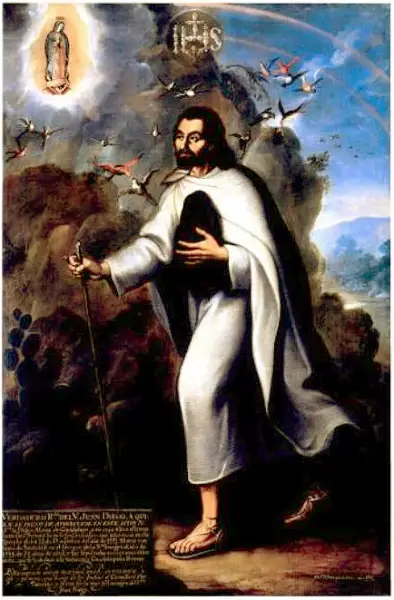
Overview
Juan Diego Cuauhtlatoatzin, whose indigenous name is roughly rendered as 'he who speaks like an eagle', was a Nahua peasant and Marian visionary born in 1474 in Cuauhtitlán, in the Aztec Empire. According to the tradition preserved in the Nican Mopohua and other colonial sources, he received four apparitions of Our Lady of Guadalupe during December 1531 — three upon Tepeyac hill and a fourth before Juan de Zumárraga, the bishop of Mexico, first bishop of Mexico. Sent to gather flowers in December from the barren summit of Tepeyac, he carried them in his mantle to the bishop, and the image of the Virgin was found miraculously imprinted upon the tilma. The cloak, traditionally said to be his, is displayed today in the Basilica of Our Lady of Guadalupe, one of the world's great pilgrimage destinations. Baptized with his wife María Lucía among the first converts of the twelve Franciscan missionaries who reached Mexico in 1524, Juan Diego was widowed two years before the apparitions. He then spent the remaining sixteen years of his life serving the Virgin at the hermitage built at the foot of Tepeyac, living in humility and devotion until his death in 1548. He was the first indigenous American canonized by the Catholic Church.
The Complete Life
Before the Apparitions
Juan Diego was born in 1474 in Cuauhtitlán, a town in the Aztec Empire under Tlacopan's sway; when the apparitions came he dwelt there or in nearby Tolpetlac. He was neither destitute nor rich nor influential: the Nican Mopohua calls him a poor ordinary person, while one witness among the indigenous testimonies of 1666 claimed his father had been headman of Cuauhtitlán, and other traditions speak of a son from his marriage. He and María Lucía, his wife, stood among the first baptized following the arrival in 1524 of the twelve Franciscan missionaries who led the evangelization of Mexico. The sources diverge on the couple's married life: one report says that after their baptism they were inspired by a sermon on chastity, preached by Fray Toribio de Benevente, known as Motolinía, to live celibately; another holds they were celibate throughout their marriage; a third claims both lived and died as virgins. María Lucía died two years before the apparitions, and Juan Diego's uncle Juan Bernardino remained the central figure of his small family. Beyond these, two eighteenth-century nuns would later claim descent from him.
§ Biography
A Devout Neophyte
Juan Diego's defining characteristics, according to every major source, were his religious fervour, his artlessness, and his respectful and gracious demeanour toward both the Virgin Mary and the initially skeptical Bishop Juan de Zumárraga. As a devout neophyte he made his habitual walks from home to the Franciscan mission post at Tlatelolco for religious instruction and the duties of devotion, a route that passed by the hill of Tepeyac. It was on this ordinary path of devotion that the extraordinary met him. The tradition insists that these qualities, together with his devotion to his sick uncle and afterwards to the Virgin at her shrine, are precisely what testify to the sanctity of life that the Church holds to be the indispensable criterion for canonization. He presented himself to the Virgin as a man of no importance, and that very humility became the instrument through which the most widespread Marian devotion of the Americas took root. The event that began at dawn on 9 December 1531 would transform the obscure walker of an ordinary road into the messenger of a new Christian world.
§ Guadalupe narrative
The Guadalupe Event
At dawn on Wednesday 9 December 1531, on his customary walk, Juan Diego came upon the Virgin Mary, who disclosed herself as the ever-virgin Mother of God and asked that a chapel be erected in her honour at Tepeyac. Bishop Zumárraga asked him to return; on the second encounter Juan Diego offered to withdraw in favour of someone of greater standing, but the Virgin insisted he was her chosen messenger. On 10 December the bishop demanded a sign, which the Virgin promised for the following day. Then Juan Diego's uncle Juan Bernardino fell gravely ill, and on the early morning of Saturday 12 December the visionaries' messenger skirted the hill to fetch a priest, only to be intercepted. In words now inscribed over the Basilica's entrance, the Virgin asked whether she was not there, his mother, assured him his uncle had recovered, and sent him up the rocky summit where only cactus and scrub grew. There he found Castilian roses, fresh and dew-laden, blooming unseasonably. He gathered them into his mantle; when he opened it before the bishop that day, the flowers fell away and the image of the Virgin remained imprinted on the cloth. The bishop venerated it immediately, and on 26 December the image was carried in procession to a chapel at Tepeyac, where the first miracle of the new shrine was worked on a wounded man.
§ Guadalupe narrative
Sixteen Years at the Hermitage
When the apparitions were over, Juan Diego received leave to dwell beside the hermitage raised at the foot of Tepeyac hill, and he spent the sixteen years left of his life in the Virgin Mary's service at the shrine she had asked to have raised. Sánchez records his uneventful life at the hermitage from the apparitions to his death; the Nican Mopohua and its companion texts give many instances of his sanctity, his humility, his self-mortification, and his religious devotion, and Becerra Tanco eulogizes his heroic virtues. The witnesses of the 1666 Informaciones Jurídicas, indigenous men and women transmitting what their parents and grandparents had known, dwelt on precisely these traits. Juan Diego had abandoned his house and land to his uncle so as to take up residence at Tepeyac, embracing a life of poverty and prayer at the Virgin's threshold. In him the earliest narratives saw embedded the human dignity of the indigenous peoples of the New World and their right to a place of honour in it, and Miguel Sánchez observes that Juan Diego looked on every resident of New Spain as spiritual heir of the holy image.
§ Biography
Death and the Earliest Evidence
Juan Diego died in 1548, in his seventy-fourth year, in the same month as Bishop Zumárraga, who died on 3 June 1548. The Codex Escalada, if correctly dated to the middle of the sixteenth century, is among the earliest notices of his death, which declares that in 1548 Juan Diego died worthily, his name given there in its indigenous form, while portraying one of the apparitions. The bishop's death and the long interval before Archbishop Alonso de Montúfar arrived in 1554 left Mexico City without a local authority over the emerging cult, and no resident priest was appointed at the ermita until Montúfar's time, so the shrine fell into temporary abeyance. Yet Miguel León-Portilla and other scholars point to various annals showing that crowds were already making their way to the chapel of Tepeyac well before 1556, and that the story of Juan Diego and the Virgin honoured as Tonantzin had already made its way abroad. By 1556 clear evidence emerges of a Marian cult at the existing oratory of Tepeyac, known under the name Guadalupe, focused on a painting and believed to work miracles, above all of healing.
§ Historicity debate
From Cause to Canonization
The modern movement for Juan Diego's canonization arose in earnest in 1974 during celebrations of the five hundredth anniversary of his traditional birth date, and in January 1984 Cardinal Ernesto Corripio Ahumada named a postulator and opened the formal process. The diocesan inquiry concluded in March 1986, the Roman stage opened that April, and with the decree of validity of 9 January 1987 the cause proceeded. The Positio was published in 1989 with the support of all the bishops of Mexico, and after scrutiny by historical and theological consultors, Pope John Paul II signed the decree on 9 April 1990. Because of the antiquity of the cult, the usual requirement of a pre-beatification miracle was dispensed with, and he was beatified at the Basilica of Guadalupe on 6 May 1990, with 9 December assigned as his feast. The healing of Juan José Barragán Silva, who survived a fatal fall in Querétaro during the beatification week after his mother invoked Juan Diego, was approved through the standard medical, theological, and congregational stages, and the decree of miracle was signed on 20 December 2001. Despite objections over the historical evidence, a special commission's favourable review was approved in 1998, and the canonization was celebrated at the Basilica on 31 July 2002.
§ Beatification and canonization
Mother of a New World
The Guadalupe event that Juan Diego carried to his bishop is the basis of the veneration of Our Lady of Guadalupe — ubiquitous in Mexico, common across the Spanish-speaking Americas, and spreading ever further; the Basilica at the foot of Tepeyac received twenty-two million visitors in 2010. Both the Nican Mopectana and Miguel Sánchez explain the apparitions as evangelical in aim: meaning to gather the peoples of the New World into faith in Christ, the Virgin showed herself first to two native sons. Archbishop Lorenzana preached in 1770 that the Virgin honoured Spaniards by her title, the natives by singling out Juan Diego, and those of mixed race by her own complexion. Pope John Paul II called the saint a model of evangelization perfectly inculturated, and indigenous participants played a prominent role in his canonization ceremony. The historicity debate, from Muñoz in 1794 and García Icazbalceta in 1883 to the Schulenburg affair of 1996 and the commission of 1998, has never extinguished the devotion; the Church considers the question closed since the canonization. Juan Diego remains patron of indigenous peoples, his tilma and roses the emblem of a faith that dignifies the humble.
§ Pastoral significance in the Catholic Church in Mexico and beyond
Timeline
- 1474
Born in Cuauhtitlán in the Aztec Empire, then subject to Tlacopan.
§ Biography
- 1524
Baptized with his wife María Lucía among the first converts after the twelve Franciscan missionaries arrived in Mexico.
§ Biography
- 1529
His wife María Lucía died, two years before the apparitions.
§ Biography
- 9 Dec 1531
At dawn on Tepeyac hill he met the Virgin Mary, who asked him to request a chapel from Bishop Zumárraga.
§ First apparition
- 10 Dec 1531
Repeated the request to the bishop, who asked for a sign from heaven.
§ Second apparition
- 12 Dec 1531
Found Castilian roses blooming unseasonably on Tepeyac; the Virgin's image was impressed on his tilma before the bishop.
§ Fourth apparition
- 26 Dec 1531
The miraculous image was carried in procession to a hastily built chapel at Tepeyac, where a wounded man was instantly healed.
§ Fifth apparition
- 1548
Died in his seventy-fourth year at Tepeyac, having served the Virgin's shrine for sixteen years.
§ Biography
- Jan 1984
Cardinal Ernesto Corripio Ahumada, Archbishop of Mexico, named a postulator and initiated the formal canonization process.
§ Beatification and canonization
- 6 May 1990
Beatified by Pope John Paul II at the Basilica of Guadalupe, with December 9 declared his feast day.
§ Beatification
- May 1990
In Querétaro, during the beatification week, Juan José Barragán Silva survived a fatal fall from a balcony after his mother invoked Juan Diego.
§ Miracles
- 28 Oct 1998
A special Historical Commission's review of the Guadalupe tradition was unanimously approved by the Congregation for the Causes of Saints.
§ Canonization
- 20 Dec 2001
Pope John Paul II signed the decree formally acknowledging the healing of Barragán as miraculous.
§ Miracles
- 31 Jul 2002
Canonized by Pope John Paul II at the Basilica of Our Lady of Guadalupe, becoming the first indigenous American saint.
§ Canonization
In Their Own Words
A back-frame, a tail, a wing, a man of no importance.
Am I not here, I who am your mother?
I am the compassionate mother of you and of all you people here in this land, and of the other various peoples who love me, who cry out to me.
A model of evangelization perfectly inculturated.
The Record
- Major works
- Hermitage service at the shrine of Our Lady of Guadalupe, Tepeyac
- Patron of
- Indigenous peoples
- Symbols
- Tilma with the impressed image of the Virgin Mary·roses
- Canonization
- Canonized by Pope John Paul II on 31 July 2002 at the Basilica of Our Lady of Guadalupe, Mexico City
Prayer
Bibliography
Show 8 sources
- "Biographical Note". Vatican Information Service. July 31, 2002.
- John Paul II. Homily at the canonization Mass, 31 July 2002.
- Sousa, Lisa; Poole, Stafford; Lockhart, James (1998). The Story of Guadalupe: Luis Lasso de la Vega's Huei tlamahuiçoltica of 1649.
- Poole, Stafford (1995). Our Lady of Guadalupe: The Origins and Sources of a Mexican National Symbol, 1531–1797.
- Brading, D. A. (2001). Mexican Phoenix: Our Lady of Guadalupe.
- Saragoza, Alex (2012). Mexico Today: An Encyclopedia of Life in the Republic. ABC-CLIO. ISBN 978-0-313-34948-5.
- Sánchez, Miguel (1648). Imagen de la Virgen María, Madre de Dios de Guadalupe, Milagrosamente aparecida en la Ciudad de México.
- Lasso de la Vega, Luis (1649). Huei tlamahuiçoltica, containing the Nican Mopohua.
Profile text adapted from the Wikipedia article, licensed CC BY-SA 4.0.
Pray with this saint every day
Save St. Juan Diego to your favorites, read the full profile, and get feast-day reminders in the Saints app.
Get the Saints AppFree on the App Store for iPhone and iPad