
died c. 360·Feast May 4
St. Judas Cyriacus
Bishop of Ancona, martyr of the True Cross legend
Overview
Judas Cyriacus, honored also as Cyriacus of Ancona, Cyriacus of Jerusalem, Quiriacus, Quiricus, or Kyriakos, was a bishop of Ancona in Italy who, by the account of his Acts, died a martyr around the year 360 while on pilgrimage to the Holy Land. Local tradition at Ancona came to identify him with the Jew named Judas Kyriakos of the legend of the finding of the True Cross: the man said to have guided the Empress Helena to the Cross hidden at Golgotha, who then received baptism, took the name Kyriakos, Greek for lordly, and was consecrated bishop of Jerusalem. Later accounts describe him debating the emperor Julian and suffering terrible torments beside his mother Anna during Julian's persecution. Empress Galla Placidia is credited with presenting Ancona with his relics, though his head was carried to Provins in Champagne. His body rests in the Cathedral of San Ciriaco, which crowns the hill of Monte Guasco on the site of a former temple of Venus. He is the patron saint of Ancona, and his feast is kept by Catholics on 4 May and by the Orthodox on 28 October.
The Complete Life
A Bishop Bound for the Holy Land
Judas Cyriacus was bishop of Ancona when he undertook a pilgrimage to the Holy Land, and there, according to the tradition preserved at Ancona, he was killed, the Church honoring him ever after as martyr and patron of the Adriatic port. His Catholic feast falls on 4 May, while the Eastern Orthodox Church keeps his memory on 28 October, though another Orthodox source assigns it to 14 April. The identification of the Ancona bishop with older and partly legendary figures has long complicated his story. He is frequently confused with Judah Kyriakos, the second-century bishop of Jerusalem who died in a disturbance there in 133 and who is remembered as the last occupant of that see in the desposynic line, descended from the family of Jesus. The multiplicity of his names, Quiriacus, Quiricus, Kyriakos, Ciriaco in Italian and Quirico in Spanish, reflects the many streams of tradition that converged on his cult across East and West. Whatever the precise historical core beneath the accretions, the affection of Ancona for its bishop has never wavered, and it centers on the grey Romanesque cathedral that bears his name and on the body that lies visible within it.
§ Judas Cyriacus, Bishop of Ancona
The Finding of the Cross
The tradition of Ancona identifies its martyr with Judas Kyriakos, the Jewish figure of the legend of the True Cross. According to that legend, Judas aided the Empress Helena in locating the Cross that had lain buried at Golgotha since the crucifixion. The oldest surviving witness to the tale is a Syriac manuscript of about the year 500, which its modern editor judged a source of exceptional worth for tracing how the legend of the inventio crucis developed. The historian Sozomen, who died around 450, records in his Ecclesiastical History the report that the site of the Holy Sepulchre had been disclosed by a Hebrew dwelling in the East, who held documents inherited from his fathers; Sozomen himself disputes the account, though he also passes on the claim that a dead person was restored to life by the touch of the Cross. Popular retellings later supplied the helper's name, Jude or Judas, and told of his conversion and baptism under the name Kyriakos, meaning lordly in Greek. Of the several fourth-century accounts of the discovery that circulated through the empire, the two told most often both named Helena, Constantine the Great's aged mother, as the one who journeyed to Jerusalem at her son's request and demolished a temple, perhaps of Venus, before the Cross could be recovered.
§ Judas Cyriacus and the True Cross
Martyr Under the Apostate
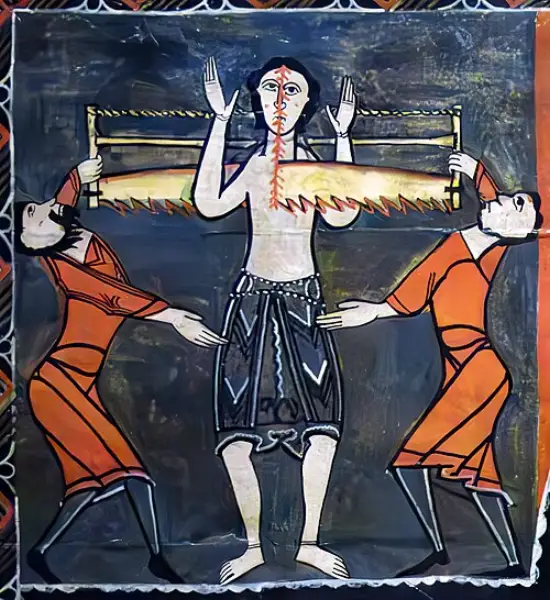
The Acts of the martyrdom, first written in Greek and then rendered into Latin and Syriac, carry the story past the discovery of the Cross. Having guided Helena, Judas received baptism, was consecrated bishop of Jerusalem, and perished in the persecution of Julian the Apostate, which places his death in the fourth century, around the year 360. In the narrative of his passion he is described as engaging the emperor Julian himself in dialogue, and he endured appalling torments together with his mother Anna. A saint of the same name, Cyriacus, also died in that century, and some confusion between the two figures may lie behind parts of the tradition. His relics reached Ancona, it is said, as a gift from the Empress Galla Placidia, though the saint's head took a different road: Henry I of Champagne brought it from Jerusalem to Provins and built a church to contain it. That church, the Saint Quiriace Collegiate, still stands; its twelfth-century works were left unfinished for want of money under Philippe le Bel, a dome was added in the seventeenth century, and the old families of the upper town were long called the Children of the Dome.
§ The martyrdom of Judas Cyriacus
The Cathedral on Monte Guasco
Ancona's chief monument to its patron is the cathedral of San Ciriaco, raised on Monte Guasco, the hill that ancient writers Catullus and Juvenal already knew as sacred to Venus as tutelary deity of the place. Some writers suppose an original church there stood in the shape of a Latin cross and dated from the eighth century. The building consecrated in 1128 and finished in 1189 endures as one of the fine Romanesque churches of Italy: a fabric of grey stone planned as a Greek cross, crowned by a dodecagonal dome over the crossing that Margaritone d'Arezzo altered in 1270, and restored early on, the works being completed in 1234. Within, Cyriacus's body rests outstretched in an open tomb, there for pilgrims to venerate the martyr at close hand. The cathedral thus binds together the strands of his legend, standing where a temple of Venus once stood, as the True Cross legend stands where a pagan shrine was cleared at Golgotha. Through this church the bishop of Ancona has watched over the city for some nine hundred years, his cult sustained by art, by feast days in East and West, and by the devotion of the Adriatic port that claims him.
§ Cathedral of San Ciriaco
Timeline
- 360
Martyred during the persecutions of Julian the Apostate, placing his death in the fourth century.
§ The martyrdom of Judas Cyriacus
- 500
The earliest extant Syriac manuscript telling how Judas Kyriakos helped find the True Cross was produced.
§ Judas Cyriacus and the True Cross
- 1128
The cathedral of San Ciriaco on Monte Guasco at Ancona was consecrated.
§ Cathedral of San Ciriaco
- 1189
Construction of the cathedral was completed.
§ Cathedral of San Ciriaco
- 1234
An early restoration of the cathedral was finished.
§ Cathedral of San Ciriaco
- 1270
The cathedral's dodecagonal dome was altered by Margaritone d'Arezzo.
§ Cathedral of San Ciriaco
In Their Own Words
The story of Judas Kyriakos originated in Greek, but became also known in Latin and Syriac and later on in many vernacular languages.
The Record
- Patron of
- patron of Ancona, Italy
- Canonization
- Pre-congregation
Prayer
Bibliography
Show 5 sources
- Ἁ Ὁγιος Κυριακὸς ὁ Ἁερομάρτυρας. 28 Οκτωβρίου. ΜΕΓΑΣ ΣΥΝΑΞΑΡΙΣΤΗΣ.
- Hieromartyr Cyriacus the Patriarch of Jerusalem. OCA - Feasts and Saints.
- Trovato, Stefano (2018). «Molti fedeli di Cristo morirono tra terribili pene». Bibliografia agiografica giulianea con edizione della Passio Cyriaci BHG 465b. Udine: Forum. pp. 51–98. ISBN 978-88-3283-105-4.
- Drijvers, Jan Willem (1997). The Finding of the True Cross: The Judas Kyriakos Legend in Syriac. Introduction, Text and Translation.
- Seeliger, Hans Reinhard (1992). "Judas Cyriacus (Quiriacus)". In Bautz, Friedrich Wilhelm (ed.). Biographisch-Bibliographisches Kirchenlexikon (BBKL). Vol. 3. Herzberg: Bautz. cols. 762–763. ISBN 3-88309-035-2.
Profile text adapted from the Wikipedia article, licensed CC BY-SA 4.0.
Pray with this saint every day
Save St. Judas Cyriacus to your favorites, read the full profile, and get feast-day reminders in the Saints app.
Get the Saints AppFree on the App Store for iPhone and iPad