
1st century - c. 65·Feast October 28
St. Jude Thaddeus
Apostle and Martyr
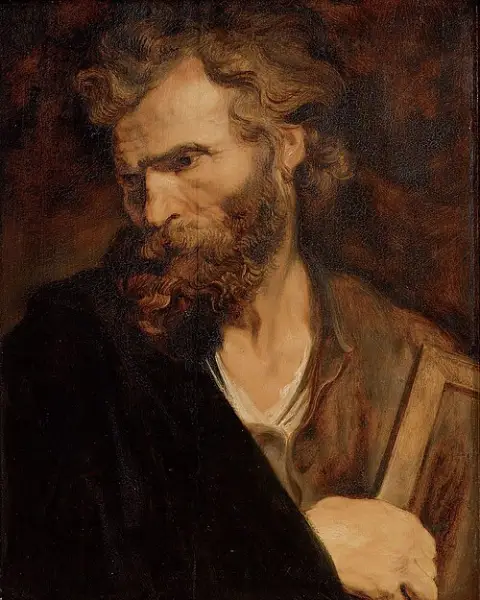
Overview
Jude, called Judas son or brother of James in the apostle lists of Luke and Acts, is one of the Twelve whose name was shadowed by another's. To keep him distinct from the betrayer Iscariot, English tradition shortened him to Jude, and the early lists of Matthew and Mark appear to know him as Thaddeus, or Lebbaeus surnamed Thaddeus, so that devotion came to speak of Jude Thaddeus. John's Gospel marks him out as present at the Last Supper, numbering him there among the apostles. Legend makes him a Galilean farmer of Paneas, the son of Clopas and Mary of Clopas, at home in both Aramaic and Greek. After Pentecost, tradition sends him preaching through Judea, Samaria, Idumaea, Syria, Mesopotamia and Libya, and both he and Bartholomew are honored as the first bringers of the faith to Armenia, where the Armenian Apostolic Church counts them her patrons. One strand of tradition has him martyred with Simon the Zealot at Beirut in Syria around the year 65, another beheaded in Armenia in 66 on the order of King Sanatruk. His relics rest under the altar of St. Joseph in St. Peter's Basilica, Rome, beside Simon's. Devotion to him as patron of hopeless causes revived powerfully in the nineteenth and twentieth centuries.
The Complete Life
Early Life
Jude, called Thaddeus in the tradition of the Syrian church and in the western calendar, was one of the twelve apostles, listed in the Gospels as Judas of James, and distinguished carefully by the evangelists from Judas Iscariot, whose name made the other Judas a burden to bear. The New Testament says almost nothing of his origins: the tradition makes him a Galilean, born at Paneas in the north, the son of Clopas and of Mary of Clopas, the sister or kinswoman of Mary the mother of Jesus, which would make him a relative of the Lord. A later Greek writer, Nikephoros, even made him the bridegroom at the wedding of Cana. With his probable cousin James the Less, he belonged to the family of Jesus that stood close to the Jerusalem church after the resurrection. He was, by the usual reading, a farmer by trade, bilingual in Aramaic and Greek like the Galilee of his time.
§ External links
Conversion and Vocation
Jude's vocation is simply the apostolic call: he appears in the lists of the twelve and disappears, as the anonymous apostles do, into the mission. The single saying the Gospels give him comes at the Last Supper in John, where he asks the Lord why he will manifest himself to the disciples and not to the world, and receives the answer that those who love him will keep his word and the Father will love them. His epistle, the Letter of Jude, one of the shortest books of the New Testament, if it is his, shows a Jewish Christian writer of Greek education contending for the faith delivered to the saints against libertine teachers, a document of the apostolic generation's vigilance.
§ Citations
Mission and Ministry
The traditions of Jude's mission all point east. The western tradition, and the ancient inventories of relics, hold that his preaching ranged over Judea and Samaria, Idumaea and Syria, the lands between the rivers, and Libya, and that he visited Beirut and Edessa, the Syrian city whose legendary correspondence with Christ had already made it a center of the faith's eastern memory. The Armenian church holds that Jude and Bartholomew were the first to bring the gospel to Armenia, arriving as missionaries in the royal period before Gregory the Illuminator, and for that claim Jude is honored as a founder and patron of the Armenian Apostolic church. The Monastery of Saint Thaddeus, in what is now northern Iran, was built over the tradition of his tomb and remains the great shrine of Armenian Christianity in that region.
§ Tradition and legend
Trial and Final Years
The traditions of Jude's death divide as his mission divided. The Armenian tradition holds that he was martyred in Armenia around the year 66, by order of King Sanatruk, together with Bartholomew and the virgin Sandukht, and that his tomb lies at the monastery that bears his name. The western tradition, followed in the legends of Simon and Jude, holds that he was martyred at Beirut, or in Persia, with Simon the Zealot, his companion in the lists of the apostles, his emblem in art the axe of his martyrdom. His body was said to have been brought to Rome and buried beside Simon's in a crypt of Saint Peter's, where the relics under the altar of Saint Joseph in the left transept are honored as theirs, translated there in 1665. The certain history behind either tradition is beyond recovery, and the church has kept both.
§ Death and remains
Canonization
Jude is a pre-congregation saint, venerated since the apostolic age. His cult in the universal church has been served by the ancient shrines, Saint Peter's in the west and the monastery of Saint Thaddeus in the east, and his feast with Simon on 28 October was fixed in the Roman calendar in the middle ages. The distinctively modern devotion, to Saint Jude as patron of hopeless cases, grew in the twentieth century around the shrines of Chicago and elsewhere, and made one of the most obscure of the twelve one of the most invoked saints of the modern world.
§ Veneration
Legacy
Jude's modern fame rests on the devotion to him as the patron of desperate and lost causes, a patronage whose origin puzzled even its historians, arising probably from the confusion of his name with Judas Iscariot, so that those reluctant to invoke the traitor's name tried the other Judas and found him generous. The National Shrine of Saint Jude in Chicago and the devotions of countless parishes have made that intercession a major movement of modern popular piety. His other legacies are older and quieter: the Armenian church's memory of its apostle, kept at the mountain monastery of Saint Thaddeus; the epistle that bears his name in the New Testament; and his office in the twelve, the anonymous apostle whose near-erasure by his own name made him, by a long detour, the saint of the last resort.
§ Introduction
Timeline
- -12
Born in Galilee into a Jewish family that later legend locates at Paneas
§ Introduction
- 65
Suffers martyrdom at Beirut about this year, one tradition says, together with the apostle Simon the Zealot
§ Death and remains
- 66
An Armenian hagiographic tradition instead dates his martyrdom to this year, ordered by King Sanatruk
§ Death and remains
- 27 Dec 1665
His bones are laid in the left transept of St. Peter's Basilica, beneath the altar of St. Joseph, sharing one tomb with Simon the Zealot
§ Death and remains
- 1929
The Claretians found the National Shrine of St. Jude as devotion to the patron of hopeless causes spreads
§ Veneration
- Sep 2023
A reliquary holding his arm bone begins a pilgrimage across the United States, stopping in 100 cities through May 2024
§ Death and remains
In Their Own Words
Lord, how is it that You will manifest Yourself to us, and not to the world?
But you, dear friends, by building yourselves up in your most holy faith and praying in the Holy Spirit, keep yourselves in God's love as you wait for the mercy of our Lord Jesus Christ to bring you to eternal life.
The Record
- Major works
- Epistle of Jude (traditional attribution)
- Patron of
- Desperate cases and lost causes·Hospitals·Chicago Police Department·Armenian Apostolic Church (with St. Bartholomew)
- Symbols
- Club or axe (instrument of his martyrdom)·Flame around his head (Pentecost)·Image of Jesus, the Image of Edessa·Scroll or book of the Epistle of Jude·Carpenter's rule
- Canonization
- Pre-congregation (ancient apostolic cult); venerated since the early Church
Prayer
Bibliography
Show 1 sources
- ↑ However, Philostorgius, the 5th-century Arian Christian historian, says in his Historia Ecclesiastica : "The district of Paneas was formerly called Dan. But in the course of time it came to be called Caesarea Philippi, and later still, wh
Profile text adapted from the Wikipedia article, licensed CC BY-SA 4.0.
Pray with this saint every day
Save St. Jude Thaddeus to your favorites, read the full profile, and get feast-day reminders in the Saints app.
Get the Saints AppFree on the App Store for iPhone and iPad