
c. 590 – 647 or 652·Feast December 16
St. Judicael
King of Domnonée who died a monk
Overview
Judicael, king of Domnonée in the mid-seventh century, belongs to the small company of rulers whom the Breton church honors as saints. Born around 590 the eldest son of King Judael and Queen Prizel, daughter of the Count of Léon, he numbered fifteen brothers and five sisters among his siblings, several of whom, like Judoc and Guinien, were themselves revered as saints. When his father died around 605, the throne was usurped by a younger brother, Haeloc, and Judicael chose the cloister of St John's Abbey at Gaël over a contested crown. Only after Haeloc's death about 615 did he take up the kingship, ruling Domnonée with authority and wisdom for some twenty years. In 635 or 636 he met the Frankish king Dagobert I at Clichy, recognized his suzerainty, and concluded a peace, yet his fear of God made him refuse the hospitality of the Frankish court. Around 642 he laid the crown aside a second time, withdrawing to Gaël or to Paimpont, the abbey of his own founding, and surrendering the kingdom to his brother Judoc. He died on Sunday, December 16, in either 647 or 652, and was buried beside his abbot Méen at Gaël, where his tomb became the center of a saint's cult.
The Complete Life
The Eldest Son of Domnonée
Judicael was born around the year 590 into the royal house of Domnonée, one of the petty kingdoms into which the Bretons of Armorica had organized themselves after crossing from Britain. According to Gregory of Tours, the Breton land in the sixth century was divided among regna of which Domnonée, Cornouaille, and Gwened were the best known, realms that had first pledged themselves to the Frankish Childebert I and struggled ever after against Frankish overlordship. Into this world of contested sovereignty Judicael's parents were Judael — in another spelling Judhael — the king of Domnonée, and Queen Prizel, child of Ausoch, Count of Léon. The household was remarkable even by the standards of Breton royalty: fifteen brothers and five sisters filled it, Judicael the first-born among them, and several of that crowd were counted saints, most famously Judoc and Guinien, while tradition also makes him brother of Judoc and Winnoc. Sanctity and sovereignty mingled in the family blood, and the boy who grew up heir to a kingdom grew up also in the shadow of altars, trained in both the governance of a petty state and the piety of a house that produced saints by the dozen.
§ Hagiographic life
The Usurped Crown and the Cloister at Gaël
Around 605 King Judael died, and the succession that should have passed to Judicael as eldest son was seized by his younger brother Haeloc. What might have become a civil war or a life of exile became instead a vocation: Judicael withdrew to St John's Abbey at Gaël, embracing the monastic life while another wore the crown of Domnonée. The choice, whether his own preference or the fruit of necessity, set the pattern of his whole career, in which kingship and the cloister contended for the same man. He remained at Gaël until Haeloc's death in about 615, when the claims of the kingdom overcame the desires of the monk. Judicael left the monastic life behind and took up the rule of Domnonée, reigning for the following twenty years with what the sources call authority and wisdom. Yet the years at Gaël were not forgotten, and the abbey between the forests of Brittany remained the place to which his heart returned, the fixed point to which he would go back once the duties of rule had been discharged and his brother could succeed him in his turn.
§ Hagiographic life
Twenty Years of Rule and the Peace of Clichy
Judicael's reign is anchored in history by his dealing with the Franks. In 635 or 636, while Dagobert I reigned over the Franks, Breton raiders struck at the Frankish frontiers; the Burgundian army, fresh from its defeat of the Basques of Soule, threatened intervention, and Judicael agreed to meet the Frankish king at his palace of Clichy. There the two kings exchanged presents, the Breton recognized Dagobert's suzerainty, and peace was concluded, a settlement recorded by Bishop Ouen of Rouen in his life of Éloi of Noyon and by the pseudo-Fredegar in his Chronicle. What followed made the episode famous: Judicael, described as a very religious man with a great fear of God, refused the hospitality of the royal court, fearing its irreligion, and departed without accepting the further honor Dagobert offered. He also minted his own coins, gold pieces that survive as tangible evidence of his kingship. The picture that emerges is of a ruler who could bargain with the mightiest monarch of the west and walk away from his court unbought, governing his small kingdom with a king's instruments and a monk's conscience.
§ Historicity
The Fear of God in a Warrior King
The sanctity of Judicael rests on a paradox that his contemporaries saw clearly: he held power as though it were a burden to be laid down, not a possession to be clutched. Twice he surrendered rule rather than cling to it, first when Haeloc usurped the throne of Domnonée and he chose the abbey of Gaël, and again around 642, when he left the kingdom to his brother Judoc and returned to the monastic habit, either at Gaël or at Paimpont, the monastery he had founded in the Breton forests. The Frankish sources supply the key to his character when they describe his fear of God and his dread of the irreligious ways of Dagobert's court, a dread strong enough to make him refuse the hospitality of a king to whom he had just sworn peace. In the company of his siblings — Judoc, Guinien, Winnoc — sanctity seems to have been the family's true inheritance, and Judicael's crown at his feet became the image of it in his iconography. He stands among those early medieval rulers, rare in every age, in whom the exercise of power was measured constantly against judgment and eternity.
§ Hagiographic life
Paimpont, Gaël, and a December Sunday
The last years of Judicael's life were spent as his first years of manhood had been, in monastic peace. Around 642 he retired from the kingship, leaving Domnonée to his brother Judoc — the saint better known in the north as Josse — and withdrew once more to Gaël's abbey of St John, or else to Paimpont, the house his own foundation had raised among the woods of Brocéliande. With him the recorded kings of Domnonée come to an end, as though his abdication had closed the line. He died on a Sunday, December 16, in either 647 or 652, the uncertainty of the year a small mark of the distance between his world and ours. His body was laid to rest in Gaël's abbey church, beside Méen — the house's founder and his abbot — and it was at that tomb that the veneration of the king-monk took root and grew. A man who had declined two thrones was honored at his grave as one who had gained a better kingdom, and the abbey that had formed him became the keeper of his memory for the centuries that followed.
§ Hagiographic life
A Saint at Gaël
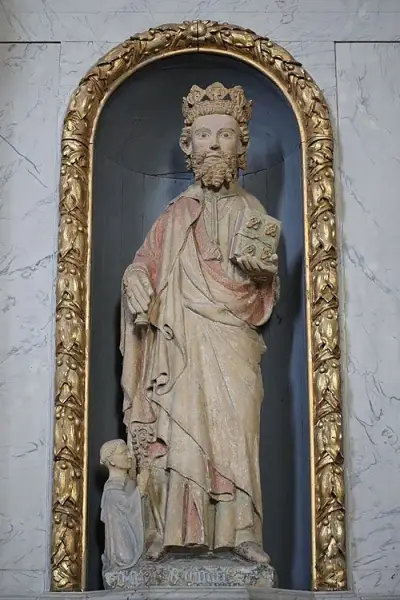
Judicael was later declared a saint, and his cult gathered around the abbey church of Gaël where he lay buried beside Méen. His feast is kept on December 16, the day of his death, and his cult was formally centered on that shrine, which the church of the region honored as the resting place of its royal monk. In art he is shown as a warrior king holding a book, his crown set at his feet, sometimes bearing the Breton shield of arms, an image that compresses his whole story into a single figure: the sovereign who counted his crown as nothing beside the wisdom of the Scriptures. The silence of the earliest sources about his title — later critics noted that old documents call him king but never king and saint — did not prevent the devotion of the Breton people, who kept his feast and his memory among the great saints of their land. His cult belongs to the oldest stratum of Breton hagiography, the age when the line between the warrior aristocracy and the church was crossed constantly, in both directions, by men of his own family.
§ Hagiographic life
Ancestors, Chronicles, and an Invented King
Judicael's afterlife in Breton memory took several forms. In the Cartulary of Redon, a noblewoman named Roiantdreh, adopting King Solomon of Brittany as her heir in 869, traced her paternal ancestry over eight generations, and some historians, including Alan J. Raude, have identified the first name in that line, Jedechael, with the early seventh-century king of Domnonée, though Arthur de la Borderie doubted it because the record styles him neither king nor saint. In the eleventh century a monk named Ingomar wrote a Life of the saint asserting that every prince who ruled Brittany in the ages after Judicael traced his line to that king, a claim Dom Morice elaborated into a whole theory of Breton royal descent. The most curious fate of his name came in 1514, when Alain Bouchart, building his Grandes Chroniques largely on the fictions of Geoffrey of Monmouth, inserted a Judicael as the tenth king in a lineage descending from the legendary Conan Meriadoc — a constructed figure drawn from the real one, believed well into the eighteenth century. Few medieval kings can claim a posterity so entangled with the historical imagination of a nation.
§ Later interpretations
Timeline
- 590
Born around this year, eldest son of King Judael of Domnonée and Queen Prizel, daughter of Ausoch, Count of Léon
§ Hagiographic life
- 605
On the death of his father around this year, the throne is usurped by his younger brother Haeloc, and Judicael retires to St John's Abbey at Gaël
§ Hagiographic life
- 615
After the death of Haeloc around this year, Judicael leaves the monastic life and takes up the rule of Domnonée
§ Hagiographic life
- 635
Meets King Dagobert I at Clichy, exchanges presents, recognizes Frankish suzerainty, and concludes peace, but refuses the court's hospitality
§ Historicity
- 642
Retires from the throne around this year to St John's Abbey at Gaël or to his own monastery of Paimpont, leaving the kingdom to his brother Judoc
§ Hagiographic life
- 16 Dec 647
Dies on Sunday, December 16, in this year or possibly 652, and is buried at Gaël Abbey beside the abbot Méen
§ Hagiographic life
- 869
The noblewoman Roiantdreh, naming her ancestry in the Cartulary of Redon, records a line some historians trace back to King Judicael
§ Later interpretations
- 1514
Alain Bouchart's Grandes Chroniques inserts a Judicael drawn from the historical king into its list of the kings of Brittany
§ Later interpretations
In Their Own Words
A very religious man and had a great fear of God
The Record
- Major works
- Monastery of Paimpont (founder)
- Symbols
- Warrior king holding a book·Crown at his feet·Breton shield of arms
- Canonization
- Declared a saint after his death; cult centered on his tomb at Gaël Abbey
Prayer
Bibliography
Show 7 sources
- Ford, David Nash (2001). "King Judicael of Domnonée". Early British Kingdoms. Nash Ford Publishing. Retrieved 25 July 2021.
- Smith, Julia M. H. (1992). Province and Empire: Brittany and the Carolingians. Cambridge University Press, pp. 5-. ISBN 978-0-521-03030-4.
- De la Borderie, Arthur (1975). Floch, Joseph (ed.). Histoire de Bretagne [The History of Brittany]. Mayenne, pp. 470-489.
- "Abbaye de Paimpont". Brocéliande. Retrieved 2020-08-14.
- Frédégaire (2001). Chronicle of Merovingian Times. Turnhout, p. 179. ISBN 2503511511.
- Morice, Pierre Hyacinthe (1750). Ecclesiastique et Civile de Bretagne [Ecclesiastical and civil history of Brittany]. Paris: Delaguette, Note XXXVIII.
- Chédeville, André; Guillotel, Hubert (1984). La Bretagne des saints et des rois Ve-Xe siècle. Éditions Ouest-France. ISBN 2-85882-613-7.
Profile text adapted from the Wikipedia article, licensed CC BY-SA 4.0.
Pray with this saint every day
Save St. Judicael to your favorites, read the full profile, and get feast-day reminders in the Saints app.
Get the Saints AppFree on the App Store for iPhone and iPad