
c. 600 – 668·Feast December 13
St. Judoc
Breton prince turned hermit of Ponthieu
Overview
Judoc, in Latin Iudocus, in French Josse, and in English sometimes Joyce, was a seventh-century Breton prince who traded royal privilege for pilgrimage and solitude. Tradition makes him a son of Juthael, king of Brittany, and brother of two further saints, Judicael and Winnoc. Around 636 he surrendered his inheritance, set out for Rome as a pilgrim, and was ordained a priest in the course of that journey. For a time he served as chaplain to the lord of Ponthieu; then he withdrew to a hermitage in the seaside woods where the River Canche empties toward the channel, at the place afterward called Saint-Josse-sur-Mer, and there he remained until his death in 668. Ancient folklore held his body incorrupt, so that his followers were kept busy cutting his hair after death. A cultus took root at his retreat: an abbey rose over the shrine in the eighth century, monks carried his relics to Winchester in 903, and his veneration spread through France, the Low Countries, England, Germany, and Scandinavia, where the forms Josse, Joos, Joost, Joyce, and the diminutive Jocelyn became popular names for men and women alike.
The Complete Life
A Prince Who Walked Away
Judoc came into the world a member of Brittany's ruling house. The Breton genealogist Augustin du Paz and the twelfth-century historian Orderic Vitalis agree in making him a son of Juthael, king of the Britons, and tradition further counts him brother of two saints, Judicael and Winnoc. His name, meaning Lord, descends from the Latin Iudocus and survives as Josse in French, Jost, Joost, or Joos in Dutch, and Joyce in English, though after the fourteenth century it fell out of common use everywhere except the Netherlands. Birth and name promised him rank, land, and command. Yet the prince's thoughts turned elsewhere. Around the year 636, while still a young man, he renounced inheritance and wealth together, the double surrender that medieval artists would later paint as a crown lying at his feet, and set out on pilgrimage for Rome. On that long road he was ordained to the priesthood, so that the man who might have governed Britons as king became instead a servant of the altar. The gesture fixed the pattern of his life: position exchanged for poverty, movement for pilgrimage, and every privilege held ready to be laid down.
§ Biography
Priest, Chaplain, and Pilgrim
Ordained during his Roman pilgrimage, Judoc did not at once vanish into solitude. Tradition has him serve as chaplain to the lord of Ponthieu, a position that bound the Breton priest to the household and chapel of a Frankish nobleman on the Channel coast. For seven years he fulfilled that ministry, learning the country that would become his home. Then, having discharged his duty, he withdrew from service and from society at once. He settled as a hermit in the forested coastland by the Canche's mouth, at the spot that took its name from him, Saint-Josse-sur-Mer, and there he lived for the remainder of his days, dying in 668. The sequence matters: prince, pilgrim, priest, chaplain, hermit. Each stage strips away something the world counts valuable, until nothing remains but the search for God alone. Medieval readers treasured exactly this shape of life, and the cultus that formed around him honored not achievements of power but the refusal of power. Folklore added its own tribute, asserting that his body lay incorrupt in death, so that those who kept his shrine were said to be forever trimming the hair of the saint who would not decay.
§ Biography
Solitude at the Edge of the Sea
The hermitage by the Canche estuary defined Judoc's spirituality for the centuries that remembered him. Between the forest and the sea he kept a life of solitude, far from the royal halls of his childhood and the episcopal cities his talents might have claimed. Nothing of his writing survives, and his legend records no foundations and no miracles worked in his lifetime; what it preserves is the choice itself, a man of the highest birth content to live unseen. The place of his retreat became holy ground almost at once. In the eighth century a small monastery, the Abbey of Saint-Josse, was built at the very spot where his shrine was kept, so that the abbey grew from the hermit's silence rather than the reverse. Pilgrims later crossed the Channel in great numbers to seek his intercession, Flemings and Germans especially in the fourteenth and fifteenth centuries, and Alban Butler records the tradition that Charlemagne handed the abbey over to Alcuin, who made of it a lodging for travelers crossing the Channel. Invocations of his name against the snakebite illness known as the mal Saint-Josse show how closely the saint of the wild coastal wood entered the fears and hopes of ordinary people.
§ Biography
Relics, Abbey, and the Silk Shroud
Judoc's cult spread from its Breton and Ponthieu origins through the Low Countries, England, Germany, and Scandinavia, leaving chapels, churches, and Christian names in its wake. In 903 monks of the Abbey of Saint-Josse fled Norman raiders for England, carrying his relics with them; these were placed in the new shrine-church of the New Minster at Winchester, and feasts on 9 January kept the memory of the translation. The abbey itself endured until 1772, when it was closed, and in 1789 it was sold and dismantled until no trace of the buildings remained, the abbey church becoming the parish church of the commune of Saint-Josse, where the shrine with his relics still rests in the village church dedicated to Saint Peter. Among the treasures of the house was the Suaire de St-Josse, a silk samite saddlecloth woven in northeastern Iran before 961, in which the saint's bones were wrapped when he was reinterred in 1134; the Louvre now preserves it. The Old French verse life composed by Pierre de Beauvais in the thirteenth century carried his story to lay readers. Few hermits of the seventh century left so long a shadow across so many lands, and fewer still can count a Persian silk among their relics.
§ Veneration
In Story, Art, and Oath
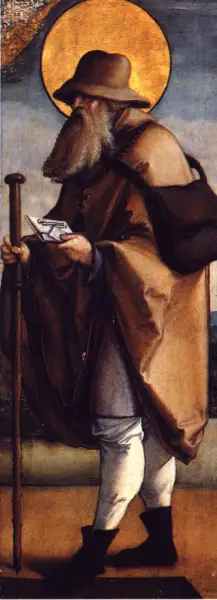
Art remembered Judoc plainly: the pilgrim's staff in his hand, the crown of his renounced inheritance at his feet. A sixteenth-century portrayal by the Master of Meßkirch shows him thus, and in Austria his figure appears on the mausoleum of Emperor Maximilian at Innsbruck, an odd honor for a man who gave away a throne. Literature gave him a longer fame. Chaucer's Wife of Bath swears by God and by Saint Joce, an oath that tells us the hermit of Ponthieu had entered the very speech of England. The French poet Eustache Deschamps, writing in the fifteenth century, called on Saint Josse in an imprecatory ballade, among a host of ills wished upon an enemy, alongside the mal Saint-Josse, the snakebite sickness invoked under the saint's name. These fragments of evidence add up to a singular fact: a figure of whom almost nothing historical is recorded became a household name across half of Europe, sworn by in taverns and prayed to in sickness. The diminutive Jocelyn, formed from his name, outlived his cult and still circulates today, a quiet legacy of the prince who gave up a kingdom for a cell in the woods.
§ Cultural depictions
Timeline
- 600
Born, by the traditional dating, into the royal family of Brittany.
§ Biography
- 636
Renounced his inheritance and wealth and set out on pilgrimage to Rome, receiving priestly ordination during the journey.
§ Biography
- 668
Died as a hermit at Saint-Josse-sur-Mer in Ponthieu after seven years as chaplain to the lord of Ponthieu.
§ Biography
- 903
Monks fleeing Norman raiders carried his relics to England and enshrined them at the New Minster in Winchester.
§ Veneration
- 961
By this date the rich silk samite saddlecloth later known as the Shroud of Saint Judoc had been woven in northeastern Iran.
§ Veneration
- 1134
His bones were reinterred, wrapped in the silk shroud now preserved in the Louvre.
§ Veneration
- 1772
The Abbey of Saint-Josse was closed.
§ Veneration
- 1789
The abbey was sold and dismantled, leaving no trace of the buildings; the parish shrine survived in the village church.
§ Veneration
In Their Own Words
Du mau saint Leu, de l'esvertin, Du saint Josse et saint Matelin... soit maistre Mahieu confondus!
by God and by Seint Joce
The Record
- Patron of
- invoked against the mal Saint-Josse, an illness from snakebite
- Symbols
- pilgrim's staff·a crown at his feet
- Canonization
- Pre-congregation
Prayer
Bibliography
Show 5 sources
- Butler, Alban, (Michael Walsh, ed.) Butler's Lives of the Saints (1991), s.v. "December 13: St Judoc, or Josse".
- Farmer, David Hugh (1997). The Oxford Dictionary of Saints (4th ed.). Oxford: Oxford University Press. p. 278. ISBN 9780192800589.
- Ordericus Vitalis. "The Legend of St. Judoc", The Ecclesiastical History of England and Normandy, Vol. 1, H.G. Bohn, 1853, p. 472.
- Spilsbury, S.V. "The imprecatory ballad: a fifteenth-century poetic genre", French Studies 33.4 (1979: 385–396).
- Bernus, M., Marchal, H., and Vial, G. "Le Suaire de St-Josse", Bulletin de Liaison du Centre International d'Études des Textiles Anciens 33 (1971: 1–57).
Profile text adapted from the Wikipedia article, licensed CC BY-SA 4.0.
Pray with this saint every day
Save St. Judoc to your favorites, read the full profile, and get feast-day reminders in the Saints app.
Get the Saints AppFree on the App Store for iPhone and iPad