
died c. 439·Feast May 22
St. Julia of Corsica
Virgin martyr of Carthage, patroness of Corsica
Overview
Julia of Corsica, remembered also as Julia of Carthage and, less often, as Julia of Nonza, was a virgin put to death for the faith, most likely in 439 or not long afterward. She was a girl of Carthage who, when the Vandals stormed her city, passed into the household of Eusebius, a merchant of Syria, and is generally understood to have been sold to him as a slave. Though she served a pagan master, she kept the disciplines of a Christian: fasting, prayer, and the reading of Scripture, growing pale and thin under his threats and blandishments. When Eusebius anchored at Cap Corse during a trading voyage to Gaul, a local tribune named Felix, presiding over pagan rites, demanded that she sacrifice to the gods. Her refusal, spoken with striking freedom of spirit, cost her blows, mutilation, flogging, and finally crucifixion. Her body was recovered by monks of Gorgona Island. In 762 Desiderius, who reigned over the Lombards, had her relics moved to the Benedictine abbey at Brescia at his queen's urging, and about a year later Pope Paul I consecrated a church there in her honor; it drew crowds of medieval pilgrims. Together with Devota she is invoked as patron of Corsica, and her feast is kept on 22 May in the West and 16 July in the East.
The Complete Life
A Daughter of Carthage in Bondage
Julia was a Carthaginian girl whose life was overturned when her city fell. In 429 Geiseric had led his Vandal people, some eighty thousand strong, across from Spain into Africa, and in 439 he seized Carthage by surprise. The conqueror disposed of many recalcitrant Christians by selling them, women especially, and it is usually understood that Julia was among those sold into slavery after the capture. She entered the household of Eusebius, whom the source styles a citizen of Syria in Palestine; the bishop who recorded her passio says only that she served a fleshly master, though one who came to admire the virtue of her service. She took as her rule the apostolic commands to serve earthly masters as serving Christ, and even in bondage she kept the practices of a free soul: when her duties were done and she had the servant's time to herself, she spent it reading or insisting on prayer. Fasting thinned her and made her pale, and no threats or blandishments of her master could draw her from it, since her heart, fixed on heaven, drew its daily food from the words of God. In the commerce of the ancient Mediterranean, a young and strong slave fetched a good price; in the economy of heaven, her price was already counted.
§ The story
Service as Freedom
The account preserved in Ruinart's edition of Victor Vitensis presents Julia's Christian constancy as the engine of the whole story. Eusebius her master, though a pagan, admired so great a virtue in his servant and seems to have had no success against it; he would later admit as much to a stranger. Sailing hard for Gaul with an expensive cargo, goods for sale, as the Latin of the text indicates, he put in for the night at Cap Corse. Seeing from afar that a pagan sacrifice was being made ready, he went down with all his company to be present; the victim that day was a bull, a beast of Poseidon, which points to the annual observance of the sacrum promontorium. While the crew celebrated, growing drunk, and Julia sighed in grief for their error, word reached the presiding magistrate that a girl aboard the ship derided the worship of the gods. This man, called Felix Saxo, held tribunician power and was perhaps the chief man of the place; he questioned Eusebius, who answered honestly that neither persuasion nor threats had moved the girl from the faith of the Christians, and that only her indispensable service had saved her from torture. Felix offered trade or ransom; Eusebius replied that all his property would not match the value of what she was to him.
§ The story
The Answer of a Free Woman
Foiled in open negotiation, the tribune prepared a banquet at which Eusebius drank himself into deep sleep, and a frenzied pagan crowd swarmed aboard the ship and hauled Julia onto the land. Felix made his offer in person: sacrifice to the gods, and he would pay her master whatever he asked and dissolve her servile condition. Her reply has echoed through the centuries: liberty, she told him, meant serving Christ, and him she served daily with an undivided mind, while his error she refused to honor and in truth detested. The tribune's power, which included manumission, could not purchase one word of compliance. He ordered her struck about the face, and she answered that if Christ had endured blows on her account, she could surely bear some on his. Then came what the passio calls the diminishment of her hair, then a flogging, and to each torment she gave back the same answer: scourged and crowned with thorns on her account, Christ had borne his; she in turn would carry the banner of faith, as she called the loss of her hair. Fearful of being indicted for cruelty, the magistrate hurried the procedure and ordered the handmaiden of Christ set upon the patibulum of a cross. One manuscript adds that a dove flew from her mouth as she died.
§ The story
Death on Cap Corse
Julia's martyrdom closed a life of which almost nothing is recorded beyond her servitude and her witness; her death on the cross at Cap Corse is the one event for which she is remembered, and the tradition holds that it occurred in 439 or shortly after. Eusebius awoke from his drunken sleep to find his slave gone, released by death into a freedom no master could contest: the narrator of the passio pictures the saint, her soul set free from the body and triumphant over pain, flying joyfully upward with the angels toward the heights of heaven. The account that preserves all this comes from the inquiry which Victor Vitensis says was made in those days among the elders, who reported hearing of Julia from their parents; by the time of that inquiry her repute as a martyr was already fixed among the people. The reliability of the underlying historian is high, for his contemporary record of the Vandal persecution is considered accurate wherever it can be checked, though the appendix carrying Julia's story survives only in Ruinart's edition. Scholars debate the rest: some place her in the sixth or seventh centuries, some have her killed by Moors rather than Roman authorities, and others hold that she died in Africa under Decius or Diocletian, her relics alone reaching Corsica with the Vandal invasions.
§ The story
From Gorgona to Brescia
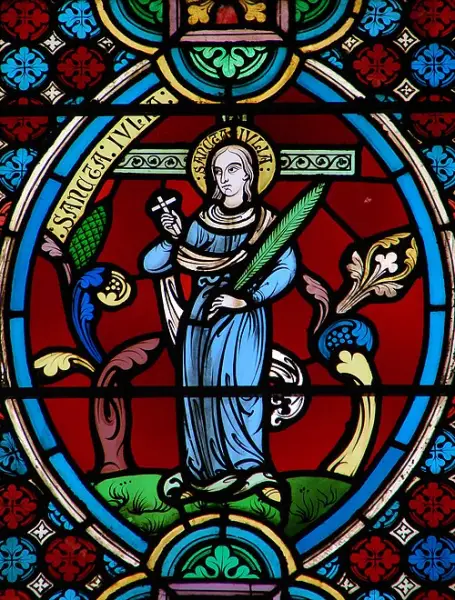
Monks from the island of Gorgona rescued Julia's relics. A legend attached to her cross a note written, it was said, in an angelic hand, bearing her name and her story; the monks cleaned the remains, covered them with pleasant aromas, and laid them in a sepulchre on their island. From there the cult moved to the mainland in glory: in 762 Desiderius, sovereign of the Lombards, granted his wife Ansa's wish and had the relics conveyed to the Benedictine abbey at Brescia, and around 763 Pope Paul I consecrated a church in her name there, a building that drew crowds of medieval pilgrims. The Basilica of Santa Giulia near Bergamo is likewise dedicated to her, and bone fragments venerated as her relics rest where the sequence of historical events says they ought to be, at the former church of Santa Giulia in Brescia, now part of the city museum. In the modern era her patronage was formally recognized: the church declared her patroness of Corsica on 5 August 1809, alongside Devota, the island's other martyr, honored from 1820. Her feast is kept on 22 May in the Catholic Church and 16 July in Orthodoxy, and in art she holds the martyr's palm and a small cross before the greater cross of her crucifixion.
§ Veneration
Timeline
- 250
An alternative scholarly tradition dates her martyrdom instead to the persecutions of Decius or Diocletian in Africa.
§ Other views
- 429
Geiseric and his Vandal people crossed from Spain into Africa.
§ Account by Victor Vitensis
- 439
The Vandals took Carthage by surprise; Julia's death occurred most probably in this year or thereafter.
§ Account by Victor Vitensis
- 762
Acting on Queen Ansa's petition, Desiderius had Julia's relics moved to the Benedictine abbey at Brescia.
§ Veneration
- 763
Pope Paul I consecrated a church in her name at Brescia, which became a popular medieval pilgrimage site.
§ Veneration
- 1809
The church declared Julia a patroness of Corsica on 5 August.
§ Veneration
In Their Own Words
My liberty is the service of Christ, whom I serve every day with a pure mind. As for that error of yours, I not only do not venerate it, I detest it.
The Record
- Patron of
- Corsica·Livorno·torture victims·pathologies of the hands and the feet
- Symbols
- Martyr's palm·crucifix
- Canonization
- Pre-congregation
Prayer
Bibliography
Show 5 sources
- Ἁ Ἁγία Ἰουλία ἡ Μάρτυς. 22 Μαΐου. ΜΕΓΑΣ ΣΥΝΑΞΑΡΙΣΤΗΣ.
- Jestice, Phyllis G. (2004). Holy People of the World: A Cross-cultural Encyclopedia. ABC-CLIO. p. 465. ISBN 9781576073551.
- Vitensis, Victor; Ruinart, Theoderic (1699). Historia persecutionis Vandalicæ in duas partes distincta. Prior complectitur libros 5 Victoris Vitensis episcopi, & alia antiqua monumenta. Posterior Commentarium historicum de persecutionis Vandalicæ. p. 453.
- Butler, Alban (1845). The Lives of the Fathers, Martyrs, and Other Principal Saints. Dublin: Duffy. pp. 282–283.
- Santa Giulia at Santi e Beati (in Italian).
Profile text adapted from the Wikipedia article, licensed CC BY-SA 4.0.
Pray with this saint every day
Save St. Julia of Corsica to your favorites, read the full profile, and get feast-day reminders in the Saints app.
Get the Saints AppFree on the App Store for iPhone and iPad