
died c. 304·Feast January 9
St. Julian and St. Basilissa
Married martyrs who kept a vow of virginity
Overview
Julian and Basilissa lived as man and wife, and both are honored as saints by the Roman Catholic Church and the Eastern Orthodox Church alike, remembered as martyrs of Diocletian's great persecution early in the fourth century. They are said to have died in 304, at Antioch according to Latin tradition or, more probably, at Antinoe in Egypt according to the Greeks. No historically certain data about either survives, and their legend is preserved only in the exaggerated shape of their Acts; this Julian has repeatedly been confused with other saints of the same name, of whom the Roman Martyrology counts thirty-nine, eight falling in January alone. The story tells that, forced by his family into marriage, Julian agreed with Basilissa that both would preserve their virginity; she founded and governed a convent for women while he gathered and directed a community of monks, and together they turned their house into a hospital able to receive a thousand patients. Basilissa stood fast through harsh persecution but ended her days in peace; Julian lived on for years after her and at last was beheaded under Diocletian together with the youth Celsus, the priest Antony, the convert Anastasius, Marcionilla the mother of Celsus, and her seven brothers. Their cult was firmly established before the eighth century.
The Complete Life
A Marriage Turned to Consecrated Life
The legend preserved in the Acts, and retold by Ælfric in his Lives of the Saints, begins with an arranged marriage. Julian's family compelled him to wed Basilissa, but on their wedding night the two reached an agreement that defined both their lives: they would preserve their virginity, each devoting to God the union that others expected them to consummate. The arrangement bore remarkable fruit. Basilissa founded a convent for women and became its superior, while Julian assembled a great company of monks and took charge of their guidance, so that a single household sponsored two communities of the consecrated life. Together the spouses converted their home into a hospital capable of housing as many as a thousand people, a work of charity so distinctive that Julian is often confused with Julian the Hospitaller, the legendary saint of innkeepers and hospital workers. The note of the tradition's own editors is honest: the idea of monks and nuns living in community is otherwise attributed to Pachomius the Great, who lived decades later, and little else is known of this couple aside from the exaggerations of their Acts. Yet the picture of a marriage transfigured into mutual consecration and public charity impressed the ancient Church deeply enough that the pair were venerated universally within a few generations.
§ Legend
Martyrs of the Persecution
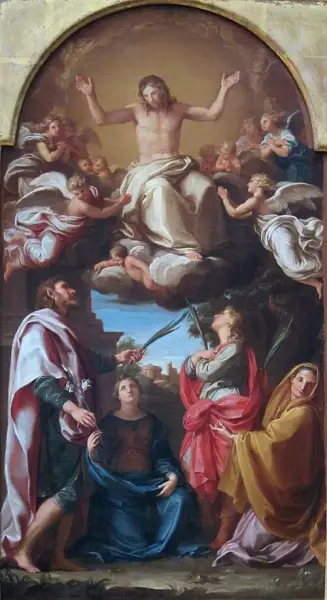
The two saints met different ends, according to the tradition. Basilissa, after standing severe persecutions, died in peace, the only member of the company spared a violent death. Julian survived her by many years and then fell victim to the final and fiercest persecution of the old Roman world, that of Diocletian. Arrested, he was tortured and put to death, beheaded in the tradition preserved by Ælfric. Latin sources locate his execution at Antioch in Syria, by order of the governor Martian; Greek sources place it at Antinoe in Egypt, which modern judgment considers the more probable setting. He did not die alone. With him suffered Celsus, a youth and the son of Marcionilla; Antony, a priest; Anastasius, a convert and neophyte; and Marcionilla herself, while her seven brothers too, the story runs, perished for the faith. The group portrait of the martyrs, with mother and son, priest and convert, and seven brothers in one company, has given the memory of Julian a distinctly communal character: churches from Constantinople to Anglo-Saxon England honored the whole band. The passage of Pompeo Batoni showing Christ with Saints Julian, Basilissa, Celsus, and Marcionilla keeps that company together on canvas to this day.
§ Julian's martyrdom
A Cult Fixed in Every Calendar
Whatever the historians may make of the couple, their cult had taken firm root well before the year 700, and the early martyrologies dispute mainly the date of keeping it. The Martyrologium Hieronymianum lists them under 6 January; Usuard, Ado, and Notker of St Gall place them under the ninth of the month; Rabanus Maurus puts them under the thirteenth; Vandelbert assigns them to 13 February; and the Menology of Canisius moves them to 21 June, the day the Greek Menaea give to another Julian, of Caesarea. The Roman Martyrology settles on 6 January for their martyrdom and the Greek Menaea on 8 January, while Old Hispanic liturgical calendars such as the Antiphonary of León keep 7 January. Constantinople possessed a church under their invocation, its dedication inscribed in the Greek Calendar under 5 July. In England, Ælfric of Eynsham wrote a Passion of St. Julian and His Wife Basilissa in his Lives of the Saints, of which only a fragment survives, but it carries the traditional legend intact: the vow of chastity made on the wedding night, the devotion to clænnysse, and the martyrdom by beheading. Few martyrs of the Diocletianic persecution are attested across so many calendars, East and West, Greek and Latin, so early.
§ Veneration
The Record
- Major works
- Hospital at their home, able to house up to 1,000 people
- Patron of
- Basilissa is invoked against chilblains
- Symbols
- palm of martyrdom
- Canonization
- Pre-congregation
Prayer
Bibliography
Show 3 sources
- Clugnet, Léon (1910). "Sts. Julian and Basilissa". In Herbermann, Charles (ed.). Catholic Encyclopedia. Vol. 8. New York: Robert Appleton Company.
- Butler, Alban. "St. Julian and St. Basilissa, Martyrs", The Lives of the Saints, vol. I, 1866.
- Kiernan, Kevin. "Odd Couples in Ælfric’s Julian and Basilissa in British Library Cotton MS Otho B.", Beatus vir: Studies in Anglo-Saxon and Old Norse Manuscripts in Memory of Phillip Pulsiano. Tempe, AZ: Medieval & Renaissance Texts & Studies (MRTS), 2005, pp. 85–106.
Profile text adapted from the Wikipedia article, licensed CC BY-SA 4.0.
Pray with this saint every day
Save St. Julian and St. Basilissa to your favorites, read the full profile, and get feast-day reminders in the Saints app.
Get the Saints AppFree on the App Store for iPhone and iPad