
c. 1127 – 1208·Feast January 28
St. Julian of Cuenca
Bishop of Cuenca and basket-weaving almsgiver
Overview
Julian of Cuenca was a Castilian priest and bishop whose episcopal office never extinguished his longing for the desert. Born at Burgos around 1127 to the nobleman Tauro, perhaps within a Mozarabic family, he earned a doctorate at Palencia and taught philosophy and theology there from 1153, supporting the poor from a basket-weaver's trade he practiced with his own hands. In 1163 he abandoned the schools for a hermit's house on the banks of the Arlanzón, was ordained priest in 1166, and wandered as an itinerant preacher as far as Córdoba and Toledo. Appointment as archdeacon of Toledo in 1191, and election to the see of Cuenca in 1196 after the city's recovery from Moorish rule, drew him back into public responsibility. As bishop he visited prisoners, fed poor farmers with grain, supported charities serving Jews and Muslims alike, and reformed his clergy, yet each year he withdrew again into solitude. He died on 20 January 1208 and was canonized by Clement VIII in 1594.
The Complete Life
A Scholar of Burgos and Palencia
Julian was born at Burgos around the year 1127, the son of a nobleman named Tauro, and one tradition adds that the family may have been Mozarabic. His first schooling came in the cathedral school of his native city, and from there he advanced to Palencia, whose studium was among the earliest centers of higher learning in the Christian kingdoms of Spain. There he took his doctorate, and in 1153 he was appointed a professor in the university's philosophical and theological departments. The chair gave him standing and an income, but he refused to let learning become a private comfort. During his Palencia years he took up the making of baskets and other trade goods, weaving them with his own hands both to support himself and to earn extra income that could be handed to the poor. The image is a striking one: a doctor of the schools standing in the marketplace selling work from his own fingers. His biographers treat the habit not as eccentricity but as the key to everything that followed, for Julian had decided early that study, manual labor, and almsgiving belonged inseparably together.
§ Life
From the Schools to the Hermit's House
In 1163 Julian resigned his teaching duties and left Palencia for a modest house outside Burgos, standing on the banks of the river Arlanzón, where he hoped to give himself wholly to solitude. Three years later, having first received the minor orders, he was ordained to the priesthood. At his side stood his companion Lesmes, and together the two men pursued a life of mortification and contemplation, disciplining body and mind for the sake of prayer. Yet the silence did not make them passive. Julian and Lesmes then became wandering preachers, and by 1191 their journeying had carried them as far as the cities of Córdoba and Toledo, deep into the frontier lands of the peninsula. The same year brought an abrupt change: Martín II López de Pisuerga, Archbishop of Toledo, summoned the wandering preacher out of his liberty and appointed him archdeacon at Toledo. Julian accepted the administrative burden, but he would not let it swallow his habits. While exercising the duties of his office he kept preaching, and he kept weaving baskets, so that the trade of his student years might still generate income for the poor.
§ Life
Bishop of a Recovered Frontier City
When Juan Yáñez, Bishop of Cuenca, died, King Alfonso VIII of Castile chose Julian to succeed him in 1196, and the Archbishop of Toledo conferred episcopal consecration upon him that June. Cuenca had recently been won back from Moorish rule, and Julian became bishop in the generation in which the city and its surrounding countryside were being reorganized under Christian governance. He took to the work with characteristic energy. He was known above all for his almsgiving, and he went personally to the prisons to visit the poor confined there. His pastoral rounds carried him across the diocese to see the faithful in their own villages, and his charity reached beyond the Christian community to Jews and Muslims as well. When harvests failed he offered grain to the poor to ease their suffering, and he aided the peasant farmers of the region whose fields were their whole livelihood. He continued to preach constantly, worked to reform the practices of the diocesan priests, and engaged with and supported the charities that provisioned the needs of his flock. The bishop's mitre never replaced the basket-weaver's hands.
§ Life
Solitude at the Heart of Office
The striking thing about Julian's spirituality is that the episcopate never cured him of his desire for the desert. On an annual basis, year after year, he withdrew from his diocese into a life of solitude and contemplation, remaining away long enough to find genuine silence before reemerging to take up his episcopal duties again. Even in these retreats the baskets kept appearing under his hands, the old trade that had bound him to the poor since Palencia. A legend preserved of him tells that Jesus Christ came to him one day disguised as a beggar so as to thank him for all he had done, a story that captures exactly how his contemporaries understood his charity: whatever the bishop gave to the least person, he gave to his Lord. The pattern of his life holds the two halves in balance that most of us pull apart — action and contemplation, public office and hidden prayer, the cathedral and the riverside hermitage. Julian shows that they can inhabit one life, provided the heart never settles comfortably into either. In this balance of hidden prayer and public mercy his whole episcopate found its shape.
§ Life
Death and Burial at Cuenca
Julian governed the see of Cuenca from 1196 until his death, spending his last dozen years in the round of preaching, almsgiving, pastoral visitation, and annual retreat that had defined his episcopate. He died in his diocese on 20 January 1208, at about eighty years of age. His remains were housed in the cathedral of Cuenca, where the faithful soon honored him as a saint. In 1578, nearly four centuries after his death, his remains were reinterred beneath an altar made in his honor in the same cathedral, a mark of the settled devotion the diocese paid to its great bishop. The casket holding his relics still rests underneath that altar, and in the twentieth century the local bishop, Inocencio Rodríguez Díez — who led the diocese from 1943 until 1973 — formally authenticated the relics, confirming the continuity of a cult that the people of Cuenca had maintained without interruption since the day their bishop died. Few Spanish dioceses can point to a founder figure so thoroughly theirs: a Castilian scholar and hermit who came to govern them and never stopped serving them. Nothing in these last years suggests any slackening of the rhythm of charity and retreat that had carried him since his student days at Palencia.
§ Life
Raised to the Altars
Clement VIII raised Julian to the company of the saints on 18 October 1594, nearly four centuries after his death, and the Roman calendar of the 1590s took in his name. That long wait was not neglect: the church of Cuenca had never ceased to venerate him, and the canonization gave the universal church what the diocese had long known. His feast is kept on 28 January, the day after the anniversary of his death. His relics, kept in a casket below the altar raised in his honor inside Cuenca Cathedral, were examined and authenticated by Bishop Inocencio Rodríguez Díez, who governed the diocese from 1943 to 1973, so that the physical evidence of the cult stood certified within living memory. The papal act of 1594 concludes a long chain of local devotion — the annual retreats and almsgiving remembered in story, the 1578 reinterment beneath his altar, and the unbroken veneration of the people who called him their saint long before the pope did. The canonization set the seal of the universal church upon a reputation that Castile had treasured for four hundred years.
§ Canonization
Patron of a City and a Craft
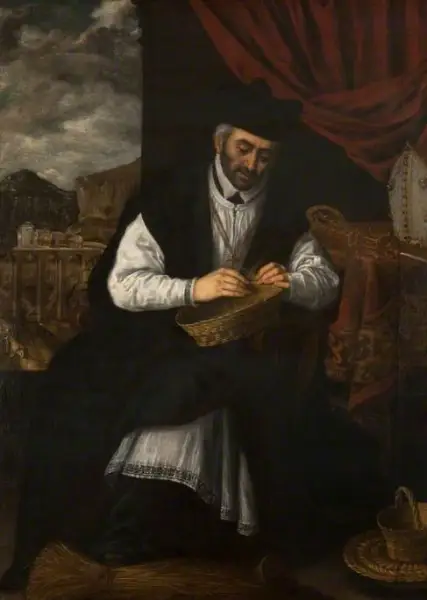
Julian of Cuenca remains the principal patron of the city and diocese whose bishop he was, and his intercession is traditionally invoked for rain, a patronage that belongs naturally to a shepherd of poor farmers who once handed out grain when the harvest fell short. Less expectedly, he is the patron of basket-weavers, the trade he practiced first as a professor earning alms for the poor and later as an archdeacon and bishop who never put the craft aside. His iconography gathers the two halves of his life into a single figure: he is shown in full episcopal attire, with mitre and crozier, while making baskets. His cult traveled far beyond Castile. On the island of Panay in the Philippines, the municipality of Janiuay, Iloilo, honors him as its patron, a devotion carried across the Pacific in the missionary expansion of the Spanish church. In art his story reached a wide audience through Eugenio Cajés's painting of the saint. The scholar who sold baskets, the hermit who became a bishop, the almsgiver whom Christ thanked in the disguise of a beggar: all of these remain the remembered face of St. Julian of Cuenca.
§ Canonization
Timeline
- 1127
Born at Burgos, in the Kingdom of Castile, to the nobleman Tauro, perhaps in a Mozarabic family.
§ Life
- 1153
Appointed professor in the philosophical and theological departments at the University of Palencia, having earned his doctorate there.
§ Life
- 1163
Left Palencia and his teaching duties to live in solitude in a modest house outside Burgos on the banks of the Arlanzón.
§ Life
- 1166
Ordained to the priesthood after receiving the minor orders.
§ Life
- 1191
Reached Córdoba and Toledo as an itinerant preacher with his companion Lesmes, then was named archdeacon of Toledo by Archbishop Martín II López de Pisuerga.
§ Life
- 1196
Chosen by Alfonso VIII of Castile to succeed Juan Yáñez as Bishop of Cuenca, and consecrated that June by the Archbishop of Toledo.
§ Life
- 20 Jan 1208
Died in his diocese at about eighty years of age and was buried in Cuenca Cathedral.
§ Life
- 1578
His remains were reinterred beneath an altar erected in his honor in Cuenca Cathedral.
§ Life
- 18 Oct 1594
Canonized by Pope Clement VIII, and his name was entered in the Roman calendar in the following years.
§ Canonization
The Record
- Major works
- Reform of the diocesan clergy of Cuenca·Charitable works for the prisoners, farmers, and poor of his diocese
- Patron of
- Cuenca·Invoked for rain·Basket-weavers·Janiuay, Iloilo
- Symbols
- Making baskets·Mitre·Crozier·Episcopal attire
- Canonization
- Canonized by Pope Clement VIII on 18 October 1594
Prayer
Bibliography
Show 4 sources
- Sainz Magaña, Elena. "San Julián de Cuenca". dbe.rah.es. Real Academia de la Historia (in Spanish). Retrieved 22 January 2024.
- "Saint Julian of Cuenca". Saints SQPN. 25 January 2017. Retrieved 11 October 2017.
- "Julian of Cuenca, St". New Catholic Encyclopedia. 2003. Retrieved 11 October 2017.
- Book of the Saints. Kessinger Publishing. 2003. p. 156.
Profile text adapted from the Wikipedia article, licensed CC BY-SA 4.0.
Pray with this saint every day
Save St. Julian of Cuenca to your favorites, read the full profile, and get feast-day reminders in the Saints app.
Get the Saints AppFree on the App Store for iPhone and iPad