
died 284 or 312·Feast February 6
St. Julian of Emesa
Physician and martyr of Homs in Syria
Overview
Julian of Emesa — known in Arabic as Elian al-Homsi and variously written Elyan or Ilyan — lived in the third century as a Christian of Emesa, the city now called Homs in western Syria. Greek and Latin sources style him Julianus the Emesene, and local memory has never separated him from the city of his birth. He is reputed to have practiced as a physician or healer, tending the bodies of his neighbors as an expression of his faith. When the Roman persecutions reached Emesa he refused to renounce Christianity, and for that refusal he was put to death, traditionally dated to either 284 or 312. His tomb became a center of pilgrimage, and in 432 the Church of Saint Elian was founded on the spot claimed for his martyrdom, his remains enshrined in a sarcophagus there. He is honored across the Catholic, Eastern Orthodox, Oriental Orthodox, Church of the East, and Anglican traditions, with feasts on 6 and 7 February, and he serves as patron of Homs, of physicians and the sick, and of sons and children.
The Complete Life
Healer of Emesa
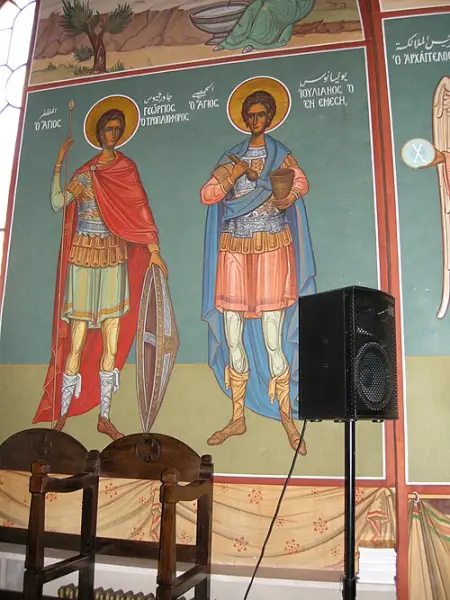
Julian belonged to the third-century church of Emesa, the prosperous Syrian city on the Orontes that is today Homs. His Greek name, Ioulianos of Emesa, and his Arabic name, Elian al-Homsi — Julian of Homs — reveal how completely his identity stayed bound to this one place. Within the Christian community he was reputed to practice as a physician or healer, and a mural in the Cathedral of Our Lady of the Annunciation in Jerusalem portrays him in exactly that role, dressed as a physician and standing beside St. George. Medicine in the late Roman world was a learned profession open to Christians, and a healer's rounds brought him into contact with every class of the city, the sick in their homes as well as those carried to him. The tradition does not preserve his teachings or the circumstances of his practice, but it preserved the one thing that mattered to the church that remembered him: when the imperial authorities demanded that he deny Christ, he would not. For that refusal he was executed, and the year of his martyrdom is given by different traditions as 284 or as 312, either way within the age of the Roman persecutions of the church in Syria.
§ Introduction
Shrines, Feasts, and an Unbroken Memory
The memory of the martyr took architectural form within a century of his death: in 432 the Church of Saint Elian was founded on the spot claimed as the site of his martyrdom, and his remains were set in a stone sarcophagus within a side chapel standing right of the church's main crypt, where pilgrims could venerate them. Homs and Antioch both rank as major shrines of his cult. In the surrounding countryside the Monastery of Saint Elian at Al-Qaryatayn, south of Homs, an old archaeological monastery with a Byzantine-style church decorated with marble columns, also houses his remains and keeps his feast. His veneration crosses every major division of Eastern Christianity: he is honored by Catholics and Eastern Orthodox on 6 February, and by the Oriental Orthodox, the Ancient Church of the East, and Anglicans on 7 February. He is patron of Homs itself and of Brownsville in Pennsylvania, and of physicians, the sick, sons, and children. The monastery's recent history shows that the memory is still contested by violence — ISIS destroyed it on 6 August 2015, and the Syriac Catholic Eparchy of Homs has begun rebuilding it.
§ Introduction
Timeline
- 284
Martyred at Homs for his refusal to renounce Christianity; some traditions place his death in 312 instead.
§ Introduction
- 432
The Church of Saint Elian was founded on the claimed spot of his death, enshrining his remains in a sarcophagus beside the main crypt.
§ Introduction
- 6 Aug 2015
The Monastery of Saint Elian at Al-Qaryatayn, which holds his relics, was attacked and destroyed by ISIS with bulldozers and bombs.
§ References
The Record
- Major works
- Remembered as a physician and healer of Emesa
- Patron of
- Homs, Syria·Brownsville, Pennsylvania·Physicians·The sick·Sons·Children
- Symbols
- Physician's garments·Palm of martyrdom
- Canonization
- Pre-congregation martyr; venerated in Catholic, Eastern Orthodox, Oriental Orthodox, Church of the East, and Anglican traditions
Prayer
Bibliography
Show 5 sources
- "Lives of the Saints: Martyr Julian of Emesa". Orthodox Church in America.
- Léontos Diakónou Historía (Λέοντος Διακόνου Ιστορία). 1864. p. 297.
- Syriac Catholic Church in Sydney (2023). "Syriac Monasteries: Monastery of Saint Elian". Syriac Church.
- Beattie, Andrew; Pepper, Timothy (2001). The Rough Guide to Syria. Rough Guides. ISBN 978-1-85828-718-8.
- Mannheim, Ivan (2001). Syria & Lebanon Handbook: The Travel Guide. Footprint Travel Guides. ISBN 978-1-900949-90-3.
Profile text adapted from the Wikipedia article, licensed CC BY-SA 4.0.
Pray with this saint every day
Save St. Julian of Emesa to your favorites, read the full profile, and get feast-day reminders in the Saints app.
Get the Saints AppFree on the App Store for iPhone and iPad