
3rd century (perhaps 4th)·Feast January 27
St. Julian of Le Mans
First bishop of Le Mans and evangelist of Gaul
Overview
Julian of Le Mans, honored in both the Roman Catholic and Eastern Orthodox churches, is remembered as the first bishop of Le Mans in Gaul. The traditions about his origins reach high and low alike: some accounts describe him as a Roman nobleman, while medieval writers, seeking an apostolic pedigree for the see, made him either Simon the Leper, whom the Gospels record as cured by Jesus, or one of the seventy-two disciples whom Christ himself sent out. Consecrated at Rome as a bishop, he was sent around the middle of the third century to evangelize the Cenomani, whose tribal capital, Civitas Cenomanorum (today's Le Mans), was suffering a shortage of drinking water. Legend credits him with bringing forth a spring from the ground by thrusting his staff into the earth and praying, a sign that opened the city to his preaching. He converted its leading citizen, looked after the poor, the infirm, and orphaned children, and worked miracles of healing and resurrection, and in old age withdrew to live as a hermit beside the Sarthe. His head has been venerated at Le Mans Cathedral since 1254.
The Complete Life
A Bishop Sent to the Cenomani
The church of Le Mans traced its origins to a mission that set out from Rome around the middle of the third century. Julian, consecrated a bishop in the eternal city, traveled into Gaul in the company of Thuribe, a priest, and Pavace, a deacon, charged with bringing the Gospel to the Cenomani people. Their capital, Civitas Cenomanorum — the modern Le Mans — was in the grip of a drinking-water shortage, and here the legends surrounding his life set their most famous scene: Julian drove his staff into the soil and prayed, whereupon water came gushing out of the earth. The miracle was remembered as the event that allowed him to preach freely within the city walls. His mission met with striking success. The principal citizen of Le Mans was converted to Christianity along with his whole family, and in gratitude he donated part of his palace to the church, so that a nobleman's residence became Le Mans' first cathedral. Julian converted many other citizens besides, and as the city's first bishop he gave himself to the poor, the infirm, and orphaned children. His miracles were said to include the resurrection of a dead man, and art shows him raising a dead child to life or vanquishing a dragon.
§ Life
Veneration Through Fire and Loss
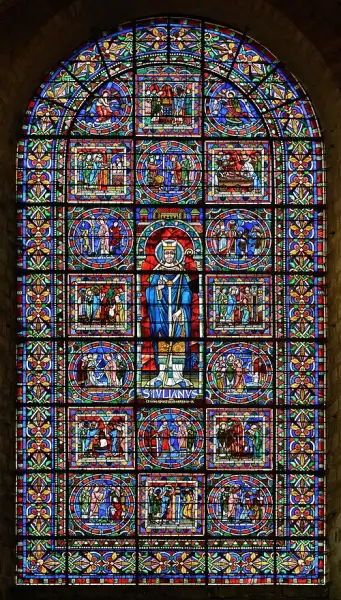
Upon reaching old age Julian withdrew to live as a hermit by the Sarthe, ending his days in the solitude he had never fully left behind, and the church he founded made him its first and lasting patron. The great Cathédrale St-Julien in Le Mans bears his name to this day, and a twelfth-century stained-glass window on its west facade depicts him surrounded by sixteen episodes of his life. His feast is kept on 27 January, with a second celebration on 25 July for the translation of his relics. The cult spread beyond Gaul: because Henry II of England had been born at Le Mans, the feast of St. Julian was celebrated in England, kept throughout the south of the country in at least nine Benedictine monasteries, and the Church of St. Julian in Norwich is likely dedicated to him. At the Benedictine convent called Notre-Dame-du-Pré his relics lay enshrined through the medieval centuries; in 1562 the Huguenots burnt or scattered most of them. His head, preserved and shown at the cathedral of Le Mans since 1254, survived the destruction and remains the chief treasure of his cult.
§ Veneration
Timeline
- 250
Left Rome, where he had been consecrated a bishop, and traveled into Gaul with Thuribe a priest and Pavace a deacon, to evangelize the Cenomani, around the middle of the third century.
§ Life
- 1254
His head, still shown at the cathedral of Le Mans, was enshrined there in this year.
§ Veneration
- 1562
Most of his relics had been enshrined for centuries at the convent of Notre-Dame-du-Pré before the Huguenots burnt or scattered them in 1562.
§ Veneration
The Record
- Major works
- Foundation of the church of Le Mans, whose first cathedral was built from a donated palace
- Patron of
- Diocese and city of Le Mans
- Symbols
- Bishop raising a dead child to life·Vanquishing a dragon
- Canonization
- Pre-congregation; venerated as first bishop of Le Mans in the Roman Catholic and Eastern Orthodox churches
Prayer
Bibliography
Show 6 sources
- Farmer, David. "Julian of Le Mans", Oxford Dictionary of Saints, OUP, (5th rev. ed.) 2011. ISBN 9780199596607.
- Kosloski, Philip. "Did the leper Jesus cured become a bishop in France?", Aleteia, January 29, 2019.
- "Saint Julian, Bishop of Cenomanis (Le Mans), Gaul". Orthodox Church in America.
- Salmani, Frank. "Saint Julian of Le Mans", Rhode Island Catholic, January 23, 2014.
- "Saint Julien Cathedral". Sanctuaire Basile Moreau.
- Butler, Alban. "Saint Julian, First Bishop of Mans, Confessor". Lives of the Fathers, Martyrs, and Principal Saints, 1866. CatholicSaints.Info. 25 January 2013.
Profile text adapted from the Wikipedia article, licensed CC BY-SA 4.0.
Pray with this saint every day
Save St. Julian of Le Mans to your favorites, read the full profile, and get feast-day reminders in the Saints app.
Get the Saints AppFree on the App Store for iPhone and iPad