
1270 – 1341·Feast June 19
St. Juliana Falconieri
Foundress of the Mantellate Sisters of the Servites
Overview
Juliana Falconieri of the Servite Order (1270 – 19 June 1341) founded the Religious Sisters of the Third Order of Servites, the community popularly called the Mantellate Sisters or Servite Tertiaries. Born into the noble Falconieri family of Florence — her uncle Alexis Falconieri numbered among the seven founders of the Servite Order, and her parents had funded the construction of the Order's mother church of Santissima Annunziata — she resolved as a young girl to follow the consecrated life under his influence. Around 1285 she took the Servite Third Order's habit from Philip Benizi, then the Order's Prior General, and lived by the rule he gave her at home until her mother's death. In 1305 she and a group of companions established a house of their own — the founding house of the Third Order's sisters — over which she presided as Superior for the rest of her life. The sisters, dressed in black gowns with leather girdles and white veils and called Mantellate for their short-sleeved working habits, devoted themselves to Our Lady of Sorrows and to the nursing of the sick. She died at Florence on 19 June 1341; a famed tradition relates that at her death, unable to receive viaticum, the Eucharistic host laid on her breast disappeared, leaving the image of a cross on her skin.
The Complete Life
A Noble House Given to the Servites
Juliana came from the noble Falconieri family of Florence, and her family tree nearly predicted her vocation. Her parents had supplied the funds for the construction of Santissima Annunziata, the mother church of the young Servite Order in Florence, and her uncle Alexis Falconieri counted among the seven holy founders whose vision had brought the Order into being. Growing up in a household so closely bound to the Servites, Juliana fell under the influence of her uncle, and at a young age she decided to follow the consecrated life herself. After her father's death, around the year 1285, she took the habit of the Servite Third Order from the hands of Philip Benizi, then Prior General of the Order — one of the most consequential figures of early Servite history placing his own hands on the habit of a fifteen-year-old girl. She did not at once enter a convent, for none existed for women of the Order. Instead she remained at home, living by the rule that Benizi had given her, and continued in that hidden obedience until the death of her mother left her free to shape a common life. The long apprenticeship at home formed the patience that would later govern a community.
§ Biography
The Birth of the Mantellate
In 1305, after her mother's death, Juliana settled with several companions in a house they could call their own, and this house turned into the founding home of the Third Order's sisters. Juliana presided as Superior of the community until the end of her life, governing it for the better part of four decades. The sisters' dress marked both their identity and their work: a black gown fastened with a leather girdle, a white veil, and — its short sleeves being designed for work — the name Mantellate by which people called them. Their main devotion was to Our Lady of Sorrows, the mystery at the heart of Servite spirituality, and their main activity was the care of the sick. Juliana directed the community of Servite Tertiaries for thirty-five years, and the sources are emphatic about her manner of leadership: she led more like a servant among her subordinates than like a mistress over them. Her life of prayer was marked by long ecstatic hours, and her charity was daily and physical — caring for the sick in the streets, in their homes, and in the hospitals of Florence. What began as one noblewoman's resolve had become a durable form of religious life for women.
§ Biography
Sorrows of Mary, Sick of the City
The spirituality Juliana handed to the Mantellate joined two loves that her order held together from its beginnings: the sorrows of Mary and the sufferings of the sick. The community's chief devotion was to Our Lady of Sorrows, the mother standing beneath the cross, and this contemplation of Mary's pain gave shape to the sisters' daily labor among the diseased and dying of Florence. They went out to where the suffering was — into the streets, into private homes, into the hospitals — rather than waiting for the sick to be brought to them. Juliana's own prayer was described as often rising into long moments and hours of ecstasy, the contemplative depth from which her tireless activity flowed. The tradition of her last illness carries this union of Eucharist and suffering to its conclusion. Deathbed accounts relate that, because of constant vomiting, Juliana found herself unable to receive Holy Communion, the sacrament she had honored all her life. She begged that a corporal be spread over her chest and the Eucharistic host laid upon it. Shortly afterward the host disappeared, and when she died a cross, matching the one marked on the host, was discovered imprinted upon her breast — a sign the church has never ceased to contemplate.
§ Biography
Death in the odor of sanctity
Juliana died at Florence on 19 June 1341, at seventy or seventy-one years of age, still Superior of the community she had founded thirty-five years before. The account of her dying preserved in the liturgical texts tells of the miraculous communion granted to her when ordinary reception had become impossible, and of the cross found upon her flesh after the host laid upon her had vanished. Straight away after her death the people of Florence and her own Order honored her as a saint, without waiting for any formal process; her body was laid to rest in the Basilica of the Santissima Annunziata, the Servite mother church her own parents had helped to build, where her shrine remains a center of devotion. Devotion to her grew steadily within the Servite family through the following centuries, nourished by the memory of the Mantellate's service to the sick and by the extraordinary signs reported at her death, until the cause of her canonization was taken up by the popes of the seventeenth and eighteenth centuries. Florence needed no papal verdict to tell it what it had lost, and the Servite family kept her memory with the affection owed to a mother.
§ Biography
From Beatification to the Universal Calendar
Pope Benedict XIII took the first formal step, acknowledging the devotion that had long been paid to Juliana and giving the Servites leave to celebrate the feast of Blessed Juliana. She was beatified on 26 July 1678 in Rome by Pope Innocent XI, and on 16 June 1737, in Rome, Pope Clement XII canonized her — a pope of Florentine origins raising the Florentine foundress to the altars of the whole church. Clement XII at the same time extended the celebration of her feast, kept on 19 June, the anniversary of her death, to the entire Church, so that the memory of the Mantellate's mother would no longer be confined to Tuscany or to the Servite Order. The path from her death in 1341 to canonization in 1737 spans almost four centuries, but each stage followed the same evidence: the immediate popular veneration after 1341, the papal approval of the Servite Order under Martin V in 1420 that stabilized the family she belonged to, the indulgent recognition by Benedict XIII, and finally the canonization decree of Clement XII. The canonization confirmed what the tireless service of the Mantellate to the sick had proclaimed for four centuries.
§ Biography
The Sisters She Left Behind
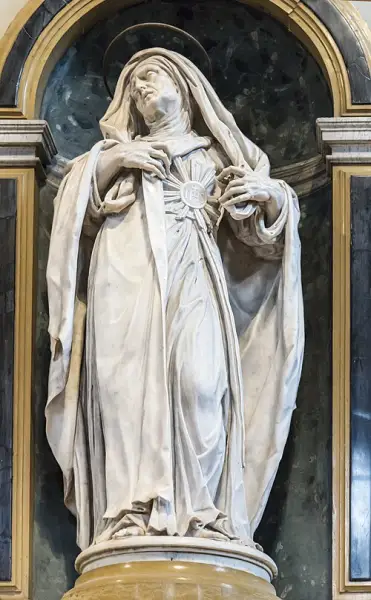
Juliana's most enduring monument is the community she founded. The Mantellate Sisters of the Third Order of Servites continued after her death the double charism she had given them — devotion to Our Lady of Sorrows and care for the sick — and spread from their first Florentine house into a religious family that endures to this day. In art she is immediately recognizable by her attributes: depicted wearing the habit of her community with a Eucharistic host shining on her breast, the image of her miraculous last communion. Her cult produced a rich artistic legacy in Florence and beyond, from Agostino Veracini's painting of the saint and Giuseppe Cassioli's 1929 triptych in the church of the Seven Holy Founders to Pier Leone Ghezzi's depiction of her death and a statue of her in St. Peter's Basilica, alongside stained glass in churches as far away as Tournai. She is invoked as patron of bodily ills, of sick people, and of sickness itself, a patronage drawn directly from the labors of her life. In 1737 her feast entered the universal calendar on 19 June, and the basilica of the Santissima Annunziata in Florence remains her chief shrine.
§ Biography
Timeline
- 1270
Born at Florence into the noble Falconieri family, whose members had funded the Servites' mother church of Santissima Annunziata.
§ Biography
- 1285
Took the habit of the Servite Third Order from its Prior General, Philip Benizi, around this year, after her father's death.
§ Biography
- 1305
After her mother's death, settled with companions in a residence of their own — the founding house of what became the Sisters of the Third Order of Servites.
§ Biography
- 19 Jun 1341
Died at Florence, aged seventy or seventy-one; the image of a cross was found on her breast where the Eucharistic host had vanished.
§ Biography
- 1420
The Servite Order was approved by Pope Martin V.
§ Biography
- 26 Jul 1678
Beatified in Rome by Pope Innocent XI; Pope Benedict XIII later acknowledged the devotion long paid to her and gave the Servites leave to keep her feast.
§ Biography
- 16 Jun 1737
Canonized in Rome by Pope Clement XII, who extended her feast of 19 June to the entire Church.
§ Biography
The Record
- Major works
- First convent of the Sisters of the Third Order of Servites (the Mantellate), founded at Florence in 1305
- Patron of
- Bodily ills·Sick people·Sickness
- Symbols
- Religious habit of her Order·Eucharistic host upon her breast
- Canonization
- Beatified 26 July 1678 by Pope Innocent XI; canonized 16 June 1737 by Pope Clement XII
Prayer
Bibliography
Show 5 sources
- "St. Juliana Falconieri". FaithND.
- "Saint Juliana Falconieri, O.S.M.". The Servite Order, Australia.
- Kirsch, Johann Peter. "St. Juliana Falconieri." The Catholic Encyclopedia. Vol. 8. New York: Robert Appleton Company, 1910. 30 Aug. 2014.
- Duffy, Patrick. "St Juliana Falconieri (1270-1341)". Catholic Ireland, 18 June 2012.
- "St. Juliana Falconieri, Virgin, Foundress of the Mantellate". Vatican News.
Profile text adapted from the Wikipedia article, licensed CC BY-SA 4.0.
Pray with this saint every day
Save St. Juliana Falconieri to your favorites, read the full profile, and get feast-day reminders in the Saints app.
Get the Saints AppFree on the App Store for iPhone and iPad