
1530 – 1604·Feast January 2
St. Juliana of Lazarevo
Orthodox noblewoman and merciful lay mother of Murom
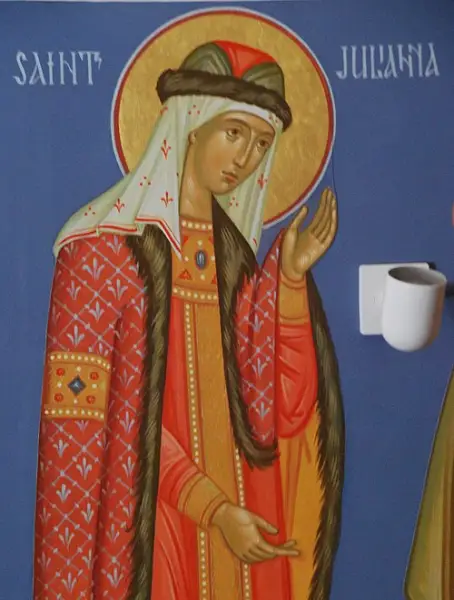
Overview
Juliana of Lazarevo, also venerated as Juliana of Murom, was born in Moscow in 1530 to Justin and Stefanida Nedyurev. She married Giorgi Osorgin, the lord of the village of Lazarevo near Murom, and spent her adult life there as wife, mother, and mistress of a landed household. Rather than withdrawing to a monastery, she consecrated herself to the poor and needy within the ordinary round of family duties, and her charity became the defining mark of her life. The Orthodox Church holds her up as a model of sanctity achieved in the world: a demonstration that God may be pleased not only by flight to a monastic cell but also within a family, amid care for children, spouse, and household. She died on 10 January 1604. Her feast is kept on 2 January by the new calendar and 15 January by the old, and she is invoked as patron of marriage, kitchens, and the home. Among her descendants was Juliana Ossorguine, wife of the theologian Fr. Alexander Schmemann and mother of the journalist Serge Schmemann, and an Orthodox parish in the Russian Church Outside of Russia bears her name.
The Complete Life
A Daughter of Moscow
Juliana was born in Moscow in 1530, the child of Justin and Stefanida Nedyurev, a family of the Russian nobility. Of her childhood the surviving account tells us little, but the world into which she was born was the world of sixteenth-century Muscovy, where noble daughters were married to cement alliances between landed houses and where a woman's sanctity was normally expected to flourish inside marriage rather than outside it. Her parents raised her in the Orthodox faith, and the virtue that would later define her, an unremitting mercy toward the poor, took root early enough to shape the whole course of her life. In due season she was given in marriage to Giorgi Osorgin, owner of the village of Lazarevo, situated near the ancient town of Murom. Marriage removed her from the city of her birth to the countryside, and it was there, as mistress of a rural estate and mother of a family, that the remainder of her earthly story unfolded.
§ Saint Juliana the Merciful
Sanctity Within the World
The distinctive greatness of Juliana lies precisely in the ordinariness of her setting. She never entered a monastery, took no vows beyond those of marriage, and exercised no public office in the Church. Her vocation was lived entirely within the family: care for her husband Giorgi, for her children, and for the members of her household at Lazarevo. Yet the Church came to see in her an answer to a question every Christian generation must face, whether God can be pleased by a life spent amid domestic cares. Her example, Orthodox writers insist, shows that forsaking the world for a monk's cell is not the only road to pleasing God; the same end may be reached within a family, amid anxieties for children, spouse, and servants. To this hidden holiness she joined active philanthropy, consecrating herself to the relief of poor and needy people with such constancy that mercy became her name: she is remembered in the icons as Juliana the Merciful.
§ Saint Juliana the Merciful
Memory and Veneration
Juliana died on 10 January 1604, and the Russian Orthodox Church numbered her among the saints. Her memory is kept on 2 January according to the new style and on 15 January according to the old, and the faithful invoke her as patron of marriage, of kitchens, and of the home, an appointment of patronage that reflects the rooms in which her sanctity was actually worked out. Her influence reached far beyond Murom. A descendant, Juliana Ossorguine, married Fr. Alexander Schmemann, one of the most influential Orthodox theologians of the twentieth century, and became the mother of the journalist Serge Schmemann. In the diaspora her cult found an institutional home in the Russian Orthodox Church Outside of Russia, whose Western-American Diocese maintains a parish dedicated as St. Juliana of Lazarevo Orthodox Church. Centuries after her death, a saint of the Muscovite countryside thus continues to feed the devotional life of Orthodox Christians on two continents.
§ Saint Juliana the Merciful
Timeline
- 1530
Born in Moscow to Justin and Stefanida Nedyurev.
§ Saint Juliana the Merciful
- 10 Jan 1604
Died at Lazarevo near Murom, after a lifetime of service to the poor.
§ Saint Juliana the Merciful
The Record
- Patron of
- Marriage·Kitchens·The home
- Canonization
- Canonized by the Russian Orthodox Church; the source records no date for her glorification.
Prayer
Bibliography
Show 3 sources
- Saint Juliana Biography
- Serge Schmemann, "Soul of Russia", National Geographic, April 2009.
- Parish web-site
Profile text adapted from the Wikipedia article, licensed CC BY-SA 4.0.
Pray with this saint every day
Save St. Juliana of Lazarevo to your favorites, read the full profile, and get feast-day reminders in the Saints app.
Get the Saints AppFree on the App Store for iPhone and iPad