
c. 1192 – 1258·Feast April 6
St. Juliana of Liège
Norbertine mystic and promoter of Corpus Christi
Overview
Juliana of Liège, also known as Juliana of Mount-Cornillon, was born around 1192 or 1193 at Retinnes in the Prince-Bishopric of Liège, in what is now Belgium. Orphaned at the age of five together with her twin sister Agnes, she and her sister were entrusted to a hospice lately established at Mont-Cornillon, just beyond the walls of Liège, where she entered the double canonry at thirteen and worked for many years in its leprosarium. From early youth she cherished a deep devotion to the Eucharist, and at sixteen she received the first of a recurring vision: a full moon crossed by a dark stripe, which she came to understand as the Church's life lacking a feast in honor of Christ's Body and Blood. Elected prioress around 1225, she shared her vision with her confessor, Canon John of Lausanne, and with him composed the earliest office for the new feast. In 1246 Bishop Robert de Thorete instituted the feast of Christ's Body and Blood in his own diocese, the first celebration of what would become Corpus Christi. Driven from her convent twice by the intrigues of a hostile supervisor, she ended her life in seclusion at Fosses-la-Ville, dying on 5 April 1258. Urban IV extended the feast to the whole Latin Church in 1264, and Juliana was canonized by Pope Pius IX in 1869.
The Complete Life
An Orphan of Retinnes
Juliana and her twin sister Agnes were born, around 1192 or 1193, at Retinnes, a village of the Prince-Bishopric of Liège in the Holy Roman Empire. The sisters lost their parents before their sixth birthday, and the orphaned girls were placed in a hospice newly founded at Mont-Cornillon, on the outskirts of the city of Liège. The establishment followed the model of a double monastery, housing both canons and canonesses in separate wings of the same foundation, and the two children were at first lodged on a small farm adjoining the canonry. When Juliana reached the age of thirteen she entered the Order herself, and for many years her labor was given to the community's leprosarium, where she cared for those afflicted with the most feared disease of the age. Her sister Agnes seems to have died young, for the archives fall silent about her after the girls' placement. The orphan who thus grew up among the sick, the religious, and the poor acquired both a tough practical charity and a spirituality of unusual interior depth.
§ Biography
The Vision of the Moon
From her earliest years Juliana honored the Eucharist with singular devotion, a trait she shared with many of the women of Liège, and she longed for a liturgical feast that would give Christ's Body and Blood their own solemn day. When she was sixteen she experienced the first of a series of visions that would recur throughout her life. In it she beheld the moon at its full splendor, yet crossed from side to side by a dark stripe. With time the meaning disclosed itself to her: the luminous sphere was the life of the Church on earth, while the opaque band cutting across it signified the absence of any feast in honor of the Blessed Sacrament. Having no means to bring such a feast into being, she kept the matter private for years, confiding it only to the anchoress Eve of Liège, who lived in a cell beside the Basilica of St. Martin, and to a few trusted sisters of her monastery. Her vision was judged worthy of illustration in the historiated initial letter of her vita, preserved in the manuscript Paris, Bibliothèque de l'Arsenal, MS 945.
§ Biography
Bringing the Feast to Birth
Around 1225 the community elected Juliana prioress of the double canonry, and in that office she at last confided her visions to her confessor, Canon John of Lausanne, who served the collegiate chapter of Saint Martin's basilica as a secular canon. John moved in circles of learning that included the distinguished French theologians and Dominican professors gathered at Liège: Bishop Robert de Thorete of Liège, Hugh of Saint-Cher, prior provincial of the Dominicans in France, and Jacques Pantaleon of Troyes, archdeacon of Liège, who would one day reign as Pope Urban IV. Through John, Juliana's vision reached these men, and they unanimously judged that nothing in the proposed devotion conflicted with Catholic faith and endorsed its institution. Authorized by the local authorities, Juliana worked with the young canon to compose the first version of the office, Animarum cibus, taking its title from the opening words of its first antiphon; the earliest text survives in the manuscript The Hague, Koninklijke Bibliotheek, KB 70.E.4. Modern scholarship, attentive to references to her musical and liturgical performance, recognizes Juliana as the author of this initial Latin office. In 1246 Bishop Robert established the new solemnity of Christ's Body and Blood in his own diocese, its first celebration anywhere; he died before the year ended, though the canons of St. Martin kept the new feast.
§ Biography
Fire Beneath Trial
Juliana's interior life joined Eucharistic yearning to steadfast endurance. As prioress she reinstated the strict Augustinian rule in her community, a reforming zeal that won her enemies as readily as it honored God. In 1240 the canonry and its leprosarium came under the charge of a supervisor named Roger, who took an immediate dislike to Juliana and to her reproaches. He stirred the townspeople against her with a charge that she had diverted and stolen the hospital's money, and under the weight of the slander she took refuge in the anchorhold of Dame Eve, her friend, and afterward found shelter in Canon John's house beside the basilica. With the help of Bishop Robert of Thourotte she was vindicated, restored to her office, and Roger was deposed. Yet when Robert died in 1247, Roger recovered his position at Mont-Cornillon when the new bishop, Henry de Gueldre, took office, and Juliana was expelled once more. Behind these quarrels stood the larger turmoil of Liège: an urban middle class demanding new rights, the rivalry of Guelphs and Ghibellines, and feuds among the lower nobility of Flanders. Through it all her devotion to the sacrament of the altar never cooled, and persecution neither silenced her nor turned her from the work she believed heaven had asked of her.
§ Biography
Exile and Quiet Ending
After her second expulsion Juliana became a wanderer among other people's monasteries. She found shelter in turn at the Cistercian houses of Robermont, Val-Benoît, and Val-Notre-Dame, and afterward spent a period among the poor Beguines. Aided by Abbess Imene, sister of Archbishop Conrad of Cologne, she eventually settled at the Cistercian Abbey of Salzinnes, and at last at Fosses-la-Ville in the County of Namur, spending her remaining years in seclusion there until she died. The woman who had given the Church its greatest Eucharistic feast ended her days far from the convent she had governed, in obscurity and dependence on charity. On her deathbed she asked for her old confessor, John of Lausanne, reportedly to disclose to him secrets she had long kept hidden; but he, like every friend from Liège, failed to reach her before the end, and she died on 5 April 1258 without the consolation of their presence. By her own wishes her friend Gobert d'Aspremont, a Cistercian monk, conveyed her body to Villers Abbey, and on the following Sunday her remains were transferred to the part of the cemetery reserved for the saints.
§ Biography
Recognition of a Cult
Although veneration of Juliana began immediately after her death, the Church's formal recognition came only centuries later. Her cult had never ceased: her feast was fixed on 6 April, and her memory lived on at Villers Abbey, where her relics rested, and throughout the diocese of Liège, whose cathedral chapter had kept the first Corpus Christi. In 1869 Pope Pius IX canonized her, closing the long interval between popular devotion and official judgment. Later pontiffs honored her as well: Pope John Paul II, on the 750th anniversary of the Feast of Corpus Christi, addressed a letter in her honor, and Pope Benedict XVI devoted a general audience address of 17 November 2010 to her, presenting her to the whole Church as the humble instrument through whom the solemnity of the Body and Blood of the Lord entered the universal calendar. The major shrine of the saint is today the former Villers Abbey at Villers-la-Ville in Walloon Brabant, Belgium, and she is venerated especially within the Premonstratensian Order and the Roman Catholic Diocese of Liège.
§ Veneration
Apostle of the Blessed Sacrament
Juliana's lasting title, Apostle of the Blessed Sacrament, rests on what followed from her vision. In 1261 the archdeacon Jacques Pantaleon, whom she had never seen rise higher than Liège, was elected pope as Urban IV. Three years later, in 1264, he extended the new feast to the whole Latin Church, assigning it the Thursday after Pentecost, through the bull Transiturus de hoc mundo — never before had a pope sanctioned a universal feast for the entire Latin Rite. Its office was entrusted to Thomas Aquinas, and Thomas produced two versions, Sapiencia edificavit and Sacerdos in eternum, whose interrelationship scholars still study as draft and final texts; within the latter stands the earliest formal exposition of the doctrine of transubstantiation. Urban sent notice of the new feast to clergy far and wide, and among the recipients was the recluse Eve of Saint Martin, Juliana's old friend, whom contemporary scholars credit with composing the first French vita of Juliana and thus takes her place among the earliest women writers of medieval Europe. After the reform of the liturgy carried out in 1969 under Pope Paul VI, the episcopal conferences of each nation may move the observance to the Sunday after Trinity, yet the solemnity itself, born of a Liège canoness's vision, remains central to the Catholic year.
§ Veneration
Timeline
- 1192
Born at Retinnes in the Prince-Bishopric of Liège, twin sister of Agnes.
§ Biography
- 1225
Elected prioress of the double canonry of Mont-Cornillon and revealed her vision to Canon John of Lausanne.
§ Biography
- 1240
Falsely accused of stealing hospital funds by the supervisor Roger, she fled the canonry before being vindicated and restored.
§ Biography
- 1246
The feast of Christ's Body and Blood was first celebrated in his own diocese at the command of Bishop Robert de Thorete.
§ Biography
- 1247
After Bishop Robert's death, Roger regained control of Mont-Cornillon under Bishop Henry de Gueldre and expelled Juliana again.
§ Biography
- 5 Apr 1258
Died in seclusion at Fosses-la-Ville in the County of Namur.
§ Biography
- 1261
Jacques Pantaleon, formerly Archdeacon of Liège, was elected pope and took the name Urban IV.
§ Veneration
- 1264
By the bull Transiturus de hoc mundo, Pope Urban IV made Corpus Christi a feast of the whole Latin Church.
§ Veneration
- 1869
Canonized by Pope Pius IX, receiving official recognition of a cult that had flourished since her death.
§ Veneration
The Record
- Major works
- Animarum cibus (the initial Latin office of Corpus Christi)
- Patron of
- Devotion to the Blessed Sacrament
- Symbols
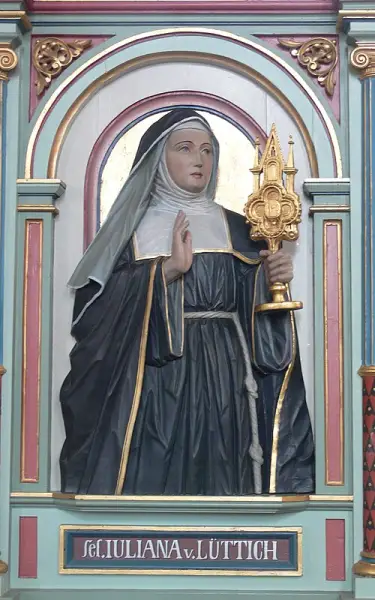
- Holding a monstrance
- Canonization
- Canonized in 1869 by Pope Pius IX.
Prayer
Bibliography
Show 7 sources
- "Norbertine Vocations 'Corpus Christi & St. Juliana of Liège'", Norbertinevocations.wordpress.com, 2008-05-25
- Benedict XVI, General audience address of 17 November 2010, dedicated to St. Juliana, Zenit.org, 30 May 2013
- McPortland, Joanne. "Juliana of Liege", Aleteia, May 29, 2016
- Mershman, Francis. "St. Juliana of Liège." The Catholic Encyclopedia. Vol. 8. New York: Robert Appleton Company, 1910. Newadvent.org, 1910-10-01
- Delville, 1999, Vie de Sainte Julienne de Cornillon
- Walters, Barbara R. The Feast of Corpus Christi. University Park: Penn State Press, 2007. ISBN 0-271-02924-2
- Wainwright, Geoffrey. The Oxford History of Christian Worship. Oxford University Press, 2006. ISBN 0-19-513886-4
Profile text adapted from the Wikipedia article, licensed CC BY-SA 4.0.
Pray with this saint every day
Save St. Juliana of Liège to your favorites, read the full profile, and get feast-day reminders in the Saints app.
Get the Saints AppFree on the App Store for iPhone and iPad