
c. 285 – 304·Feast February 16
St. Juliana of Nicomedia
Virgin martyr who vanquished the devil in chains
Overview
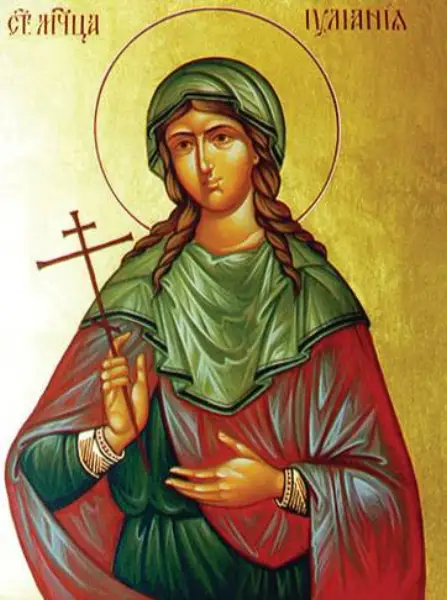
Juliana of Nicomedia is an Anatolian Christian martyr said to have been put to death during the Diocletianic persecution around 304. The oldest notice of her appears in the Martyrologium Hieronymianum under 16 February, which records Cumae in Campania as her birthplace, while the hagiographic legend, known to Bede, presents her as the daughter of a pagan nobleman of Nicomedia, betrothed as a child to the senator Eleusius, an advisor of the emperor. Secretly baptized a Christian, she refused marriage to her pagan suitor, was denounced to the Roman governor, and endured flogging, burning, and boiling oil before beheading. Her Acts recount a struggle with Satan himself, whom she overcame and led in chains, an episode that fixed her iconography: a virgin with a winged devil on a tether, or enduring torments, or fighting a dragon. A letter of Gregory the Great attests her special veneration near Naples at the end of the sixth century, and devotion to her spread widely through the Middle Ages, taking deepest root in the Netherlands, where she was honored as patroness of the sick. Early in the thirteenth century her remains were translated to Naples. The East keeps her feast on 21 December, the Roman Catholic Church on 16 February.
The Complete Life
Between Cumae and Nicomedia
The historical record and the legend tell two different opening chapters for Juliana's life, and honest devotion must hold both. The Martyrologium Hieronymianum, the oldest witness, notes her birth under the sixteenth of February with the words naming Cumae in Campania as her place of origin. The Greek and Latin Churches alike list a martyr named Juliana, and her life is catalogued among the texts of the Bibliotheca Hagiographica Graeca and Latina. The Acts that Bede drew upon for his Martyrologium, however, tell a legendary tale set in the East: Juliana, daughter of an illustrious pagan called Africanus, was born in Nicomedia and betrothed while still a child to Eleusius, a senator among the emperor's counselors. Her father hated the Christian faith. Complication enters even here, for a noble lady named Sephora, traveling through Nicomedia after the martyrdom, carried a martyr's body to Italy for burial in Campania, and it seems the reverence paid to one Juliana in Nicomedia may have merged with that owed to another who suffered at Cumae — two distinct persons whose memories the centuries entwined.
§ Historical background
A Secret Baptism and a Refusal
According to the legend, Juliana's decisive act was made in secret and sealed in silence. While her father remained hostile to the Christian faith and her wedding to the senator Eleusius approached, the young woman received baptism without telling either parent. When the day of the marriage drew near she refused to be married, a defiance wholly unexpected of her. Her father urged her not to break the engagement, and when she would not obey, he surrendered her to the governor — who was, in the bitter irony of the tale, her own former fiancé. A variant account makes Eleusius a prominent officer from Antioch and describes her parents as astonished pagans: their daughter, always obedient, now resisted them without explanation. Eleusius, his dignity wounded, made enquiries, discovered her hidden conversion, and denounced her to the Roman governor, who had her arrested and imprisoned. Even from her cell the pressure continued, for her persuaders still hoped to save her life by making her Eleusius's wife. She answered them all with one refusal: she preferred death to marriage with a pagan.
§ The legend
Trial by Fire and Word
The martyrdom narrative puts Juliana's victory in both body and speech. She was flogged, made to pass through fire, and immersed in a cauldron of boiling oil, before the sentence of beheading was finally carried out around 304, in the persecution of Maximian. Another Christian, Saint Barbara, suffered alongside her, and both came to be venerated as saints. The alternative narrative preserves a dialogue at the moment of her disfigurement: after flogging her on the governor's orders, Eleusius seared her face with a red-hot iron and mocked her, telling her to go and look at her beauty in a mirror. Juliana, we are told, answered with a light smile, declaring that at the resurrection of the righteous there would be neither burnings nor wounds, but only the soul; she preferred, she said, the temporary wounds of the body to the wounds of the soul that torture eternally. The same account appends an epilogue of poetic justice: Eleusius, filled with hate to the end, was afterwards shipwrecked on an unknown island and devoured by a lion.
§ Alternative narrative
The Combat with the Dragon
What set Juliana apart among the virgin martyrs of the ancient Church was the combat her Acts describe, not against magistrates alone but against Satan in person. Because the account dwells on her conflicts with the devil, artists gave her a singular attribute: a winged demon led submissively by a chain in the saint's hand. Other images show her undergoing the successive tortures, and still others show her locked in battle with a dragon, the beast that is the devil's oldest emblem. This iconography made her a figure of peculiar comfort to ordinary Christians besieged by temptation and sickness alike. Her image crossed into vernacular art and letters: a medieval stained-glass depiction of her survives in the church of St Mary at Martham, her effigy appears on the rood screen of St Andrew at Hempstead near Holt in Norfolk, and the church of St Mary at North Elmham carries her image as well. In the eighth century the Anglo-Saxon poet Cynewulf, as the poem is believed to be his, made her the subject of a long work built around an extended dialogue between the saint and the demon she had restrained.
§ Veneration
Patroness of the Sick
Few early martyrs commanded a devotion so durable or so widely dispersed. A letter of Gregory the Great testifies that around the year of his pontificate a noble Christian woman, Januaria, had raised an oratory on her own land and sought relics of Saints Severin and Juliana for its consecration; Gregory wrote to Fortunatus II, bishop of Naples, directing him to grant the request — proof that the special veneration of Juliana flourished in the neighborhood of Naples at the close of the sixth century. Devotion to her grew throughout the Middle Ages and persisted with particular strength in the Netherlands, where the faithful honored her as patron saint of the sick and sought her intercession in illness. Early in the thirteenth century her remains were transferred to Naples, and a contemporary writer's description of that translation still survives. Both the Latin and the Greek Churches kept her memory from the beginning: the Catholic Church celebrates her feast on 16 February, the date already fixed in the ancient martyrology, while the Greek Orthodox Church keeps it on 21 December.
§ Historical background
Timeline
- 285
Born, according to the earliest notice at Cumae in Campania, though the legend places her birth in Nicomedia.
§ Historical background
- 304
Beheaded after torture — burning and boiling oil — during the Diocletianic persecution.
§ The legend
The Record
- Patron of
- Against sickness, patroness of the sick
- Symbols
- A winged devil led by a chain·Enduring various tortures·Fighting a dragon
- Canonization
- Pre-congregation canonization; venerated as a martyr since antiquity by East and West alike.
Prayer
Bibliography
Show 7 sources
- Kirsch, Johann Peter (1910). "St. Juliana". In Catholic Encyclopedia. 8. New York: Robert Appleton Company.
- "Gregorii Magni exist.", lib. IX, ep. ####, in J. P. Migne's Patrologia Latina, LXXXVII, 1015.
- Bibliotheca hagiographica graeca. Bruxellis, Société des Bollandistes. June 27, 1909 – via Internet Archive.
- Bibliotheca hagiographica latina antiquae et mediae aetatis. Bruxellis: [s.n.] June 27, 1898 – via Internet Archive.
- "St. Juliana of Nicomedia | Antiochian Orthodox Christian Archdiocese". ww1.antiochian.org. Archived from the original on 2019-07-01. Retrieved 2019-06-27.
- "Our Patroness- Saint Juliana of Nicomedia". stjulianacatholichurch.com.
- "Norfolk Churches".
Profile text adapted from the Wikipedia article, licensed CC BY-SA 4.0.
Pray with this saint every day
Save St. Juliana of Nicomedia to your favorites, read the full profile, and get feast-day reminders in the Saints app.
Get the Saints AppFree on the App Store for iPhone and iPad