
1751 – 1816·Feast April 8
St. Julie Billiart
Foundress who taught from a bed of paralysis
Overview
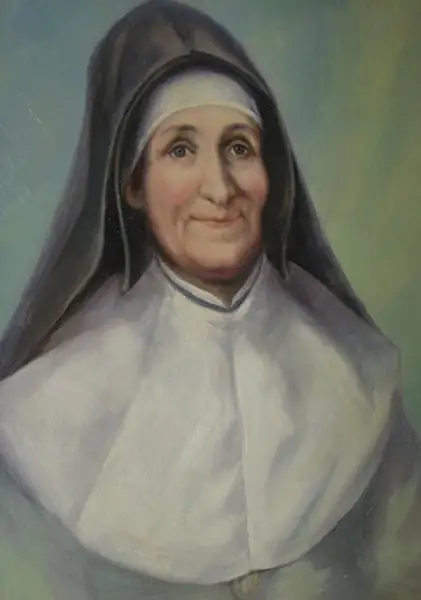
Julie Billiart, a French Catholic nun and educator, cofounded the Sisters of Notre Dame de Namur and became one of the nineteenth century's great apostles of the Christian education of girls. Born on 12 July 1751 at Cuvilly in Picardy to a farming and shopkeeping family, she taught the catechism to other children before she was eight, took a private vow of chastity at nine, and was so esteemed for piety that neighbors called her the saint of Cuvilly. In 1774 she witnessed her father's shooting in the family store, and the trauma of that day began the mysterious paralysis that confined her to bed for twenty-two years. Even helpless and later speechless after the terrors of the French Revolution, she taught, embroidered altar linens, and received a vision foretelling the congregation she would found. In Amiens she met the noblewoman Françoise Blin de Bourdon, and on 2 February 1804, with Catherine Duchâtel, they founded the Sisters of Notre Dame; three months later Julie was miraculously cured of her paralysis on the Feast of the Sacred Heart. As Mother Julie she established fifteen convents and traveled tirelessly until her death at Namur on 8 April 1816. Pius X beatified her in 1906, and Paul VI canonized her on 22 June 1969.
The Complete Life
The Saint of Cuvilly
Julie Billiart first saw the light on 12 July 1751, at Cuvilly, a village of Picardy in the north of France, one of the children of Jean-François Billiart, a farmer and shop owner, and his wife Marie-Louise-Antoinette Debraine, strong Christian parents both. Her childhood impressed everyone who knew it. By the age of seven she knew the catechism by heart and had begun teaching it to her friends. Educated at the village school kept by her uncle, she received her First Communion, was confirmed, and bound herself by a vow of chastity at nine years old. Fourteen brought the settled conviction that she belonged to the religious life. Her needle earned admiration as well as her piety: the beautiful embroidery and lace she worked was sold in the family store, and she gave the proceeds to local churches and to the Carmelite convent nearby. When misfortune struck the family in her sixteenth year — the store was robbed and its finances never recovered — Julie hired out as a farm worker and turned the fields into a mission, teaching her fellow laborers hymns, lecturing on faith and virtue, and telling them the stories of the Bible. Such was the esteem her goodness won that the countryside commonly called her the saint of Cuvilly.
§ Early life
Paralysis and the Hidden Altar
In 1774, as Julie worked beside her father in the family store, an unknown assailant shot him before her eyes. The shock of that day planted a mysterious illness in her strong frame. Slowly paralysis took hold, worsened by poor medical treatment, until by 1784 she lay confined to her bed as a helpless invalid — a state that would last twenty-two years. Yet the bed became a hidden altar. Julie exercised an uncommon gift of prayer, giving four or five hours daily to contemplation and receiving the Eucharist every day she was able. Her hands did what her legs could not: she made linens and laces for the altars of the village churches, and she taught. Poor peasants from Cuvilly came to her bedside, as did noblewomen from across Picardy, and she prepared the village children for their First Communion. When the French Revolution broke out in 1789, her paralysis did not blunt her courage; she conducted her defiance from her bed, sheltered a priest who refused the revolutionary oath, and organized her whole village to boycott the priest loyal to the new government. Forced at last to flee, she escaped under a mound of straw in a wagon bed to Compiègne.
§ Early life
Founding the Sisters of Notre Dame
Exile brought fresh crosses. In Compiègne the strain of separation, anxiety for those who sheltered her, and grief over her father and over the Martyrs of Compiègne — sixteen Carmelite sisters guillotined in 1794 — stole from Julie even her power of speech. There, too, came the vision that marked her future: she heard the words promising daughters for an Institute marked by the cross. In October 1794 she reached a small apartment in Amiens and met Françoise Blin de Bourdon, the noblewoman and nun she recognized at once from her vision. Their friendship deepened through years of correspondence while de Bourdon nursed her family in Gézaincourt, and in 1797 the two, with the Abbé Thomas, fled the Terror together to Bettencourt. There they met Father Varin, and when they returned to Amiens in February 1803 he entrusted orphan girls to their care. On 2 February 1804, Julie, Françoise, and Catherine Duchâtel made vows of chastity and founded the Sisters of Notre Dame, consecrated to the schooling and welfare of young girls; Varin helped restore Julie's speech. On the Feast of the Sacred Heart, 1 June 1804, after a novena, she rose from her bed cured, and soon afterward set out on successful missions to Saint-Valery-sur-Somme and Abbeville.
§ Life and work
How Good the Good God Is
The soul of Julie Billiart was, in the judgment of the Catholic Encyclopedia of 1913, governed above all by ardent charity springing from a lively faith — a charity that showed itself in a thirst for suffering gladly joined to the cross and in zeal for the salvation of souls. Her whole spirit was gathered into the simple, childlike exclamation forever on her lips and pen: how good the good God is. As founder and first superior she shaped her congregation around that trust. She established the order's devotions from its beginning, abolished the ancient division between choir sisters and lay sisters in favor of a complete equality of rank, and yet matched every sister's task to her talents and schooling. She insisted on the spiritual formation of the women who would teach in the schools, ably seconded by de Bourdon, known in religion as Sister St. Joseph. Julie taught her first companions, high-born ladies all, how to lead the interior life while they labored for God's cause and the relief of the poor. She held that universal education was a basic human right and teaching the greatest work on earth, and on 2 February 1806 she saw in vision her Sisters as a light of revelation shining through the whole world.
§ Legacy
Mother Julie's Last Journey
Opposition from the religious authorities of Amiens to the congregation's work elsewhere forced a decisive relocation: in 1809 the young institute moved to Namur, whence it took the name Sisters of Notre Dame de Namur, and the Namur convent became its motherhouse, remaining so into the twentieth century. Julie's energies seemed doubled by her cure. Between 1804 and 1816 she founded fifteen convents in the towns of France and Belgium — Ghent and Namur chief among them — and undertook some hundred and twenty long and toilsome journeys by the roads of a Europe at war. She kept up a close correspondence with her spiritual daughters, and hundreds of those letters were preserved at Namur. In January 1816 her strength at last gave way. For three months she bore pain in silence and patience, and on 8 April 1816 she died at Namur, the Magnificat upon her lips, sixty-four years old. The congregation she left behind spread across the world: by 2020 the Sisters of Notre Dame de Namur were working in sixteen countries on five continents, carrying on the educational work she had begun with eight orphans in a rented house at Amiens.
§ Life and work
From Obscurity to the Altars
Julie's cause moved slowly through the Church's courts. Her beatification process opened in 1881 and reached completion on 13 May 1906, when Pope Pius X raised her to the altars as blessed; then her story resided in obscurity for decades. The first miracle demanded for canonization came on 20 November 1919 at Namur, where a man named Homer Rhodius, afflicted with renal disease, was cured through intercession sought to Billiart, with a relic applied that had been obtained for him by his daughter and Sister Marie-Ludovica of the Namur Sisters. The cause was formally opened on 23 July 1924, and then stalled. The second miracle arrived, fittingly, from the mission fields: on 30 September 1950, in the village of Mata Virgem in southern Brazil, Otacilio Ribeiro da Silva, a farmer of twenty-nine, was delivered from an inoperable tumor after the congregation's sisters prayed through Julie's intercession with her relic and picture. Mary Verona, an assistant mother general of the Coesfeld Sisters resident in Rome, read the account in her congregation's 1952 newsletter and pressed the decades-long effort forward. The da Silva miracle was authenticated in 1958, the Rhodius miracle was re-examined in 1967, and on 22 June 1969 Pope Paul VI canonized Julie Billiart, with the healed farmer attending the ceremony alongside his fourteen-year-old daughter, named Julie in honor of the saint.
§ Legacy
A Light of Revelation
Whatever measure one applies, Julie Billiart altered the possibilities of her age. To a disheartened and destitute age she carried the gospel, and with it confidence in the goodness of God, preparing vulnerable children who cried out for survival for their duties in life — and beyond them. Her conviction that education is a basic human right and teaching the greatest work on earth anticipated by more than a century the world's formal declarations on the rights of the child, and she grounded it not in theory but in fifteen foundations, a hundred and twenty journeys, and hundreds of letters of spiritual direction. Her feast is kept on 8 April, the day of her death, and she is venerated as patroness of educators and teachers, the profession she served first from a sickbed and then from the saddle of relentless travel. The institute she founded with Françoise Blin de Bourdon endured revolution, Napoleonic suspicion, and the quarrels of bishops, and grew into a congregation spanning sixteen countries on five continents. Wherever its sisters teach, the childlike credo of their mother is still heard: how good the good God is.
§ Legacy
Timeline
- 12 Jul 1751
Born at Cuvilly in Picardy to Jean-François Billiart and Marie-Louise-Antoinette Debraine.
§ Early life
- 1774
Witnessed the shooting of her father in the family store, the trauma that began her mysterious paralysis.
§ Early life
- 1784
Confined to her bed as a helpless invalid, beginning twenty-two years spent in prayer, teaching, and embroidery.
§ Early life
- 1789
The French Revolution broke out; her defense of a non-juroring priest forced her to flee Cuvilly to Compiègne.
§ Life and work
- Oct 1794
Settled at Amiens in a modest lodging, where Françoise Blin de Bourdon came into her life.
§ Life and work
- 1797
During the Reign of Terror she escaped with de Bourdon and the Abbé Thomas to Bettencourt.
§ Life and work
- Feb 1803
Returned to Amiens, where Father Varin entrusted the care of young orphan girls to her and de Bourdon.
§ Life and work
- 2 Feb 1804
Founded the Sisters of Notre Dame at Amiens with de Bourdon and Catherine Duchâtel, vowing herself to the education of girls.
§ Life and work
- 1 Jun 1804
Cured of her paralysis on the Feast of the Sacred Heart after praying a novena at her confessor's direction.
§ Life and work
- 25 Oct 1805
Made the first religious vows of the new congregation with de Bourdon and two other sisters.
§ Life and work
- 2 Feb 1806
Received a vision of the Sisters of Notre Dame as a light of revelation throughout the world.
§ Life and work
- 19 Jun 1806
The congregation received approval by imperial decree, counting thirty members.
§ Life and work
- 1809
Religious opposition at Amiens compelled the move of the congregation to Namur, thereafter its motherhouse.
§ Life and work
- Jan 1816
Fell ill and, after three months of silent suffering, died with the Magnificat on her lips at Namur on 8 April.
§ Life and work
- 1881
Her beatification process was begun.
§ Legacy
- 13 May 1906
Beatified by Pope Pius X.
§ Legacy
- 20 Nov 1919
Homer Rhodius was healed of renal disease at Namur through her intercession, the first miracle for canonization.
§ Legacy
- 22 Jun 1969
Canonized by Pope Paul VI; the healed Otacilio Ribeiro da Silva attended the ceremony.
§ Legacy
In Their Own Words
Oh, qu'il est bon, le bon Dieu
These are the daughters that I will give you in an Institute, which will be marked by my cross
The Record
- Major works
- Sisters of Notre Dame de Namur (cofounder)·Fifteen convents and schools for poor girls in France and Belgium
- Patron of
- Educators·Teachers
- Canonization
- Beatified 13 May 1906 by Pope Pius X; canonized 22 June 1969 by Pope Paul VI.
Prayer
Bibliography
Show 10 sources
- Sister of Notre Dame (1910). "St. Julie Billiart". Catholic Encyclopedia. Vol. 8.
- "Born into a Simple Farming Family". Sisters of Notre Dame de Namur. Cincinnati, Ohio. Retrieved 18 July 2022.
- Stevenson, Anne (20 March 2020). "St. Julie Billiart". Sisters of Notre Dame de Namur. Ipswich, Massachusetts. Retrieved July 19, 2022.
- "Saint Julie Billiart". Loyola Press. Retrieved 19 July 2022.
- "Violence and Personal Trauma for St. Julie". Sisters of Notre Dame de Namur. Cincinnati, Ohio. Retrieved 18 July 2022.
- "New Traumas to Bear". Sisters of Notre Dame de Namur. Retrieved 18 July 2022.
- "A Community is Formed". Sisters of Notre Dame de Namur. Retrieved 19 July 2022.
- Index ac status causarum beatificationis servorum dei et canonizationis beatorum (in Latin). Typis polyglottis vaticanis. January 1953. p. 129.
- "St. Julie - Celebrating 50 Years a Saint". Sisters of Notre Dame de Namur. Retrieved 18 July 2022.
- "Saint Julie Billiart". Franciscan Media. 8 April 2021. Retrieved 19 July 2022.
Profile text adapted from the Wikipedia article, licensed CC BY-SA 4.0.
Pray with this saint every day
Save St. Julie Billiart to your favorites, read the full profile, and get feast-day reminders in the Saints app.
Get the Saints AppFree on the App Store for iPhone and iPad