
fl. late 5th century·Feast Not recorded in the source
St. Julitta of Cornwall
Celtic hermit of Tintagel and founder of Lanteglos
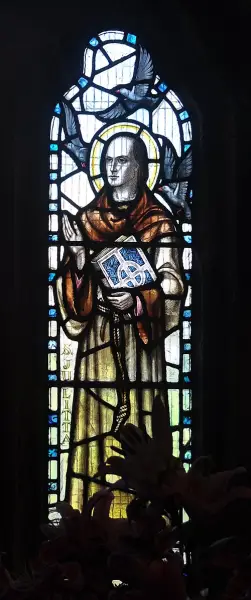
Overview
Julitta, also called Juliot, is a male Celtic saint of the age of the first evangelization of Cornwall, to whom two parish churches in that county are dedicated. According to the tradition recorded in the Cornish Church Guide, he settled at the end of the fifth century at the site now occupied by Tintagel Castle, on the north Cornish coast, and there established a small monastic community — one of the little settlements of prayer from which the Christian faith spread through the peninsula. In some accounts he is numbered among the Children of Brychan, the prolific saintly family of Welsh tradition, and St Nectan and the holy female hermit St Keyne are thought to have been his companions, kin of his who also left their names upon the Cornish landscape. His cult attached itself permanently to the locality: St Juliot's parish church and that of Lanteglos by Camelford both stand under his patronage, the Norman chapel within Tintagel Castle was dedicated to him, and a holy well at Jetwells near Camelford preserves his memory in its very name, which descends from Juliot's well. He must not be confused with the two early female martyrs who bear the same name, Julitta of Caesarea and Julitta of Tarsus.
The Complete Life
A Monastery Beneath Tintagel
In the closing years of the fifth century, when Roman Britain had long fallen away and the Christian settlements of the Celtic west were taking root, Julitta came to the headland beneath what is now Tintagel Castle and made his dwelling there. On that exposed Atlantic site he established a small monastic community, the typical instrument of early Cornish Christianity: a handful of monks, a cell or oratory, and a life of prayer and labor at the edge of the known world. The tradition preserved in the Cornish Church Guide associates him with the Children of Brychan, the great saintly kindred of the Brycheiniog dynasty whose descendants peppered Wales, Cornwall, and Brittany with dedications. In some accounts his companions in the Cornish mission were St Nectan, whose well at Hartland became famous across the West Country, and St Keyne, the holy female hermit whose wells likewise drew pilgrims for centuries. Whether kin or fellow laborers, they belonged to the same movement of ascetic settlers who carried the faith from Wales into Dumnonia, and Julitta's Tintagel settlement stood among the earliest of their foundations on the northern coast.
§ Julitta (Cornwall)
Two Churches and a Holy Well
Julitta's name never left the Cornish map. He is the patron of two parish churches: that of St Juliot, which preserves his very name in its dedication and its parish, and that of Lanteglos by Camelford, whose dedication to the saint survives in the church of St Julitta. Within the walls of Tintagel Castle itself the Normans, building amid the ruins of the Dark Age settlement, consecrated their chapel to St Julitta — a quiet acknowledgment that the headland had been holy ground long before any fortress stood there. At Jetwells, near Camelford, a holy well keeps his memory in the plainest way possible: the place-name is simply the worn-down form of Juliot's well, the spring associated with his settlement. Devotion of this kind, fixed to wells and parish boundaries, is the most durable monument the Celtic saints possess. Care must be taken, however, not to confuse the male Cornish Julitta with the two early female martyrs of the same name — Julitta of Caesarea, the widow venerated by Saint Basil, who left a written testimony of the saint's life on the seventieth anniversary of her death, and Julitta of Tarsus, the mother of the child martyr St Cyricus, honored in France as St. Cyr. All three were martyrs of the third or fourth century and saints of both Eastern and Western Christendom; the Cornish hermit belongs to none of their stories.
§ Julitta (Cornwall)
The Record
- Major works
- Small monastic community at Tintagel
- Patron of
- Parish churches of St Juliot and Lanteglos by Camelford
- Canonization
- Pre-congregation canonization; venerated from the Celtic period in Cornwall.
Prayer
Bibliography
Show 3 sources
- The Cornish Church Guide (1925). Truro: Blackford; p. 134
- Radford, C. A. Ralegh (1939) Tintagel Castle, Cornwall. London: H.M.S.O.; p. 7
- Ellis, P. B. (1992) The Cornish Saints. Penryn: Tor Mark Press; p. 16
Profile text adapted from the Wikipedia article, licensed CC BY-SA 4.0.
Pray with this saint every day
Save St. Julitta of Cornwall to your favorites, read the full profile, and get feast-day reminders in the Saints app.
Get the Saints AppFree on the App Store for iPhone and iPad